Amazon FBA prep is the work that makes a unit acceptable to a fulfillment center: barcodes and labels, packaging, and the product-specific steps such as poly bagging, bubble wrapping and marking sets. Amazon’s own guide puts that work on the seller, and its fee list carries no prep line.
You do it, you pay someone to do it, or your supplier does it to Amazon’s spec.
Two Amazon pages, both checked for this update, settle what Amazon requires and what it charges: Amazon’s FBA prep, packaging and labeling guide, dated July 7, 2026, and its FBA page. The rest of this post is about who does the work, and what it costs when it is done wrong.
What FBA prep covers
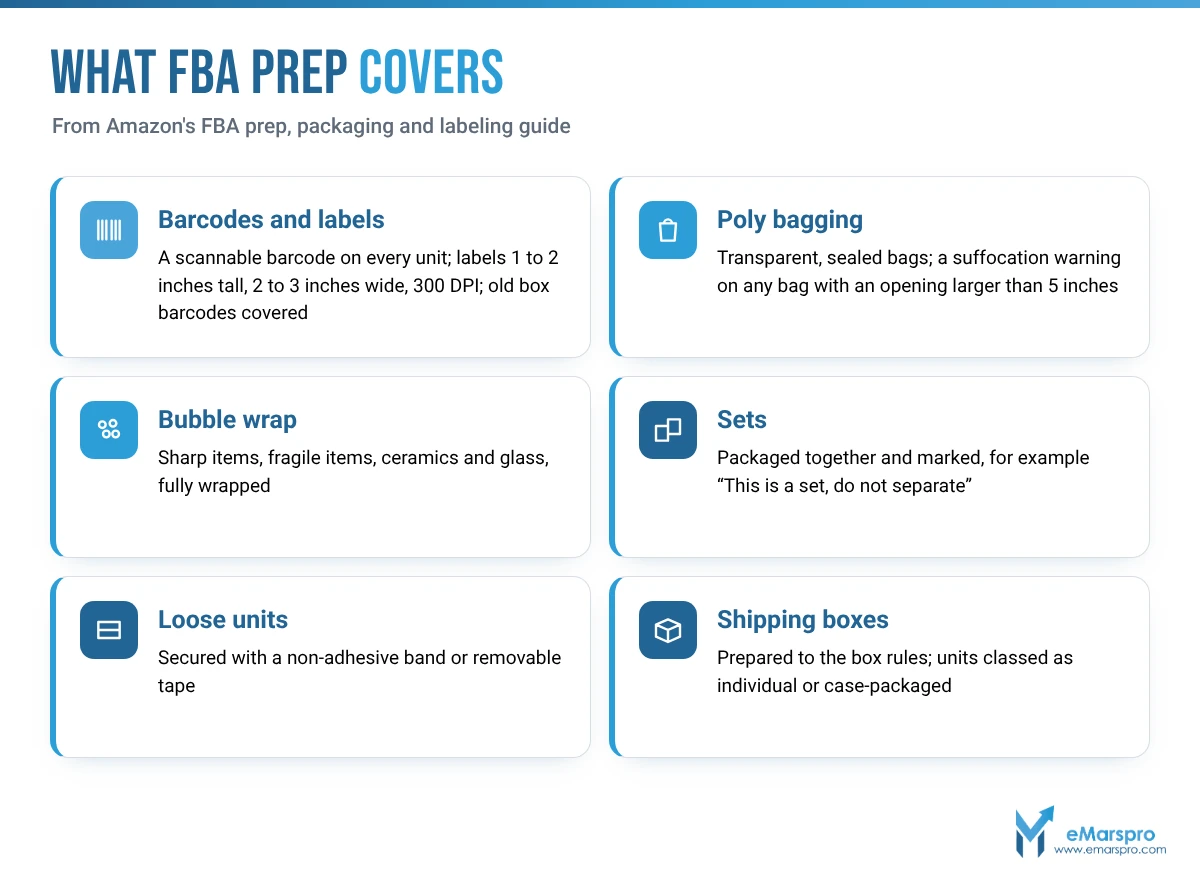
Amazon’s guide says prep comes down to three core areas: barcodes and labeling, packaging, and product-specific preparation. The table below is the guide’s own list, shortened; it is also the checklist our Amazon FBA management team runs against every inbound shipment plan before the stock ships.
| Area | What Amazon asks for |
|---|---|
| Barcodes and labels | A scannable barcode on every unit; labels 1 to 2 inches tall and 2 to 3 inches wide, printed at 300 DPI on a laser printer; existing box barcodes covered with opaque tape |
| Poly bagging | Transparent, completely sealed bags for perforated packaging, pellets, powders and granular items; plush and baby products; apparel, fabrics and textiles; jewelry and small products; liquids. A suffocation warning label on any bag with an opening larger than 5 inches |
| Bubble wrap | Sharp items, fragile items, ceramics and glass are fully bubble wrapped instead of bagged |
| Sets | Items sold together are packaged together and marked, for example “This is a set, do not separate” |
| Loose units | Secured with a non-adhesive band or removable tape |
| Shipping boxes | Prepared to the box rules, with units classed as individual or case-packaged; the box and case limits are in the packaging post below |
FBA packaging requirements covers the box and case rules in detail; this post stays on the unit.
What Amazon does and does not do for you
What it does: tells you the rules, in the guide above and in the category pages inside Seller Central, and adds rules when a product earns them. The guide says Amazon may add specific prep requirements to a product based on damage-related returns, so a product that keeps arriving broken gets a stricter standard.
What it does not do by default: the prep. Amazon’s FBA page names its cost lines as fulfillment, storage, aged inventory, returns processing, removal, disposal and liquidation orders, and inbound placement; prep and labeling are not among them, so budget them as your cost whoever does the work.
What there is instead is a penalty clause: Amazon may refuse, return or repackage any product delivered with inadequate or non-compliant packaging, at your expense.
That clause is why prep is checked before the shipment leaves, not hoped for at Amazon’s end: the fix at the fulfillment center is slower and costs more than the fix at the prep table.
The three routes for getting prep done
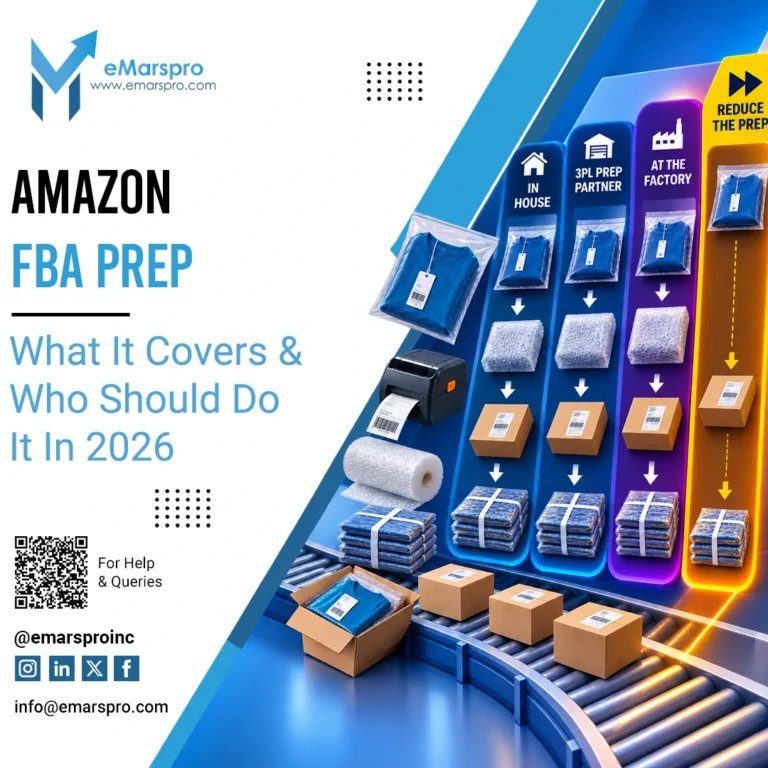
1. In house
You or your team bag, wrap, label and pack. It costs time and materials, and it scales badly: the week your volume doubles is the week the prep table becomes the bottleneck. It is the right route while SKUs are few and you are still learning what each category needs.
2. A prep center
A third-party warehouse receives your stock, preps it to Amazon’s spec and ships it in. You pay per unit and per service. The gain is time and the discipline of a team that does this daily; the risk is that their mistake arrives at Amazon under your seller account, not theirs.
3. Supplier prep
The manufacturer packs to Amazon’s spec at source: poly bags, suffocation warnings, FNSKU labels on each unit, identical case packs. It is the cheapest per unit when it works, because the labor is already in the factory, and identical case packs are what qualify a shipment for the no-fee placement option, which shipping to Amazon FBA explains.
How to choose between the three
- Volume: under a few hundred units a month, in house usually wins on cost; above it, the hours start to cost more than a prep fee.
- Category: liquids, glass, textiles and sets carry rules that a supplier can build into the pack line once and a prep center knows by heart.
- Supplier capability: if the factory can label and bag to spec, start there and inspect the first shipment yourself.
- Your time: the owner bagging units is the most expensive prep worker in the business.
What a failed prep check costs you
Three costs, in order of arrival. The immediate one is Amazon’s clause: refused, returned or repackaged at your expense, with the units unsellable until it is resolved.
The second is time: a shipment held at receiving is stock you paid for that is not on sale, which in Q4 is margin you do not get back. How Amazon receives your units shows where the hold happens.
The third is standing: the prep requirement Amazon can add to a product after damage-related returns applies to the product, not the batch, so later shipments carry it too. The FBA fees sellers miss lists the other charges that follow a bad shipment.
Questions to ask before you ship a partner a pallet
- Which categories have you prepped in the last month, and can I see a photo of a finished unit from each?
- Who checks the case pack against the shipment plan before it leaves, and how?
- What happens, and who pays, when Amazon refuses or repackages a shipment you prepped?
- How fast do you turn a received pallet into a shipped one in November?
- Will you label at the unit level with the FNSKU I send, and photograph the labels?
Where AI helps with FBA prep, and what a person decides
Amazon’s seller AI page, updated August 2026 and checked for this update, names Seller Assistant as an agentic AI assistant that helps sellers find information and manage their business, and says it can take action on a seller’s behalf.
For prep, its useful job is the question: which rules apply to this product, and has Amazon added a requirement to it.
On our side, an AI tool such as ChatGPT or Claude reads the inbound problem reports and the returns reasons for a SKU and drafts the exceptions: products with damage-related returns, shipments with receiving discrepancies, categories where the rule changed.
What a person decides: how the unit is packed, which route preps it, and whether a supplier’s first shipment passes inspection. AI reads, people decide.
Frequently Asked Questions
The work that makes a unit acceptable to an Amazon fulfillment center. Amazon’s guide groups it into three areas: barcodes and labeling, packaging, and product-specific preparation such as poly bagging, bubble wrapping and marking sets. The seller is responsible for all three before the unit ships.
Not by default. Amazon’s guide puts the prep on the seller, and Amazon’s FBA page lists fulfillment, storage, aged inventory, returns processing, removal and inbound placement as its cost lines, with no prep fee among them. Amazon may refuse, return or repackage non-compliant inventory at your expense, which is a penalty, not a service.
In house while volume is low and the SKUs are few; a prep center when volume, category rules or your own time make the in-house routine the bottleneck; supplier prep when your manufacturer can pack to Amazon’s spec at source. The mistake arrives at Amazon under your seller account whichever route you pick, so the checks stay yours.
Amazon’s guide says it may refuse, return or repackage any product delivered with inadequate or non-compliant packaging, at your expense, and may add specific prep requirements to a product based on damage-related returns. The cost is the repackaging or return charge, the delay before the units are sellable, and any added prep requirement on that product afterward.
Where prep sits in the wider FBA operation
Prep is the first gate in the inbound chain: get it right and the shipment, the placement option and the receiving scan follow; get it wrong and every later step waits. If you want the chain run end to end, our FBA operations team begins with a free account audit and findings inside 48 hours.
Prep Is The First Gate In The Inbound Chain
Get it right and the shipment, the placement option and the receiving scan follow. Our FBA operations team runs prep, labels and inbound end to end and starts with a free account audit, findings within two days.