

Quick answer: AI keyword research for Amazon means using AI to speed up the slow parts: clustering terms by intent, finding gaps and drafting copy. Most tools that claim AI still discover keywords with classic algorithms; only a few have a genuine AI keyword feature. Start with Amazon’s own search data, then add the tools that earn it.
Almost every AI keyword research for Amazon article blurs one line: which tools have a real AI keyword feature, and which just wrap an old algorithm in the word AI. This post draws that line, then shows the workflow our team runs.
What AI actually changes, and what it does not
Keyword discovery, mining competitor listings and search reports for terms, is still mostly algorithmic. That part has worked the same way for years. Where AI genuinely helps is after discovery: clustering hundreds of terms by intent, spotting gaps a human would miss, and drafting listing copy you then edit.
So the honest framing is AI as an accelerator, not an oracle. The tools that survive are the ones where the AI does a real job, not the ones that relabel a keyword table.
Start with Amazon’s own data
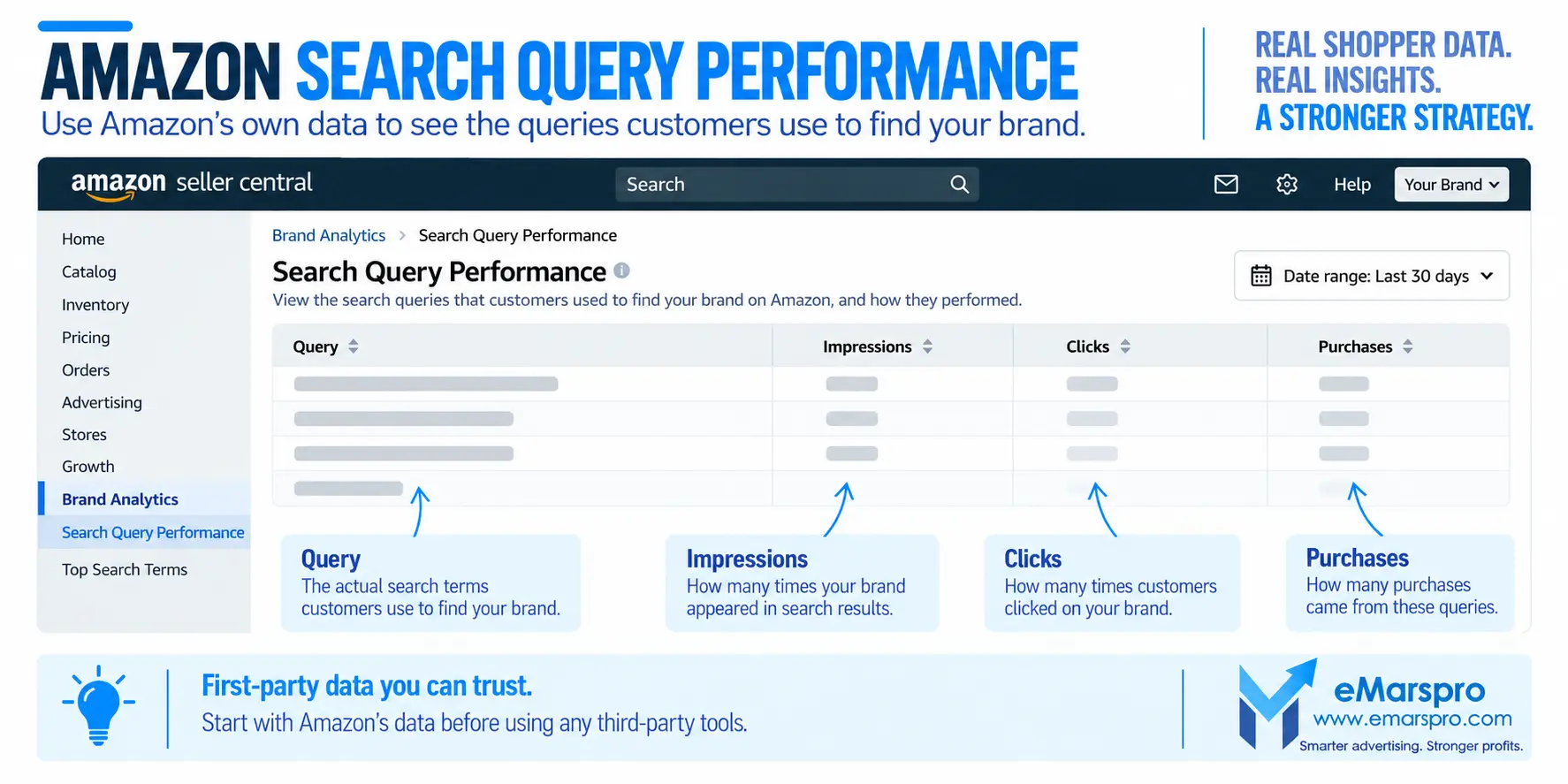
Before any tool, use the data Amazon gives you. Amazon Brand Analytics includes the Search Query Performance dashboard, which lists the queries customers use to find your brand with their impressions, clicks and purchases, and the Top Search Terms dashboard for the wider store. This is first-party demand, and it beats any third-party estimate.
The tools that survived, honestly rated
We audited each tool at its own site. The test: does it have a named AI keyword feature, or is the AI really about listing copy while keyword discovery stays algorithmic? Both are useful. Only the first is AI keyword research.
| Tool | AI keyword feature? | What the AI actually does |
| Perpetua | Yes, named | An AI Keyword Research Tool that generates search terms categorized by intent, cross-referenced to search frequency |
| Helium 10 | Yes, assistant and MCP | A conversational assistant and MCP that expand keywords, surface trends and run gap analysis; Cerebro and Magnet stay algorithmic |
| Jungle Scout | No, copy and chat | AI Assist refines listings and reads sentiment; keyword discovery is Keyword Scout, which is algorithmic |
| SmartScout | No, copy | AI Listing Architect writes copy from your keyword data; the keyword tools themselves are analytical |
| DataDive | No, copy | AI Copywriter and competitor briefs; keyword tracking is Rank Radar, non-AI |
| ZonGuru | No, copy | Keywords on Fire is algorithmic; the AI is a ChatGPT-powered Listing Optimizer |
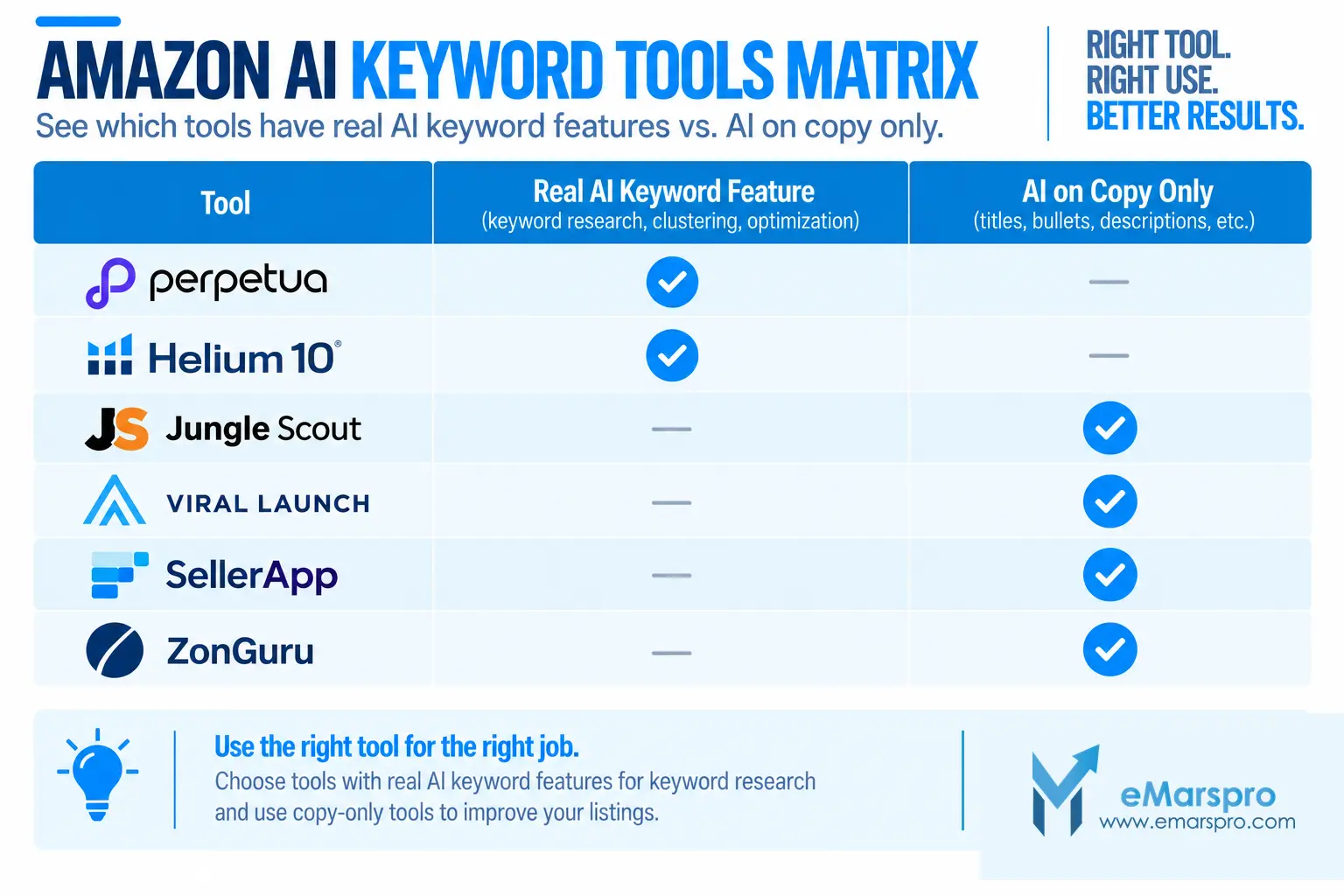
Two survivors have a genuine AI keyword feature: Perpetua’s AI Keyword Research Tool and Helium 10’s assistant and MCP. Say that plainly to anyone who tells you their tool does AI keyword research.
For completeness, the four we rate as copy-AI, each audited at its own site, are Jungle Scout, SmartScout, DataDive and ZonGuru. They are useful tools, but their keyword discovery is classic mining, not AI.
Our process, step by step
Here is the workflow, in order. The AI steps sit on top of real data, never in place of it.
- Pull first-party demand from Amazon Brand Analytics: Search Query Performance for your brand, Top Search Terms for the category.
- Mine competitors with an algorithmic tool (reverse-ASIN and keyword expansion). This is discovery, and it is not AI.
- Cluster and dedupe with AI: group the raw list by intent, and let an AI keyword tool flag gaps and near-duplicates.
- Validate against the live SERP and the shopping assistant era: write for how buyers ask questions, not only how they type.
- Deploy: map the final set to your title, bullets and backend, and hand the commercial terms to your PPC plan.
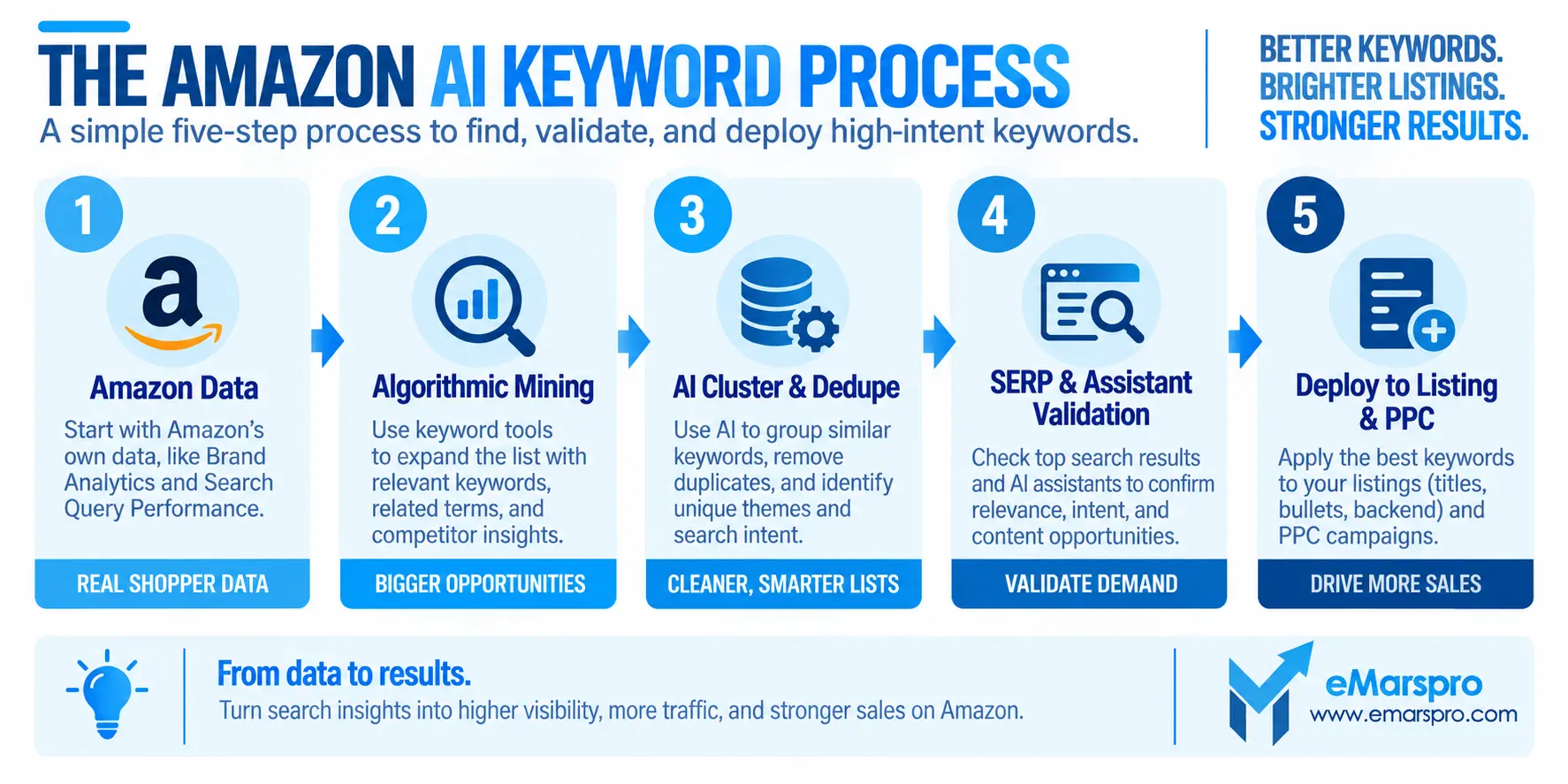
Steps one through three are where our account team spends its keyword time, and step five is where the list meets Amazon PPC management. The AI earns its place in step three, not the whole chain.
Write for the AI shopping assistant, not just the search box
Discovery is shifting. Alexa for Shopping, formerly Rufus answers shoppers in conversation, so some queries now sound like questions rather than keyword strings. You still need the right terms in your listing, but phrase them the way a shopper would ask. The keyword list and the copy have to serve both the search box and the assistant.
Frequently Asked Questions
AI speeds up parts of it, clustering terms by intent, spotting gaps and drafting listing copy, but the discovery layer in most tools is still classic algorithmic mining, not AI. Treat AI as an accelerator on top of real search data, not a replacement for judgment.
Only a few tools have a genuinely named AI keyword feature. Perpetua’s AI Keyword Research Tool and Helium 10’s assistant and MCP are the clearest today. Most others apply AI to listing copy while keyword discovery stays algorithmic, so pick by what the vendor actually names, not the marketing.
Amazon Brand Analytics gives you the Search Query Performance and Top Search Terms dashboards, real first-party demand for your brand and the wider store. Start there, then use tools to expand and cluster. First-party data beats any third-party estimate every time.
It shifts some discovery from typed searches to conversational prompts through Alexa for Shopping, formerly Rufus. You still need the right terms in your listing, but write them the way a shopper would ask a question, not only how they would type into a search box.
Use AI Where It Earns Its Place
AI keyword research works best when it builds on real Amazon data and human judgment. If you want our team to apply that approach to your catalog, start with a free 48-hour Amazon account management audit.