

Black Friday listing optimization is the work left after the deal is submitted: the coupon and price that show against the badge, a main image that passes Amazon’s rules, the variation the badge lands on, and the stock that keeps the Prime badge on. The deal window closed on October 20; this is what still moves.
Every Amazon rule below is from Amazon’s own pages, checked for this update: its holiday notice for the deal windows, fees and the price lookback, and its image guidance for the main image. The gift keywords and the A+ pass are in our holiday listing optimization post and are not repeated here.
What a Black Friday-ready listing shows
On the day, a shopper sees five things before the title: the deal badge Amazon draws, the coupon tag, the Prime badge, the strikethrough price, and the main image. Four of the five are decided by settings and stock, not by copy. That is why the November work is checks, not rewriting.
| Element | Who draws it | What decides whether it shows |
|---|---|---|
| Deal badge (Best Deal, Lightning Deal) | Amazon | A deal submitted inside the window and approved; the deal price inside the lookback rules |
| Coupon tag | Amazon | A coupon created in Seller Central; it is not part of the event deal window |
| Prime badge | Amazon | Stock in FBA that arrived by the dates Amazon’s notice ties to Prime-badge eligibility |
| Strikethrough price | Amazon | A deal or discount Amazon can measure against the item’s recent price |
| Main image | You | Amazon’s image rules, applied the same on Black Friday as in March |
The window closed on October 20: where each lever stands
Amazon’s 2026 holiday notice set the submission window for Black Friday Week and Cyber Monday deals at July 8 to October 20, with no new eligibility requirements for Best Deals, Lightning Deals and Prime Exclusive Price Discounts, and a fee per promotion that the notice states in full.
If a deal is in, the badge is Amazon’s to draw. If it is not, the levers left are:
• A coupon, which sits outside the event window and draws its own tag; our Amazon coupons vs Lightning Deals post has the margin math and Amazon’s coupon rules.
• A plain price discount, which earns the strikethrough only if Amazon can measure it against the recent price.
• The images, the variations and the stock, which decide how the badge or the coupon converts.
Our Amazon listing optimization team runs this pass on every deal ASIN in the last week of October, in that order.
The main image and the gallery for deal week
Amazon’s image guidance does not change for Black Friday: the main image shows the actual product alone, on a pure white background, filling 85% or more of the frame, at least 1,000 pixels on the longest side, with no added text, graphics or watermarks and no props that are not in the box.
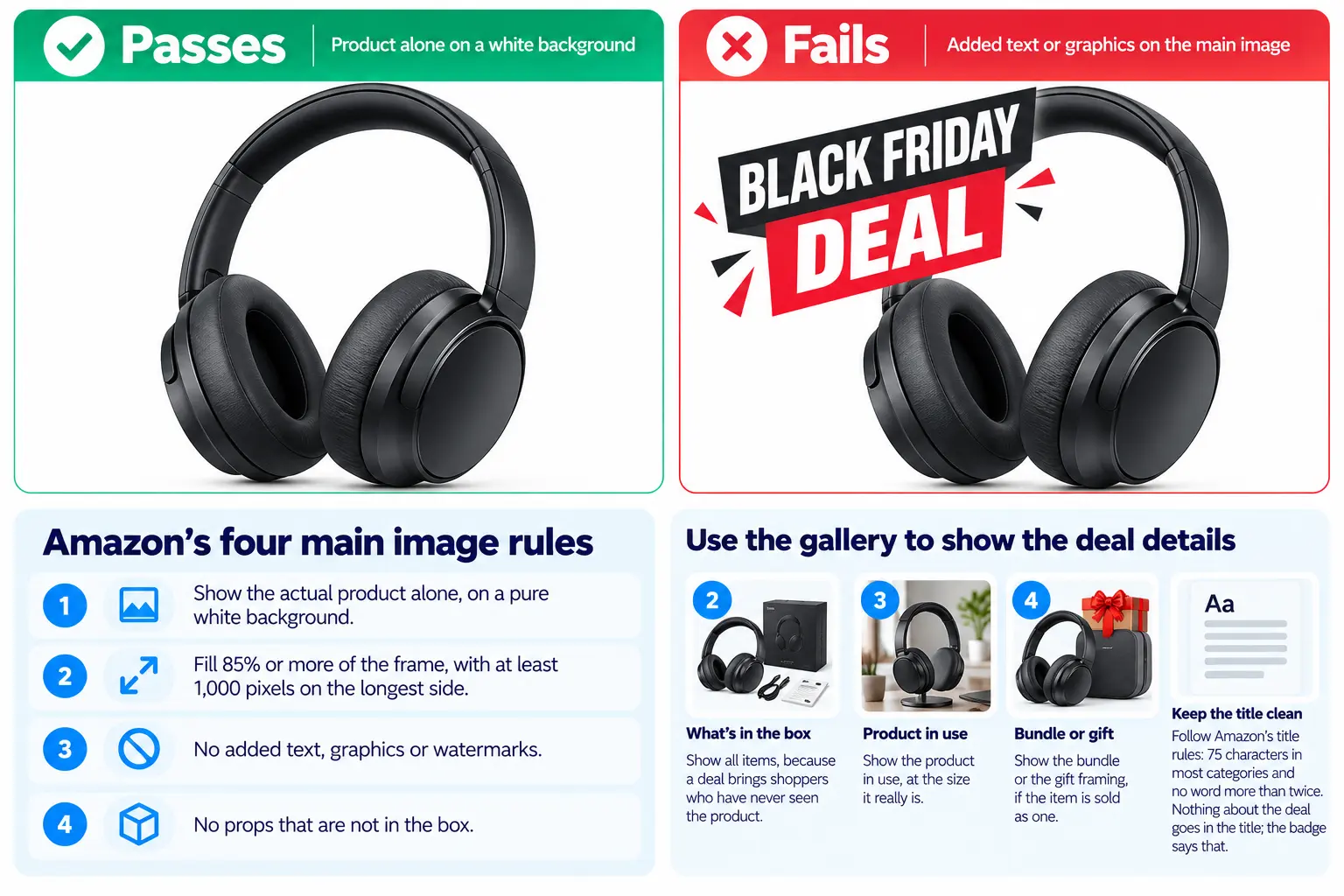
A “Black Friday deal” graphic on the main image breaks that rule on the day it matters most.
The gallery is where the event lives:
• Image two: what is in the box, because a deal brings shoppers who have never seen the product.
• Image three: the product in use, at the size it really is.
• Image four: the bundle or the gift framing, if the item is sold as one.
• The title stays inside Amazon’s title rules: 75 characters in most categories and no word more than twice. Nothing about the deal goes in it; the badge says that.
Variations: the badge lands on one child
A deal is submitted on a specific ASIN. In our experience, on a variation family the badge shows on that child, and the shopper who lands on the parent sees it only once that child is selected.
Before the event, check three things:
• The deal ASIN is the child with stock.
• The parent’s images and bullets do not point shoppers at a child without a deal.
• No child is suppressed for a missing attribute. A suppressed child the week of the event is the listing problem our Amazon Black Friday strategy post warns about in its first phase.
Price: the lookback decides the strikethrough
Amazon measures a deal price against the item’s recent prices; its notice describes a 30-day and 60-day lookback and makes one exception, that Prime Big Deal Days prices do not count toward the maximum deal price for Black Friday Week and Cyber Monday. In practice:
• Hold the regular price steady from now until the event. A price that moves in late October moves the baseline the deal is measured against.
• Decide the coupon and the deal together. A coupon on top of a deal price is a second discount Amazon shows as one, and the margin floor is the only thing that stops it.
• Check the strikethrough shows on the listing the day before the event, not the morning of it.
Stock and the Prime badge
The badge Amazon’s notice ties to its inbound dates is the Prime badge: inventory that arrived by October 14 at AWD, October 21 at FBA with minimal shipment splits, or October 28 with Amazon-optimized splits.
A deal ASIN that goes out of stock on Black Friday morning loses the deal and, in our experience, its place in search with it. Our Amazon FBA holiday deadlines post has the ship-by math; the check here is one line: is the deal quantity in the building.
How AI helps with Black Friday listing optimization
• Amazon’s own listing tool in Seller Central drafts a title, bullets and description from a few words, an image or a URL; Amazon says the seller reviews and approves every field and is responsible for it.
• For our own work, ChatGPT and Claude draft the gift-season bullets and the image briefs from the keyword map; a person edits them against Amazon’s title and image rules.
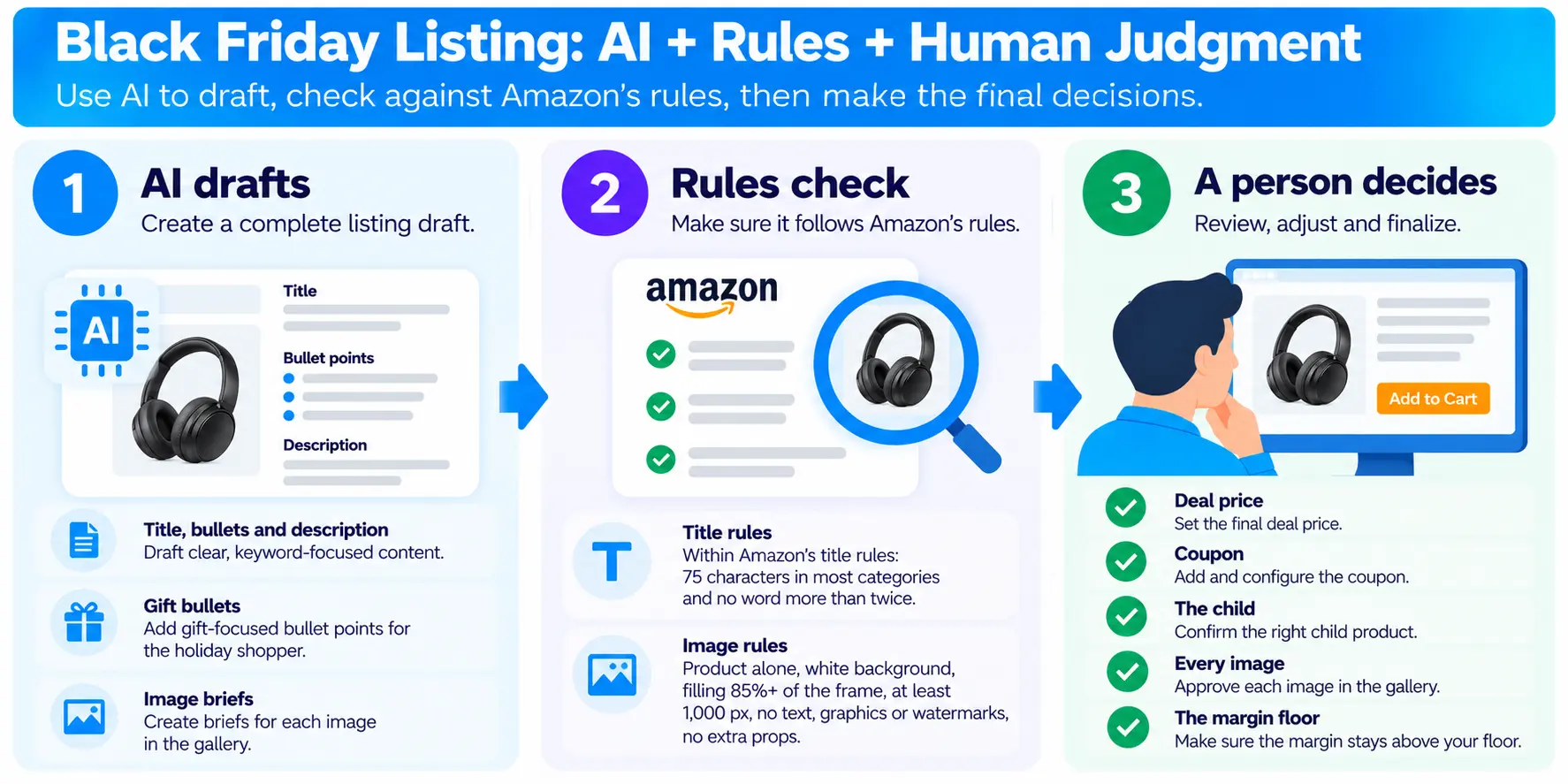
What a person decides: the deal price, the coupon, which child carries the deal, every image that goes live, and the margin floor. AI drafts; the seller sets the price.
Frequently Asked Questions
Not for the event badge this year. Amazon’s holiday notice set July 8 to October 20 as the submission window for Black Friday Week and Cyber Monday deals. After that date the levers left are coupons, a plain price discount, the images, the variations and stock, which is what this post covers.
The same thing it must show all year. Amazon’s image guidance asks for the product alone on a pure white background, filling 85% or more of the frame, at least 1,000 pixels on the longest side, with no added text, graphics or watermarks. Black Friday messaging goes in the secondary images, the coupon and the badge Amazon draws itself.
Yes. Amazon measures a deal price against the item’s recent prices; its 2026 notice describes a 30-day and 60-day lookback and says Prime Big Deal Days prices are excluded from it. A price raised in October to be “cut” in November does not pass, and a coupon stacked on a deal price can take the margin below zero.
It can draft the changes. Amazon’s own listing tool in Seller Central generates a title, bullets and description from a few words, an image or a URL, and we use ChatGPT and Claude to draft the gift-season bullets. A person checks every change against Amazon’s title and image rules first; Amazon says the seller is responsible for the content.
Checks, not rewrites
With the deal window closed, Black Friday listing optimization is a list of checks: the coupon and price against the badge, the main image against Amazon’s rules, the right child, the stock in the building. Run it the last week of October and the listing is ready for the day.
If you would rather have the checks run on every deal ASIN for you, our listing team starts with a free audit of your listings, PPC and account health, with findings within 48 hours.



