
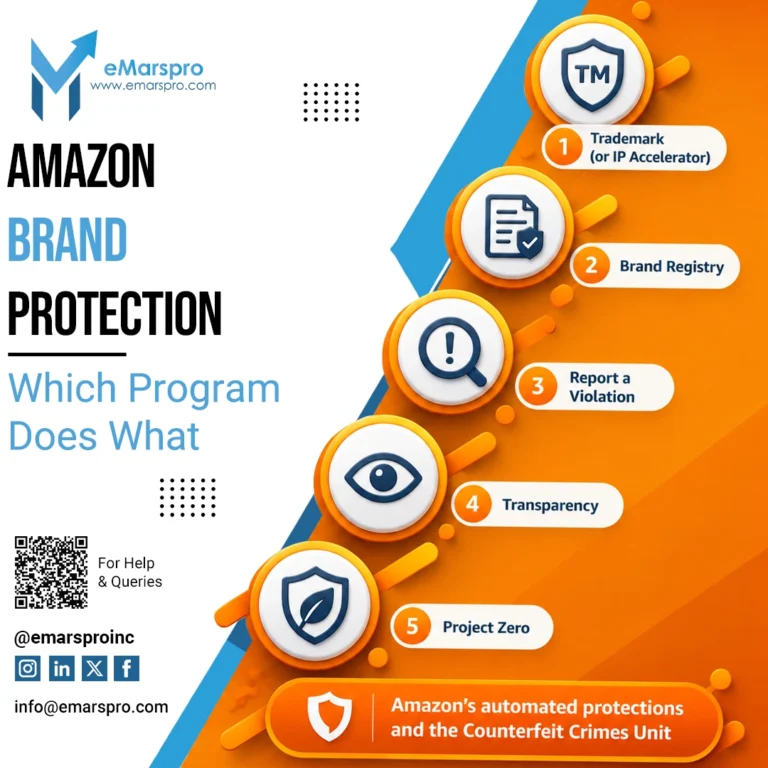
To protect your brand on Amazon you use Amazon’s own programs in a set order: a trademark, then Brand Registry, then the reporting tool it opens, then Transparency serial codes for counterfeits and Project Zero for brands that qualify. Each solves one problem; the usual mistake is enrolling in one and expecting it to do the work of the others.
This guide covers what each program does as Amazon describes it, checked for this update against Amazon’s Brand Registry page and its Trustworthy Shopping site the threats each one answers, and the order we enroll a brand on the accounts we manage.
What Amazon brand protection is
Amazon brand protection is the set of tools Amazon gives a brand owner to control how its products appear and who sells them: proof of ownership (Brand Registry), reporting (Report a Violation), authentication (Transparency), self-service removal (Project Zero) and enforcement (the Counterfeit Crimes Unit). It answers six threats:
• Counterfeits sold under your brand name.
• Hijackers: another seller on your listing, often with a different product.
• Unauthorized resellers undercutting your price.
• Copied content: your photos, A+ Content and manuals on someone else’s listing.
• Fake reviews, on your listing or a competitor’s.
• Listing changes you did not make.
Our Amazon account management team enrolls every brand it takes on in the programs it qualifies for in the first month, because every threat above is cheaper to prevent than to reverse.
The warning signs
• A new seller appears on your listing with a lower price.
• Reviews arrive describing a product that is not yours.
• The title, images or bullets change and nobody on your side changed them.
• A duplicate listing appears with your photos.
• A sudden rise in complaints about quality or authenticity.
Legal solutions: the trademark and Brand Registry
Everything starts with the mark. Amazon’s Brand Registry page sets the eligibility: a pending or registered trademark for the brand name or logo, issued by the government trademark office of a country with an Amazon store, and the brand name or logo permanently on the product or its packaging.
Only the trademark owner enrolls; agents are added as users afterward. Amazon calls the program free.
| Program | What Amazon says it does | When to use it |
|---|---|---|
| Brand Registry | The enrollment that opens the tools below, plus A+ Content, Brand Analytics and Stores | First, as soon as the mark is pending or registered |
| IP Accelerator | Connects a brand without a trademark to Amazon-vetted legal providers to trademark and enroll | Before Brand Registry, when there is no mark yet |
| Report a Violation | One place to report suspected IP infringement, store policy violations and compliance concerns | Every hijacker, copied image and unauthorized seller, with evidence |
A listing that gets suppressed while a report is open is a different case; our Amazon listing reinstatement team handles that side.
Technological solutions: Transparency and Project Zero
| Program | What Amazon says it does | When to use it |
|---|---|---|
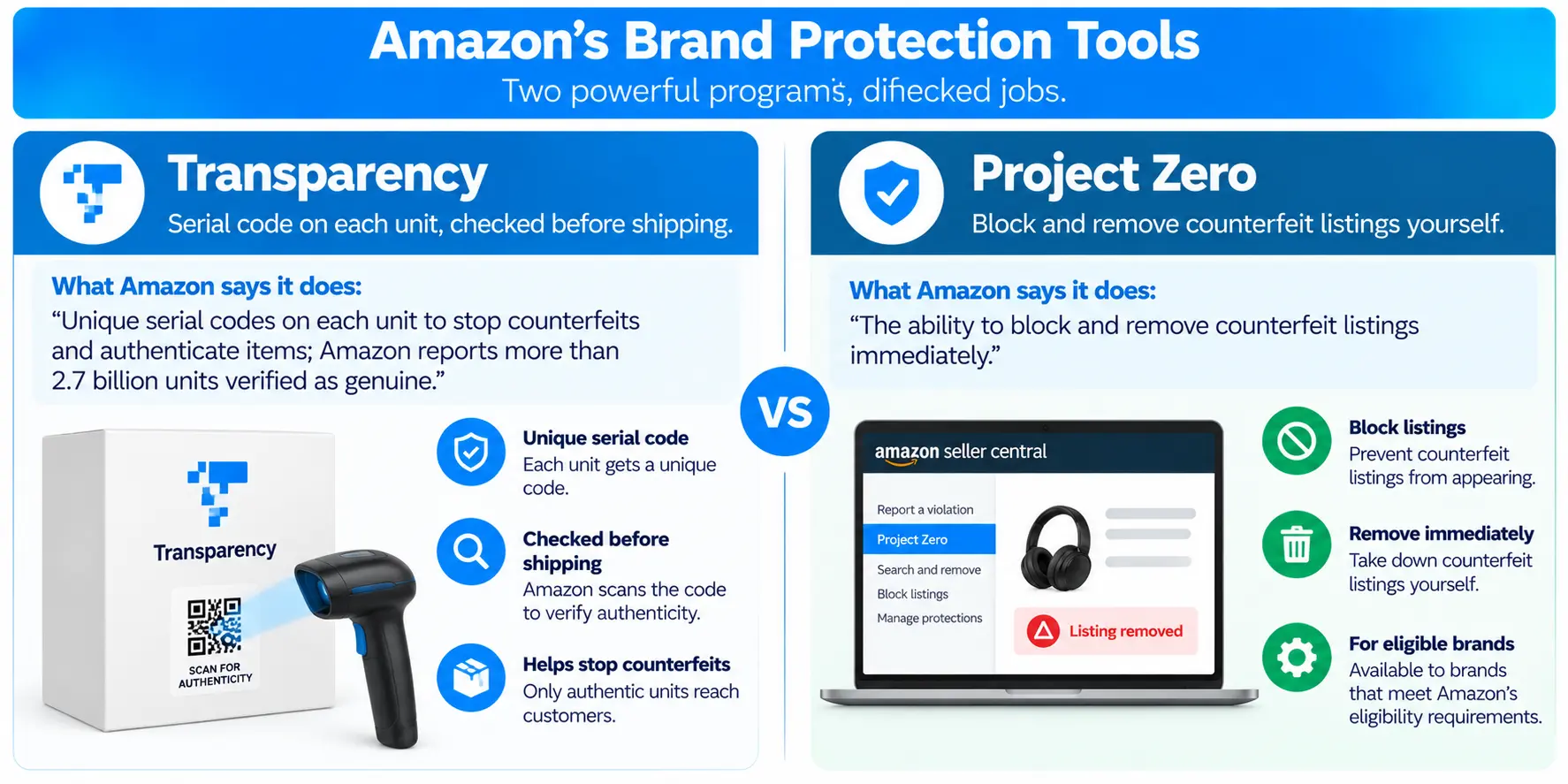
| Transparency | Unique serial codes on each unit to stop counterfeits and authenticate items; Amazon reports more than 2.7 billion units verified as genuine | Brands with a counterfeit problem, or a product worth copying |
| Project Zero | The ability to block and remove counterfeit listings immediately | Brands eligible for it, once the reports show a pattern |
| Amazon’s automated protections | Billions of attempted detail page changes scanned daily; more than 99.9% of suspected infringing listings blocked before a brand reported them, by Amazon’s latest figures | Always on; the brand’s enrollment is what tells the systems whose brand it is |
| Counterfeit Crimes Unit | Amazon’s team that has pursued more than 32,000 bad actors through litigation and criminal referrals since 2020 | Reached through the reports a brand files, not applied to |
The order we enroll a brand
1. The trademark, or IP Accelerator if there is none.
2. Brand Registry, with the one country’s office first and the others added after approval.
3. Report a Violation for the first hijacker or copied image, with the evidence Amazon asks for attached the first time.
4. Transparency on the products that are copied or worth copying, serial codes applied at the factory or the prep center, not in the warehouse the week of the event.
5. Project Zero once the brand is eligible for it.
A brand that does step 4 before step 2 has serial codes and no way to prove the brand is its own. The order is the point.
How AI helps with Amazon brand protection
• Amazon’s own systems do the scanning: billions of attempted detail page changes checked daily and the large majority of suspected infringing listings blocked before a brand reports them, by Amazon’s account.
• For our own work, ChatGPT and Claude draft the Report a Violation submission from the evidence (the screenshots, the order record, the trademark number); a person checks it and files it.
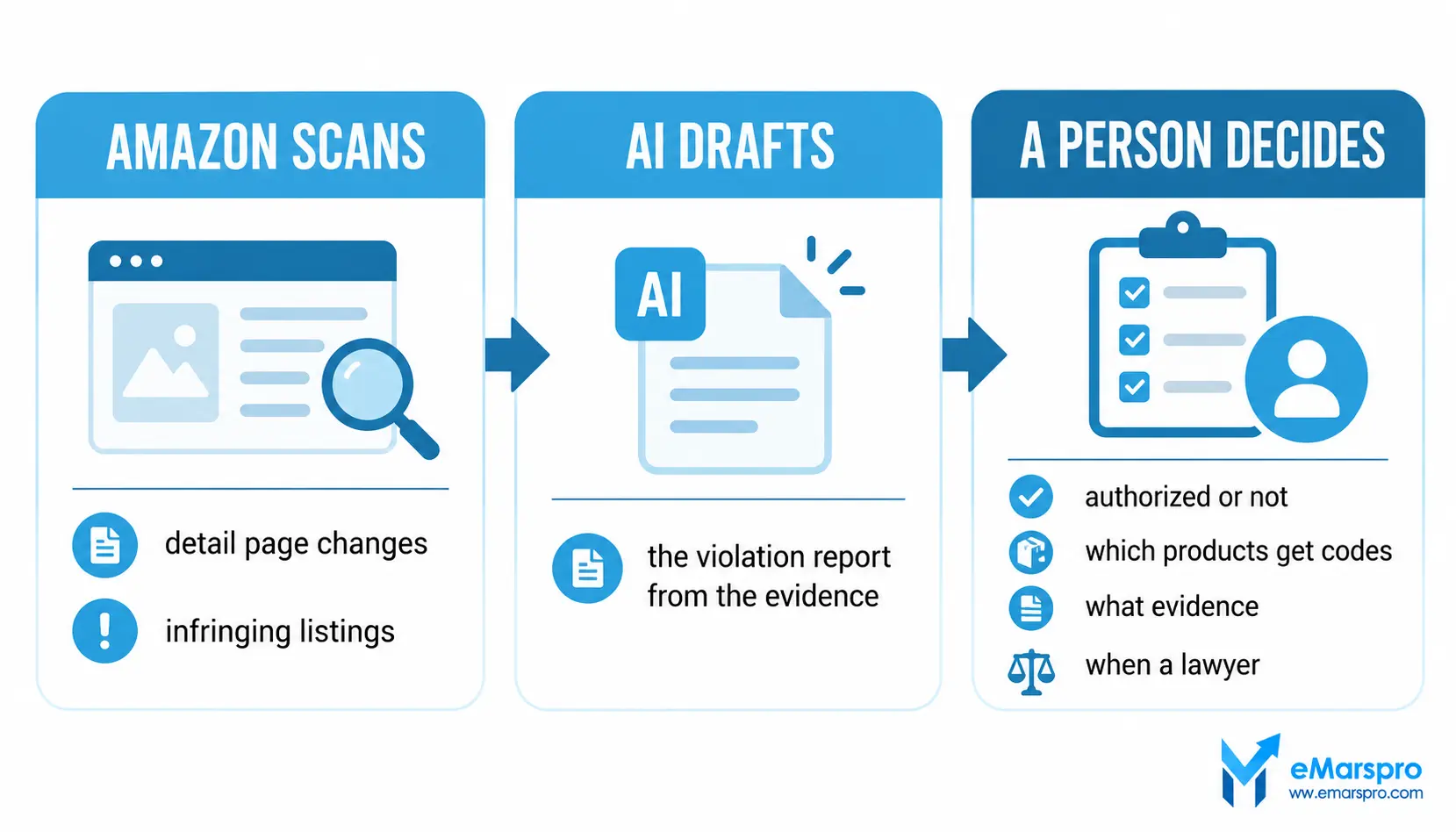
What a person decides: whether a seller is unauthorized or merely unwelcome, which products get serial codes, what evidence goes in a report, and when a case needs a lawyer rather than a form.
Frequently Asked Questions
Not automatically. Amazon’s Brand Registry page says enrollment lets you select one country’s trademark office, and other offices can be added after approval. A brand selling in the US and Europe enrolls with the US mark first, then adds the EU registration.
Each unit carries a unique serial code; Amazon describes the program as using those codes to stop counterfeits and authenticate items, and reports more than 2.7 billion product units verified as genuine through it.
Through Brand Registry’s Report a Violation tool, which Amazon describes as the one place to report suspected IP infringement, store policy violations and compliance concerns. Brands eligible for Project Zero can block and remove counterfeit listings themselves. A listing suppressed in the process goes to a reinstatement case, not a report.
A pending or registered trademark for the brand name or logo, issued by the trademark office of a country with an Amazon store, and the brand name or logo on the product or packaging. Amazon accepts a pending application in some cases. A brand with no trademark can use IP Accelerator, which connects it with Amazon-vetted legal providers.
Yes. Amazon says it scans billions of attempted product detail page changes a day and blocked more than 99.9% of suspected infringing listings in its latest report before a brand had to report them. The brand’s job is the part no scanner does: the trademark, the enrollment, the serial codes and the reports a person files.
One program per problem, in order
Amazon gives a brand five tools and an enforcement team. Enroll in the order above, file reports with evidence, and put serial codes on the products that get copied. Protection on Amazon is a sequence, not a subscription.
If you would rather have the enrollments, the reports and the monitoring run for you, our Amazon account team starts with a free audit of your listings, PPC and account health, with findings within 48 hours.



