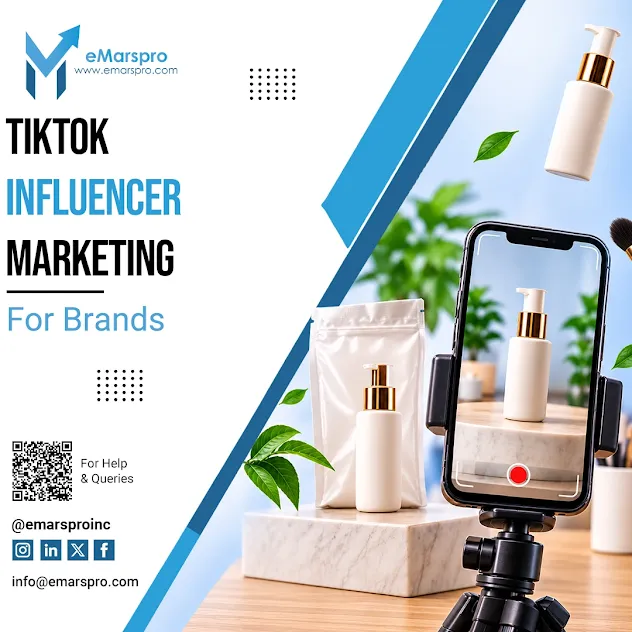
TikTok influencer marketing for a brand that sells is creators making shoppable videos and LIVEs about your product for their own audience, paid by commission on the orders they produce through TikTok Shop’s affiliate program, or by a fee when the sale happens on your own store.
The first kind is the one this guide covers, because TikTok tracks the order to the creator and pays the commission from it: how the affiliate program works, who qualifies, the commission math, how to choose creators, samples and briefs, measurement, the mistakes we see, and where AI helps.
Every program rule and figure below comes from TikTok Shop’s own seller guides and policies, checked for this update: the affiliate collaboration guide, the standard commission page, the affiliate marketing policy and the seller and creator matchmaking guide.
How TikTok influencer marketing works now
There are two ways to pay a creator. Through TikTok Shop’s affiliate program, the creator adds your product to their showcase, posts a video or runs a LIVE with the product tagged, and earns a commission on each order the platform attributes to them.
Off the Shop, you pay a fee for content and send the viewer to your store with a link or code.
TikTok Shop’s affiliate guide names two collaboration types for sellers in the US. Open collaboration sets a rate any eligible creator can take, per product or for the whole catalog.
Target collaboration sends invites to creators you choose, with its own rate, a pitch message, a deliverable (short video or LIVE) and an expiry date; invites go out in batches of 50.
A creator is paid one rate per product, and a targeted rate always overrides the open rate for that product, even when the open rate is higher, so TikTok recommends setting the targeted rate above the open one. Standard and Shop Ads commission can be set separately; if no ads rate is set, ad orders pay the standard rate.
The creator campaign is one channel. Where it lands, what the listing says when the viewer arrives, and what the paid and organic content around it do are the rest of the plan.
That is why our social media marketing team runs creator work beside the paid and organic work on one calendar, with the listing checked before the first video posts.
Who can run it: the qualification rules
TikTok’s affiliate marketing policy sets thresholds on both sides. A shop needs a Shop Performance Score of 3.5 or higher on the 0 to 5 scale, a product Voice of Customer index below 1.5 times the category average, and products with no intellectual property, fair-trading or review violations and no inauthenticity flag.
A shop that slips between 3.0 and 3.5 keeps its existing collaborations but cannot add products; below 3 it is disqualified.
On the creator side, TikTok asks for a Promotion Performance Score of 3.5 or higher, a Creator Health Rating of 150 or higher, a sales record and sustained quality content before a creator can promote products in its regulated categories. The creators you can invite have already cleared a bar.
In practice that means the account health work comes before the creator work. A brand with a weak Shop Performance Score should fix fulfillment and reviews first, which is the account work our TikTok Shop agency team does; the TikTok Shop Black Friday strategy post covers setting affiliate rates before the deal events.
The commission math
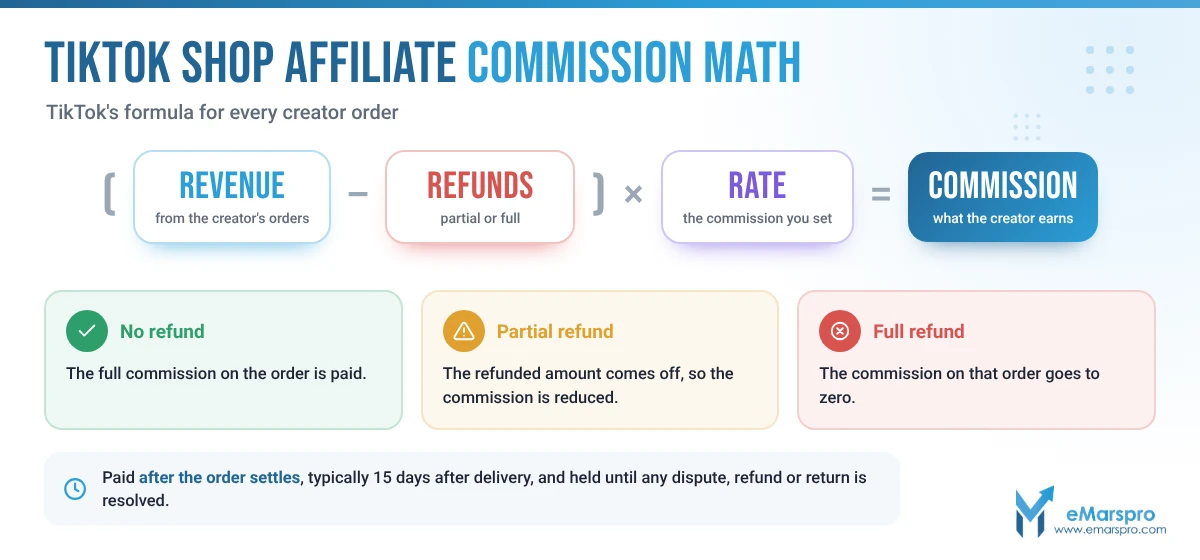
TikTok’s standard commission page gives the formula: commission equals revenue minus refunds, times the commission rate. A partial refund reduces it; a full refund takes it to zero. It is paid after the seller’s order settles, typically 15 days after delivery and later where the seller’s settlement runs later, and held until any dispute, refund or return is resolved.
Rate changes have timing rules. An increase applies at once. A decrease is delayed 30 days for creators already promoting the product in their showcase, with a notice 2 days before the lock ends on standard rates; removing the product from a showcase ends the locked rate. A product nobody has promoted takes the lower rate immediately.
Shoppable carousel posts pay 60% of the video rate by default; the open collaboration settings let you change it. The rate you set should come from the margin after the platform fee, the sample cost and the refund rate on that product, not from what a competitor pays.
Choosing creators who sell
TikTok’s matchmaking guide points sellers to the Affiliate Center’s creator search: by name, product, hashtag or keyword, with filters on profile, performance and follower demographics. It also says not to use sales volume as the only benchmark. The screen we run:
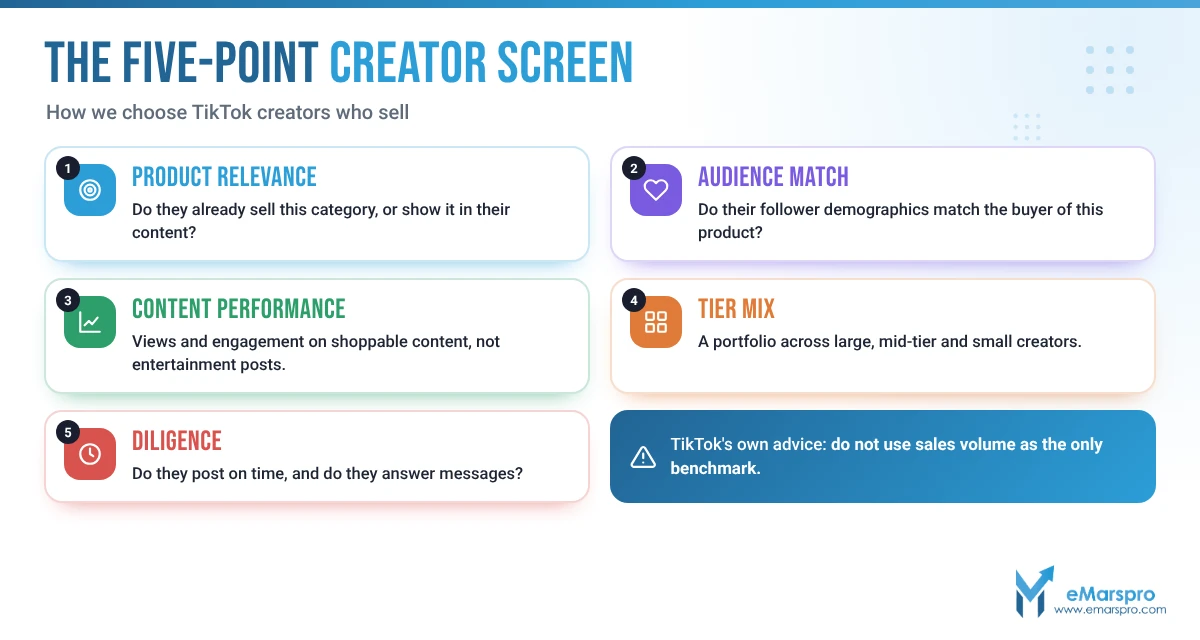
- Product relevance: does the creator already sell this category, or show it in their content?
- Audience match: do the follower demographics match the buyer of this product?
- Content performance: views and engagement on their shoppable content, not on their entertainment posts.
- Tier mix: a portfolio across large, mid-tier and small creators.
- Diligence: do they post on time, and do they answer messages?
The video ideas for the TikTok Shop affiliate program post covers what the content itself should show once the creator is chosen.
Samples, deadlines and the brief
Both collaboration types carry a free-sample option. Targeted invites can approve sample requests automatically or by rule; open collaboration can offer a batch of samples with a quantity and request period, and eligibility thresholds set once on the sample settings page (category, followers, sales volume, shoppable content) apply to every request.
TikTok’s guide gives creators 14 days to post after receiving a sample, and suggests a reminder 7 days after delivery and a follow-up 7 days before the content deadline. Refundable samples give the creator 120 days to meet the seller’s criteria.
The brief is where campaigns are won or lost. It names the product’s real claims, the ones on the listing and nothing more, the use the video should show, the deliverable and the deadline. A creator briefed on reach makes a video that says what the listing cannot keep, and the returns land on your account, not theirs.
Measuring the campaign
Inside TikTok Shop, the Affiliate Center’s analytics show the orders each creator produced, so each one can be read against the samples and the rate. TikTok’s guide treats zero affiliate orders 14 days after samples arrive as the point to troubleshoot. The usual causes are the wrong creators, the wrong rate, or a listing that does not convert the traffic.
Off the Shop, creator content is measured with the link or code it carries and the landing page’s conversion. In both cases the number that matters is orders against the cost of samples, commission and fees, read per creator, then per tier. Our TikTok marketing strategy post covers the content calendar those numbers feed into.
Common mistakes brands make
- Briefing on reach instead of the product, so the video makes a claim the listing cannot keep.
- Picking creators by follower count when the follower demographics do not match the buyer.
- Setting one commission rate and never reading it against margin, refunds and sample cost.
- Sending samples without a deadline, so the content never posts.
- Starting creator work on a shop whose performance score is near the 3.5 line, so new products are blocked mid-campaign.
- Using an AI-made scene or voice without the disclosure TikTok requires.
Where AI helps with TikTok influencer marketing, and what a person decides
AI does the reading and the drafting. ChatGPT or Claude read a creator export from the Affiliate Center and rank it against the buyer profile, draft the pitch message and the brief from the listing’s real claims, and summarize the comments under a creator’s video to show what buyers asked. A person approves the shortlist, the rate and every brief.
On the content side, TikTok’s community guidelines draw the line. Synthetic or manipulated media that shows realistic scenes must be clearly disclosed, with the platform’s label, a sticker or a caption. Synthetic media that uses the likeness of a real private person is not allowed, and a public figure’s likeness cannot be used in an endorsement.
So an AI-made creator is not a creator. AI can draft a script, clean up audio, cut a video to length or add captions; the person on screen and the claims in the video are real, and anything realistic that AI generated carries the label.
On the campaigns we run, a person checks the label before the video is approved. How we run AI across every account is on our AI eCommerce agency page.
Frequently Asked Questions
Creators making videos and LIVEs about your product for their own audience, paid by commission on the orders they produce through TikTok Shop’s affiliate program, or by a fee for content when the sale happens somewhere else. For a brand that sells, the first kind is the one TikTok tracks and pays, which is why this guide covers it.
The seller sets it, per product or for the whole shop, anywhere from 1% to 80% on TikTok Shop’s affiliate guide. Commission is calculated on revenue minus refunds, so a returned order pays nothing, and it is paid after the order settles, typically 15 days after delivery. A targeted rate always overrides the open rate for the same product.
Yes, if the shop qualifies: TikTok’s affiliate marketing policy asks for a Shop Performance Score of 3.5 or higher and products clear of policy flags. Start with an open collaboration at one rate, add targeted invites to creators who already sell your category, and send samples with a posting deadline. The first orders show which creators to invite next.
In the Affiliate Center’s creator search, filter by category, follower demographics and content performance, then shortlist creators whose audience matches your buyer, not whose follower count is largest. TikTok’s own guidance says not to use sales volume as the only benchmark. A creator whose audience already buys your category beats a larger one whose audience does not.
Only inside TikTok’s rules. Realistic AI-made or AI-edited scenes must be disclosed, synthetic media that uses a real private person’s likeness is not allowed, and a public figure’s likeness cannot be used in an endorsement. AI is useful for the brief, the shortlist and the edit; the creator on screen is a real person.
Creators sell what the listing can keep
Qualify the shop, set the rate from the margin, choose creators by audience match, brief them on the real claims, and read the orders per creator at day 14. If you would rather have that run for you, our social media team starts with the free social media audit on that page, findings inside 48 hours.
Plan Your Creator Campaign With Us
Our social media team runs creator work beside your paid and organic content, and starts with a free social media audit, findings within 48 hours.