Prime Big Deal Days 2026 is scheduled for October 6 to 7. The deal-submission window is closed, but
brands still control which participating SKUs receive support, how much margin they protect, and whether
available inventory can meet demand.
The immediate job is not to recreate a missed submission. It is to avoid turning a confirmed promotion,
existing price discount, or advertising push into a low-margin event that leaves the account short of stock for
the rest of Q4.
Direct answer
After the deal deadline, brands should shift from deal selection to event control. Confirm participating SKUs,
calculate contribution margin after every event cost, check inventory availability, set advertising guardrails,
and prepare the account for Amazon’s holiday peak fulfillment fees beginning October 15.
The deal deadline has passed but the event risk has not
Amazon’s seller announcement lists September 8 as the Prime Big Deal Days deal-submission deadline.
The event itself is scheduled for October 6 to 7, which leaves time to improve the decisions surrounding any
deal or price promotion already in place.
Amazon also states that a Prime Big Deal Days promotional price is excluded from the 30-day and 60-day
lookback windows used for Black Friday Week and Cyber Monday deal pricing. Read the official 2026
holiday seller announcement before changing an offer or assuming that one event will determine the next
The useful question is now narrower: which actions can still protect profitability and availability when
demand rises?
Calculate the contribution margin before event traffic arrives
Revenue is not the approval metric. Review each participating SKU at its promotional selling price, then
account for product cost, referral and fulfillment fees, promotion fees, advertising spend, and an appropriate
returns allowance from the brand’s own history.
Amazon says Best Deals, Lightning Deals, and Prime Exclusive Price Discounts carry a $100 upfront fee
per promotion plus 1.5% of promotional sales, capped at $5,000. Treat that fee as one part of the SKU
economics, not as a line item that can be reviewed later.
For each SKU, set a simple decision status: protect, limit, or suppress. Protect a SKU with room for demand
and margin. Limit a SKU whose economics tolerate only controlled advertising. Suppress a SKU whose
promotion would add revenue without acceptable contribution.
Confirm the inventory position before increasing demand
A confirmed deal does not create inventory availability. Amazon lists September 16 as the arrival deadline
for FBA shipments using Amazon-optimized shipment splits to help maintain Prime-badge eligibility during
Prime Big Deal Days. A later arrival should not be treated as a guaranteed event fix.
Review sellable units, inbound status, reserved units, and realistic daily demand by SKU. Then decide which
SKUs can carry event traffic without creating an avoidable stockout or leaving too little cover for Black Friday
Week and Cyber Monday.
This is also where Amazon FBA management becomes an operating discipline rather than a shipping task.
Forecasting, replenishment, and fee exposure belong in the same SKU decision.
Set advertising guardrails before the event starts
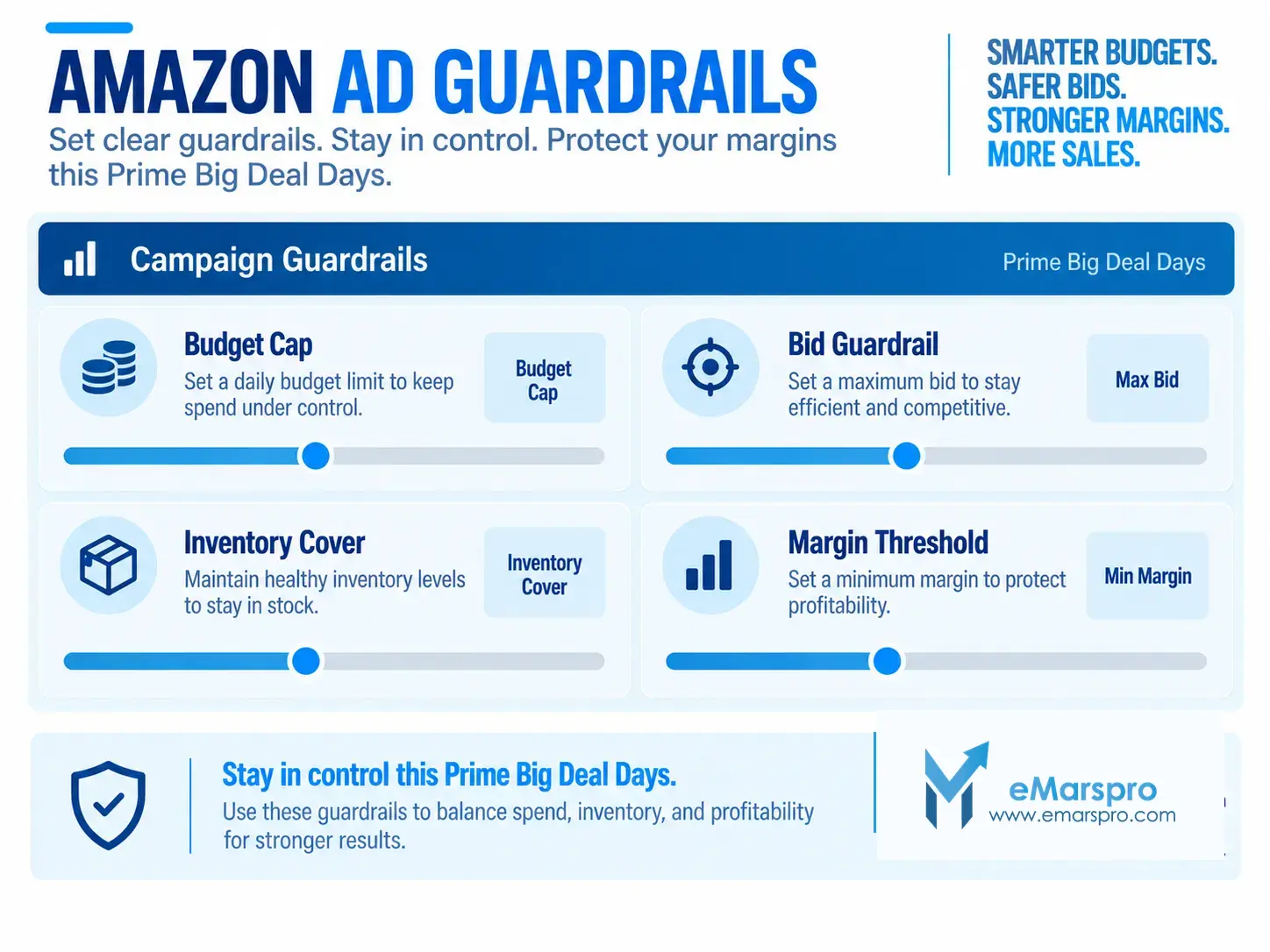
Event traffic can make a weak SKU look successful for a few hours. Set an approved daily budget, a
maximum bid or cost threshold, an inventory floor, and a reason to reduce spend before demand begins to
rise.
Review at the SKU level, not only at the campaign level. A campaign can appear efficient while it shifts
spend toward products with lower margins, limited inventory, or a promotion that already removed too much
room.
Teams that need a wider operating review can use Seller Central consulting to turn the event plan into
assigned actions across catalog, inventory, pricing, and advertising.
Plan for the October 15 cost change now
Amazon’s holiday peak fulfillment fees begin October 15, 2026 and continue through January 14, 2027.
Amazon says the increase averages $0.32 per unit, with a 3.5% fuel and logistics-related surcharge applied
on top of the holiday peak fulfillment fees.
This does not mean every SKU changes by the same amount. It means event and Q4 pricing should be
reviewed with the actual size, weight, fulfillment path, and promotion economics of each SKU. A product that
works in early October may need a different advertising or price decision later in the month.
Measure what Prime Big Deal Days actually created
Prepare the post-event review before October 6. Capture a normal daily sales baseline, expected margin, ad
budget, inventory position, and the list of SKUs receiving support. After the event, compare against the
same measures rather than celebrating total sales alone.
Ask four questions: Did the SKU generate incremental contribution? Did advertising improve total
performance or only claim sales that would have occurred anyway? Did the event create a stockout risk?
Did the promotional price change the next Q4 decision?
For brands that want an outside operational view, Amazon account management starts with a free account
audit and findings in 48 hours. The audit CTA button is intentionally not included here until the approved
landing page is available.
Frequently Asked Questions
No. Amazon’s seller announcement lists September 8, 2026 as the Prime Big Deal Days deal-submission deadline. Brands can still review participating SKUs, inventory availability, price promotions, and advertising controls before the October 6 to 7 event.
Amazon lists September 16 as the arrival deadline for FBA shipments using Amazon-optimized shipment splits to help maintain Prime-badge eligibility during Prime Big Deal Days. It is an arrival target, not a guarantee that later inventory will support the event.
Amazon states that Best Deals, Lightning Deals, and Prime Exclusive Price Discounts carry a $100 upfront fee per promotion plus 1.5% of promotional sales, capped at $5,000.
Amazon states that holiday peak fulfillment fees begin October 15, 2026 and end January 14, 2027. The per-unit increase averages $0.32, and Amazon says the 3.5% fuel and logistics-related surcharge applies on top.
Get Your Free Amazon Account Audit
Get a free Amazon account audit covering your listings, PPC, and account health, with findings delivered within 48 hours. Irfan Syed writes about marketplace advertising at eMarspro, where the team manages sponsored ads across Amazon and 60+ marketplaces.