
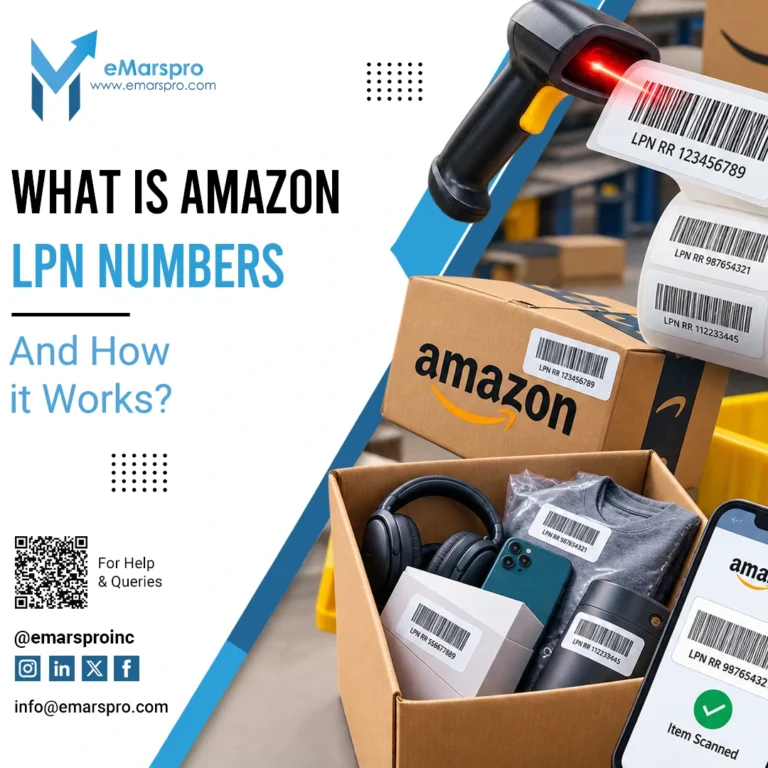
An Amazon LPN number is a license plate number: a unique serial number Amazon assigns to a specific unit or container so it can be tracked through the fulfillment process. You will most often meet one on a returned unit, where Amazon applies an LPN label and records the same number in the FBA Customer Returns report.
Amazon staff’s definition of an LPN is the source for the statements in this post, checked for this update.
The post explains what the number is, how it works inside Amazon’s warehouses, where to find the matching row in your reports, and what a seller does with it.
What is an Amazon LPN (license plate number)?
LPN stands for license plate number. In Amazon staff’s words, it is a unique serial number that identifies specific items throughout the fulfillment process, and LPNs help track inventory and shipments as they move through the supply chain. The name is the analogy: a car model is shared by thousands of cars, but each one has its own plate.
That is the difference from the barcodes you print. An FNSKU identifies a product; every unit of that product shares it. An LPN identifies one unit, or one container, and no other. When a returned unit reaches you with an LPN label over the original barcode, that label is Amazon’s record of that single unit’s journey.
Reading LPNs across the returns report is part of the inventory routine our Amazon FBA management team runs for wholesale sellers, because it is how you answer the question every return raises: which unit, from which order, and why.
How do Amazon LPN numbers work?
Item tracking and allocation
Amazon’s forum answer on where LPNs are assigned says an LPN is assigned to a pallet, carton or tote when goods arrive at a warehouse or distribution center, stays with the goods as long as they are in that packaging, and may be replaced if the goods are repackaged.
The number follows the container through receiving and storage; a single unit gets its own when Amazon handles it on its own, a return being the common case. How Amazon receives and stores your units covers that path.
Quality control
When a unit comes back or is found opened, Amazon processes it as an individual item rather than as one more unit of an FNSKU. The LPN is what makes that possible: the grading decision, the disposition (sellable or unsellable) and the reason code attach to the number, not to the product.
Returns management
For a seller, the LPN is the key that joins the physical unit to the data. The FBA Customer Returns report lists each return with its order ID, the return reason, the disposition and the LPN, and Amazon staff point sellers to that report to look up a returned unit.
A unit in your hands and a row in the report meet on that one number.
How to find the LPN in your returns report
Open the report
In Seller Central, open Reports, then Fulfillment, and under Customer Concessions choose FBA customer returns. Set the date range, request the download (.csv or .txt) and open it when the status shows it is ready. The path can move with Seller Central’s menus; the report name does not.
Read the row
Each row carries the return date, order ID, SKU, ASIN, FNSKU, quantity, fulfillment center, the detailed disposition, the return reason, the status and the LPN. Search the LPN from the label to find the unit’s row; search the order ID to find every unit from one order.
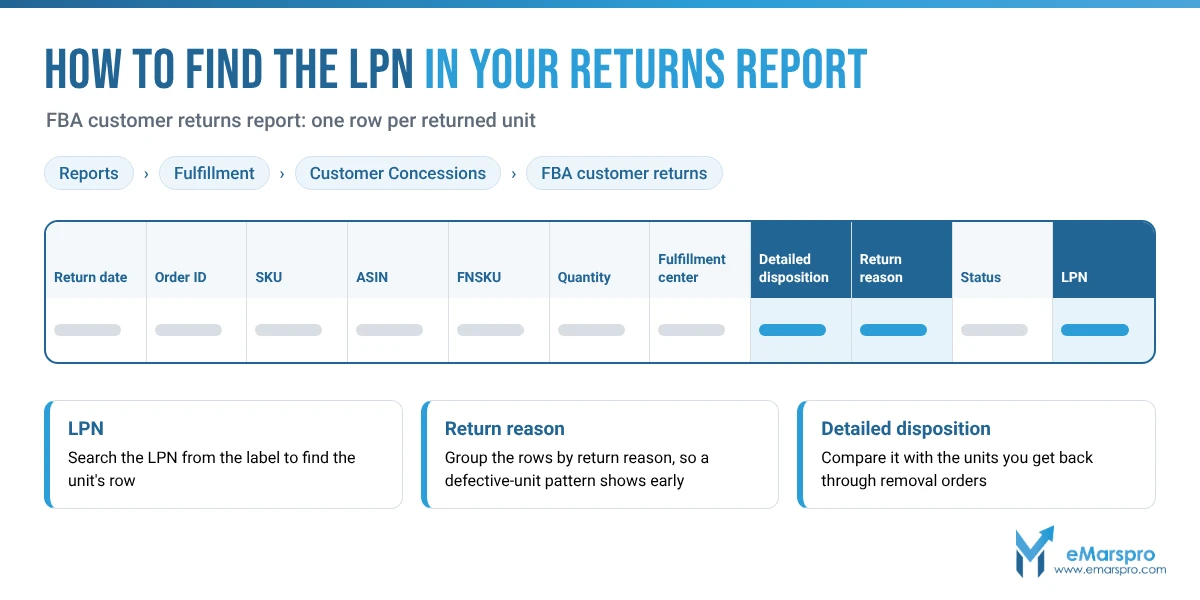
Two reads are worth doing on every pass. Group the rows by return reason, so a defective-unit pattern on one SKU shows before it becomes a listing problem.
And compare the disposition column with the units you get back through removal orders: a unit whose grade in the report does not match its condition on arrival is a Seller Support case, and the LPN is the evidence.
Amazon LPN labels: the unit’s record
The LPN label is applied by Amazon over or beside the original barcode so the unit scans as itself from then on. Treat it as part of the unit’s record: photograph it when a returned unit arrives, before you remove packaging, because the number on the label is what Seller Support will ask for in a claim about that unit.
If you resell returned units, the LPN history matters twice. Managing returns after the holidays covers the January volume, and selling refurbished units on Amazon Renewed covers the program whose rules start with knowing each unit’s history.
Where AI helps with returns data, and what a person decides
Amazon’s seller AI page, updated August 2026, names Seller Assistant for questions inside Seller Central; a question about where a report sits or what a disposition code means is the kind it is built to answer.
On our side, an AI tool such as ChatGPT or Claude reads the week’s FBA Customer Returns export and drafts the exceptions: reason codes clustering on one SKU, units whose report grade does not match the condition they came back in, LPNs that match no row.
What a person decides: which pattern is a product problem, which unit becomes a claim, and what changes in the listing. AI reads, people decide.
Frequently Asked Questions
The FNSKU (Fulfillment Network Stock Keeping Unit) is the barcode for a product in your catalog: every unit of the same product carries the same FNSKU. The LPN is a unique serial number for one specific unit or container, which is why Amazon uses it to trace a single returned item.
Tracking. Amazon staff describe the LPN as a unique serial number that identifies specific items throughout the fulfillment process and helps track inventory and shipments through the supply chain. One of its most visible uses to a seller is on a returned unit.
Amazon’s forum answer says an LPN is assigned to a pallet, carton or tote when goods arrive at a warehouse, stays with the goods while they are in that packaging, and may be replaced if they are repackaged. On a returned unit, Amazon applies the LPN label when it processes the return; you see it when the unit comes back.
Because a return is one specific unit with its own history, and the FNSKU cannot tell units apart. The LPN lets Amazon, and you, match the physical unit to the row in the FBA Customer Returns report that records the order, the return reason and the disposition.
Sellers search for “LPN RR” and “LPN HE” because the LPN on a return label carries a two-letter prefix. The whole string, prefix included, is the identifier to search in the FBA Customer Returns report. Amazon publishes no separate definition for the prefixes.
Where that leaves you
An LPN is a tracking number for one unit, and the FBA Customer Returns report is where it pays off. Read the report on a set cadence, photograph every label on arrival, and claim what the data supports. If you want the returns routine run for you, our FBA team starts with a free account audit, findings in 48 hours.
Read The Returns Report On A Set Cadence
Photograph every label on arrival and claim what the data supports. If you want the returns routine run for you, our FBA team starts with a free account audit, findings within 48 hours.



