Walmart inventory management runs on three layers: the stock tools built into Seller Center, WFS (Walmart’s own fulfillment program) if you let Walmart hold the inventory, and the weekly routine that stops stockouts and stranded stock.
Get all three right and the performance standards Walmart grades you on mostly take care of themselves, because two of the eight are inventory failures in disguise.
This update checks every rule against Walmart’s own pages: Walmart’s Seller Performance Standards, last updated July 28, 2026, and its WFS overview, both read for this update. It is also the routine our Walmart account management team sets up first on a new account.
Why inventory is a performance metric on Walmart
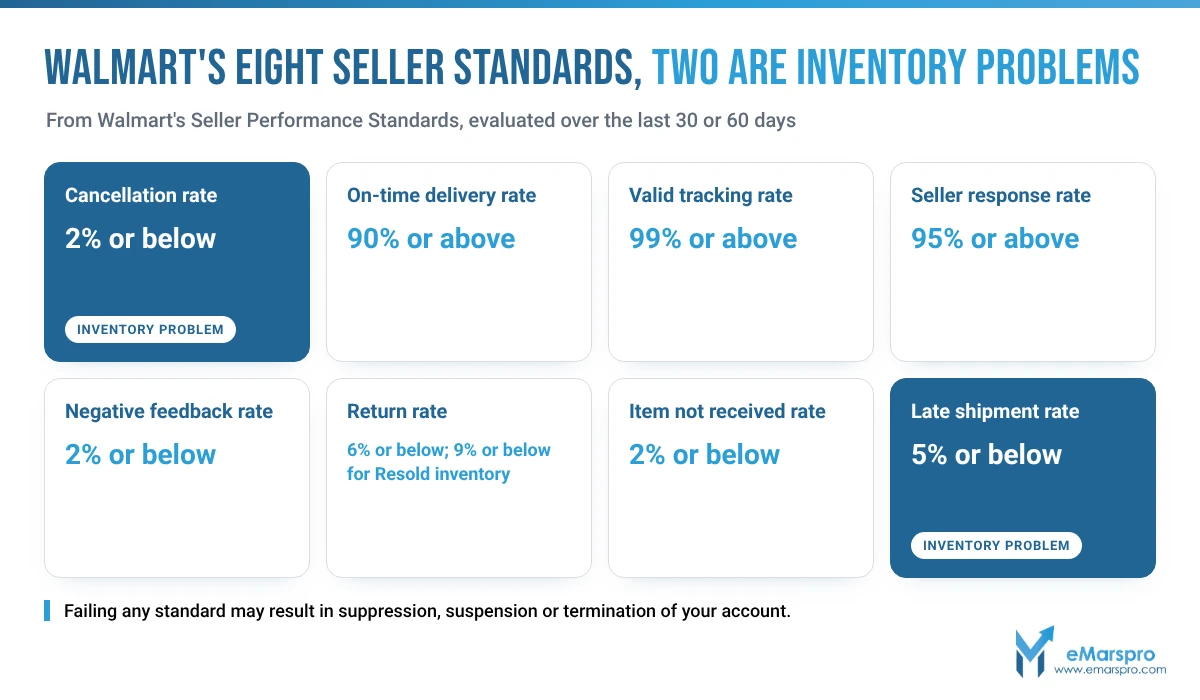
Walmart’s standards page lists eight metrics, evaluated over the last 30 or 60 days:
| Metric | Walmart’s standard |
|---|---|
| Cancellation rate | 2% or below |
| On-time delivery rate | 90% or above |
| Valid tracking rate | 99% or above |
| Seller response rate | 95% or above |
| Negative feedback rate | 2% or below |
| Return rate | 6% or below; 9% or below for Resold inventory |
| Item not received rate | 2% or below |
| Late shipment rate | 5% or below |
Two of them are inventory problems. A cancellation often starts as an oversell; a late shipment often starts as a stockout that was still showing as in stock. The page’s consequence line is plain: failing any standard may result in suppression, suspension or termination of your account.
So the inventory routine below is account protection, not housekeeping.
Layer 1: what Seller Center gives you
- Stock per item, updated by hand, by bulk file or through the API from your own system, so the quantity Walmart shows is the quantity you can ship.
- Inventory and order reports to read what sold, what is low and what is stranded (listed but unsellable, or in stock but unpublished).
- Alerts on low stock and oversells, which are only useful if someone reads them the same day.
- The Listing Quality & Rewards dashboard, whose score counts the offer alongside content, discoverability, ratings and reviews.
Setting up a Walmart seller account covers where these sit on a new account. The habit that matters is the sync: if your warehouse system and Seller Center disagree, Seller Center wins with the buyer, and the gap becomes a cancellation.
Layer 2: WFS, when Walmart holds the stock
Walmart’s WFS overview describes the service: Walmart picks, packs and ships orders in two days or less, handles order questions and takes returns in any Walmart store or by mail. It also fulfills orders from your website, Amazon, eBay, Shopify and TikTok Shop, so one pool of stock can serve several channels.
| WFS rule, from the overview | What it states |
|---|---|
| Product limits | Up to 500 lbs, within 120 by 105 by 93 inches including packaging; non-perishable; no temperature control; shipped from the US or cleared through customs |
| Quantity | No minimums or maximums; Walmart recommends at least 50 items with continual replenishment |
| Fees | Walmart says its rates cost 15% less than other marketplace fulfillment providers (its own data, July 2024 to June 2025) and that there are no setup, monthly or hidden fees; the per-item rates are on its pricing page, not the overview |
| Credits | Up to $2,000 in WFS credits for new sellers, terms apply |
| Performance | Walmart’s standards page: with WFS, most performance metrics will be met for you, with the exception of the Negative Feedback Rate |
That last line is the case for WFS as an inventory decision: the metrics that stockouts and late shipments damage move to Walmart’s side of the table. What stays with you is replenishment, which is Layer 3, and the one metric WFS cannot fix, the feedback a wrong or disappointing product earns.
Layer 3: the weekly routine
| Day | Task | Why |
|---|---|---|
| Monday | Reconcile Seller Center quantities with your warehouse and WFS stock; fix every mismatch the same day | Mismatches are next week’s cancellations |
| Tuesday | Restock math for the top items: average daily sales over the last 30 days, times lead time in days, plus a buffer | The reorder quantity, not a guess |
| Wednesday | Stranded and unpublished items: why each one is not selling, and the fix | Stock that is listed but unsellable is the quietest loss |
| Thursday | WFS inbound: what is in transit, what is received, what is short | Replenishment is the one WFS job that stays yours |
| Friday | The standards read: cancellation and late shipment rates against the thresholds, and the inventory cause behind each miss | The account is graded on the result, not the effort |
Before Walmart’s deal events the routine tightens: Walmart’s Black Friday seller strategy covers the stock split between Walmart’s November windows. And when a metric slips, the Walmart seller account suspension post covers what Walmart does next and how to answer it.
Do you need inventory software?
Seller Center alone works while the SKU count is small and the sync is one person’s daily job. Software earns its fee when several channels draw on the same stock, when the restock math has to run for dozens of items, or when the sync has broken twice.
The test is simple: if the Monday reconciliation takes more than the morning, buy the tool.
Where AI helps with Walmart inventory, and what a person decides
Walmart named an AI-Powered Listing Tool and a Smart Assistant with round-the-clock support for sellers at its 2025 Marketplace Seller Summit (checked for this update); the assistant is the place to ask where a report sits or what a flag means.
On our side, an AI tool such as ChatGPT or Claude reads the weekly inventory and order exports and drafts the exceptions: items whose sell-through moved, quantities that disagree between systems, stranded items with no fix logged.
What a person decides: the reorder quantity, whether an item moves to WFS, and which stranded listing is worth fixing. AI reads, people decide.
Frequently Asked Questions
Seller Center is the system: stock levels per item, updates by hand, by file or through the API, the inventory and order reports, and the alerts that fire when an item runs low or oversells. Walmart Fulfillment Services adds a second layer, where Walmart holds the stock and you manage the replenishment to its warehouses.
With WFS, Walmart receives, stores, picks, packs and ships the units, delivers in two days or less and takes returns in any Walmart store or by mail. Walmart’s standards page adds that with WFS most performance metrics will be met for you, except the Negative Feedback Rate. Seller-fulfilled stock stays in your warehouse, and every metric is yours.
Walmart’s WFS overview says there are no minimums or maximums and recommends setting up at least 50 items with continual replenishment. For each item, send what average daily sales cover for the lead time plus a buffer, and review it on a set cadence; stock that sits is a storage cost, stock that runs out is a lost rank.
A cancellation. Walmart’s standards ask for a cancellation rate of 2% or below and a late shipment rate of 5% or below, and say that failing any standard may result in suppression, suspension or termination of the account. Oversells and the late shipments that follow a stockout are inventory problems that show up as performance problems.
Inventory is where Walmart accounts quietly win or lose
Two of Walmart’s eight standards are inventory failures, and both are preventable with a sync, a restock calculation and a Friday read. Our Walmart account team starts every account with a free audit of exactly these numbers, findings within 48 hours.
Inventory Is Account Protection On Walmart
Reconcile, restock and read the standards every week. If you want that routine run for you, our Walmart account team starts with a free account audit, findings within 48 hours.