

Setting up a Walmart seller account takes three stages: meet the seven requirements, apply at seller.walmart.com and pass Walmart’s approval review, then complete onboarding in Seller Center.
There is no setup fee and no monthly fee; Walmart charges a referral fee of 6% to 15% only when you sell. Here is how to sell on Walmart Marketplace in 2026, from application to first sale.
Who Can Sell on Walmart Marketplace: The 7 Requirements
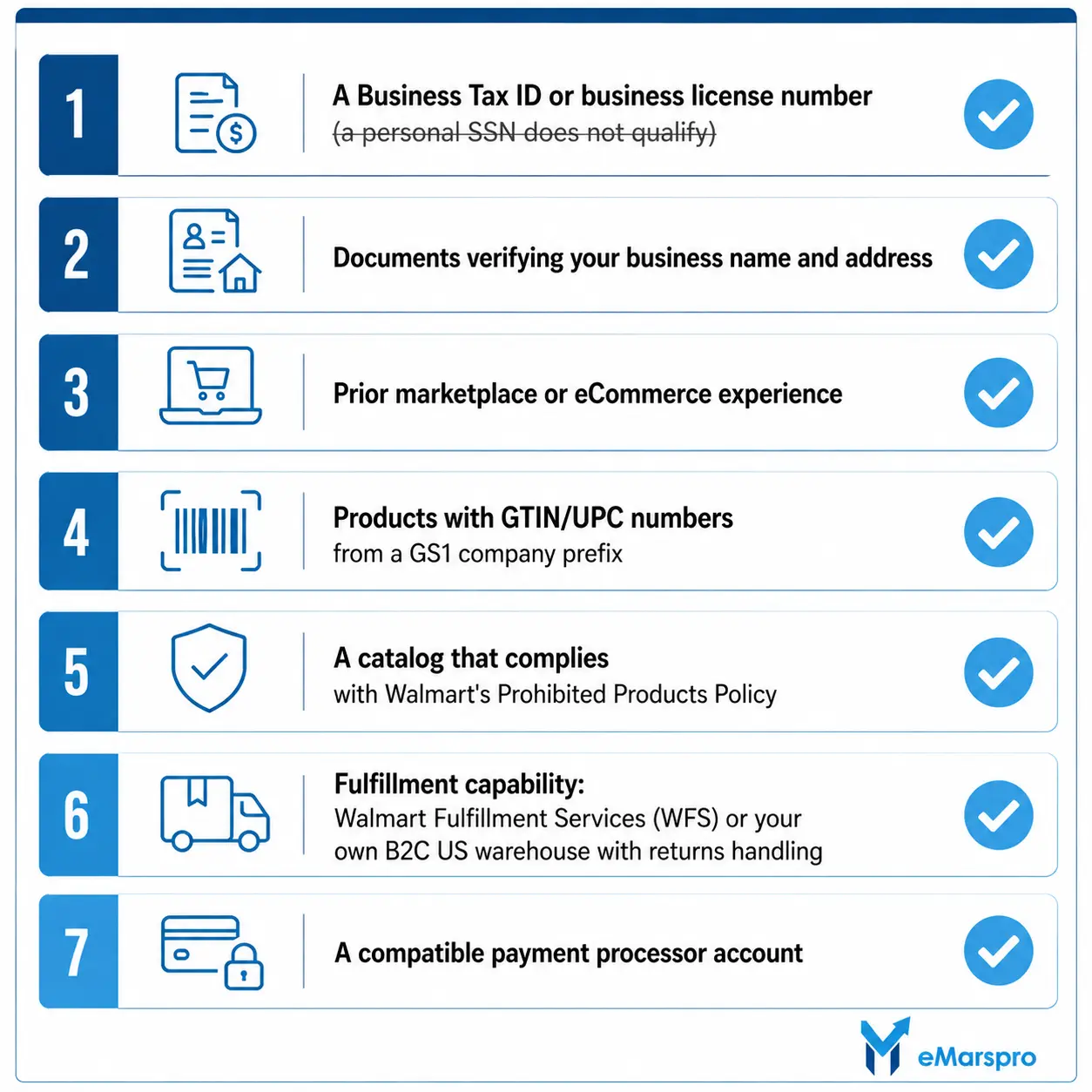
Walmart approves businesses, not beginners. Checked against Walmart’s own requirements today, you need:
- A Business Tax ID or business license number (a personal SSN does not qualify)
- Documents verifying your business name and address
- Prior marketplace or eCommerce experience: Walmart wants proof you already know how to sell online
- Products with GTIN/UPC numbers from a GS1 company prefix
- A catalog that complies with Walmart’s Prohibited Products Policy
- Fulfillment capability: Walmart Fulfillment Services (WFS) or your own B2C US warehouse with returns handling
- A compatible payment processor account
Missing one of these is the most common reason applications stall. Fix the gap before you apply, not after a rejection.
Step 1: Apply at seller.walmart.com
The application itself is short. You submit your business details, tax information, and the documents above, then verify your identity.
- Be exact: the business name and address must match your documents character for character
- Show your track record: list your strongest marketplace presence and sales history; approval leans heavily on it
- Timing: straightforward applications clear in days; mismatched documents can stretch the review for weeks
Step 2: Pass the Approval Review
Walmart reviews every application rather than approving automatically. What moves an application through:
- Real, verifiable eCommerce history with healthy metrics
- A catalog that fits Walmart’s categories and policies
- A fulfillment answer Walmart trusts: WFS or a US warehouse that can hit two-day-capable delivery promises
If you are rejected, you can reapply once the gap is fixed. The rejection email usually names it.
Step 3: Complete Onboarding in Seller Center
Approval opens Seller Center, where the real setup happens:
- Company profile: logo, customer service contacts, return policy
- Payment setup: connect your payment processor account
- Shipping setup: methods, regions, and delivery promises you can actually keep
- Catalog upload: listings with your GTINs, either one by one, by bulk feed, or through an integration
- Launch checklist: Walmart’s own onboarding guide tracks each step until your items go live
What It Costs: No Monthly Fee, Ever
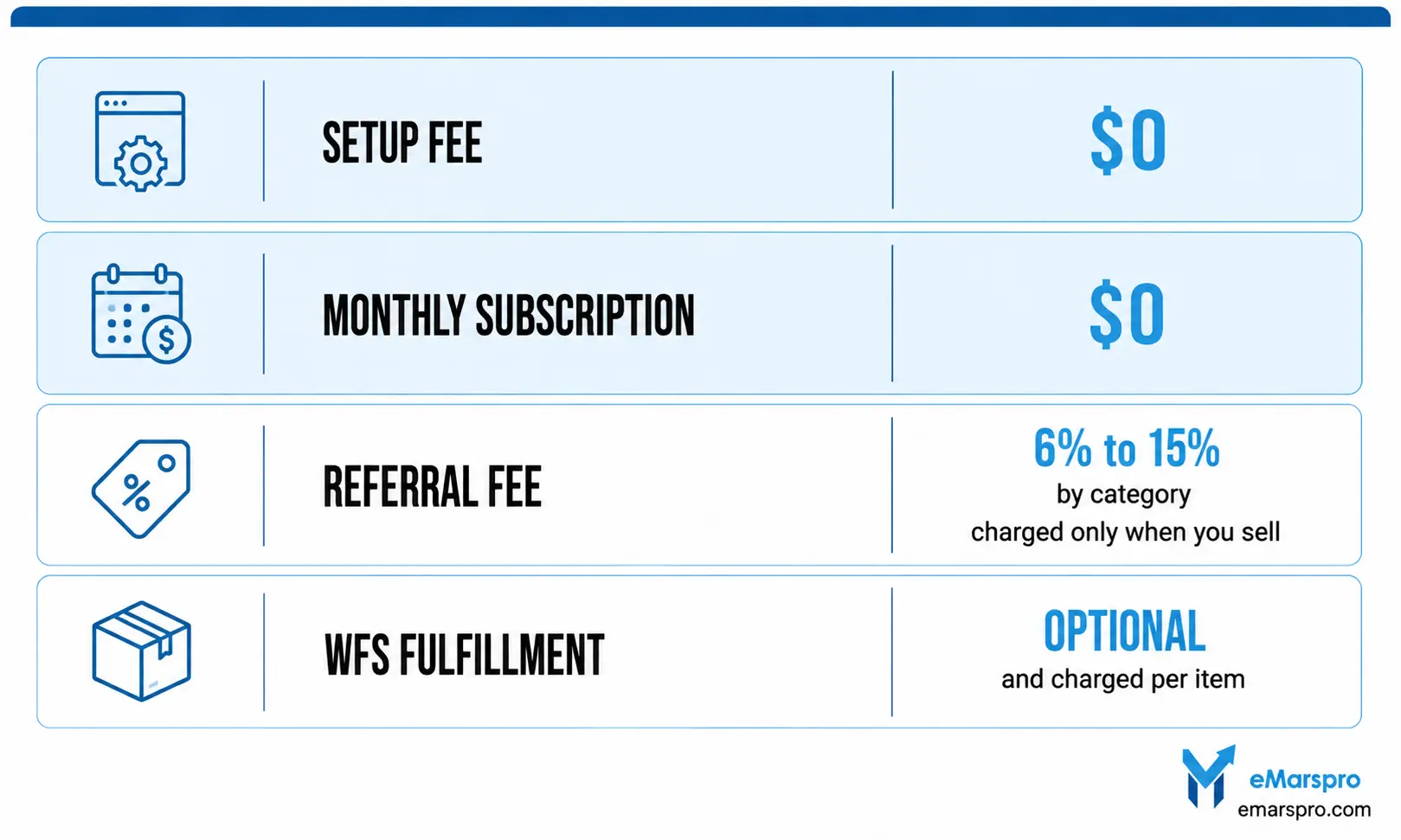
This is the part most guides get wrong, so here it is from Walmart’s own Marketplace page, checked August 15, 2026:
| Fee | Amount |
|---|---|
| Setup fee | $0 |
| Monthly subscription | $0. Walmart states: “There are no setup, monthly, or hidden fees for any sellers” |
| Referral fee | 6% to 15% of the sale price, by category, charged only when you sell |
| WFS fulfillment (optional) | Fulfillment and storage fees per item if you use WFS |
Walmart is also running new-seller incentives worth up to $75K in savings for accounts created before January 31, 2027, terms apply. Reason enough not to sit on a ready application.
Your First 30 Days: Set Up the Account to Survive
Getting approved is stage one. Walmart holds sellers to eight performance standards from the first order, and new accounts fail them through inattention, not bad faith:
- Price sharp: the Buy Box and Walmart’s pricing rules both punish uncompetitive prices
- Promise honestly: set delivery times you can hit; on-time delivery is a tracked standard
- Watch the dashboard daily: cancellations, tracking validity, and response times are all measured
- Decide on WFS early: two-day delivery capability changes both your conversion rate and your metrics
The full monitoring routine is in our guide to avoiding Walmart account suspension, and it is worth reading before your first sale, not after your first warning.
Setting up is a one-week project. Running the account is the real work, and it is what our Walmart account management team does daily across brands selling on Walmart’s US marketplace.
Frequently Asked Questions
Nothing. Walmart charges no setup fee and no monthly fee; you pay a referral fee of 6% to 15% of each sale, by category. Optional WFS fulfillment has its own per-item fees.
Clean applications with matching documents typically clear within days to a couple of weeks. Document mismatches and thin eCommerce history are the usual causes of long reviews or rejections.
Not as private individuals. Walmart requires a business tax ID or business license, verifiable business documents, and prior marketplace or eCommerce experience.
No. You need a credible fulfillment answer: either WFS or your own US-based B2C warehouse that can handle deliveries and returns. Many sellers start with their own fulfillment and add WFS later.
The audience is real: Walmart reports roughly 280 million customers a week across its stores and eCommerce. For sellers already succeeding on other marketplaces, it is the largest US expansion move available, with no fixed cost to maintain the account.
Ready To Launch, Or Already Stuck?
If the requirements list above reads like a checklist you’ve already passed, the application is worth filing this week while the new-seller incentives run. And if the account exists but has never taken off, that’s an operating problem, not a setup problem: our Walmart marketplace management team starts with a free 48-hour audit that shows you exactly what’s holding it back.