

Managing an Amazon seller account is a routine, not a project: a few checks every day, a longer pass every week, and a fee and listing audit every month. Miss the routine and the account tells you with a warning; miss the warning and it tells you with a deactivation.
This checklist is for a brand or reseller who already sells and wants the account run properly, whether by one person or a team. The thresholds and fees below were checked for this update on Amazon’s own pages, and the AI section covers what Seller Assistant can now take off your desk.
What metrics does Amazon judge you on?
Four numbers decide whether Amazon treats your account as healthy. Amazon’s seller policies guide states the first three as targets; the fourth is the composite score shown at the top of Seller Central.
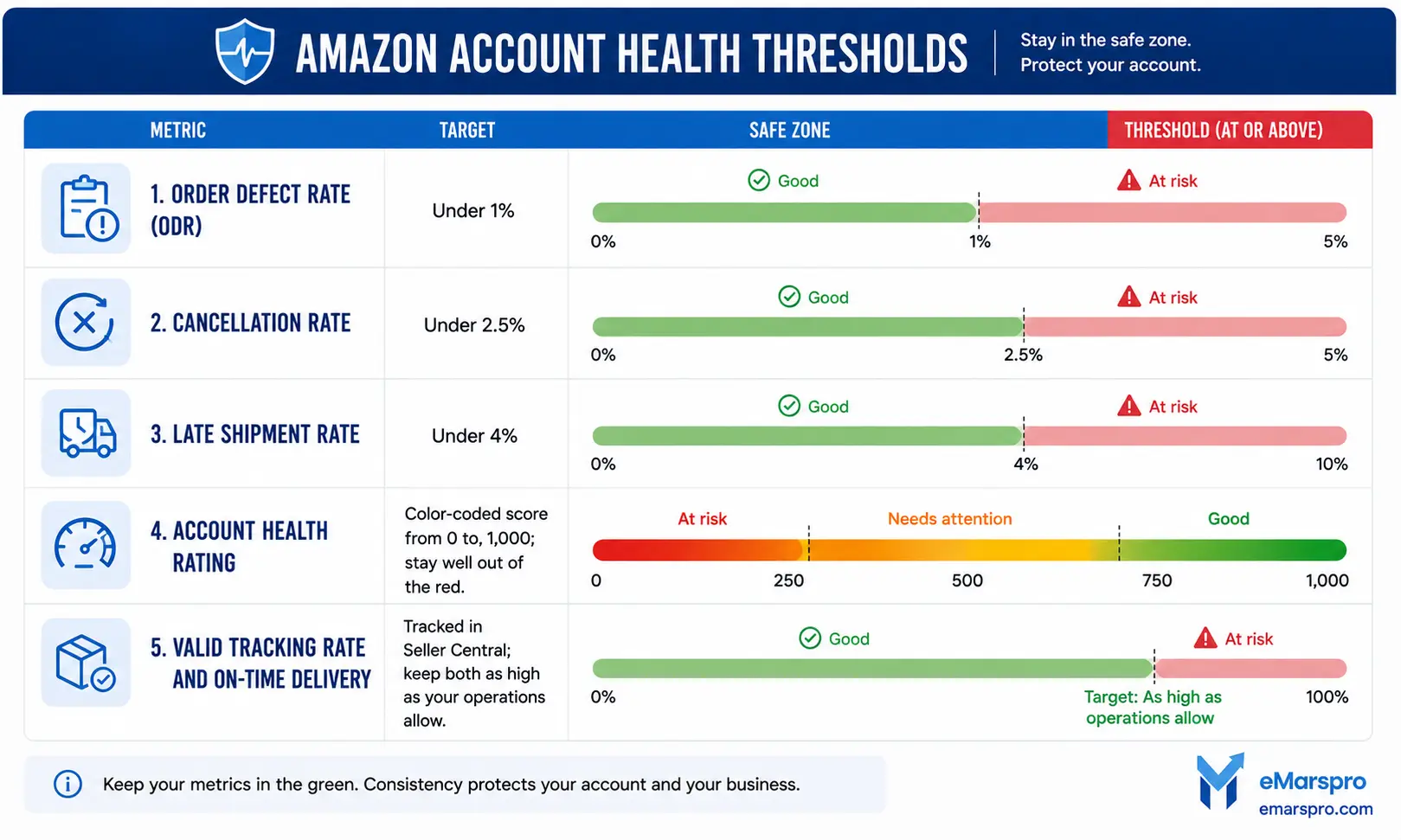
| Metric | Target Amazon states | What moves it |
|---|---|---|
| Order Defect Rate (ODR) | Under 1% | Orders with a defect, as a share of all orders |
| Late shipment rate | Under 4% | Seller-fulfilled orders confirmed after the expected ship date |
| Pre-fulfillment cancellation rate | Below 2.5% | Orders you cancel before shipping, usually stock you did not have |
| Account Health Rating | Color-coded, 0 to 1,000 | Policy violations on the account |
Check them on a schedule rather than when a notice arrives. A metric that drifts for two weeks is a process problem (stock counts, handling time, a listing that misleads); fixing the process is what brings the number back, not a one-off appeal. Our Amazon account management routine is built around these four numbers.
The daily 15 minutes
Buy Box and pricing alerts: a lost Buy Box on a top product usually means a price or stock change worth a look today, not Friday.
Orders and shipments: confirm every seller-fulfilled order inside its handling time; check that FBA orders are flowing.
Buyer messages: answer them daily, weekends included; a slow reply is the first thing a buyer complains about.
Account Health dashboard: open it, read any new notification, and act on policy warnings the day they land.
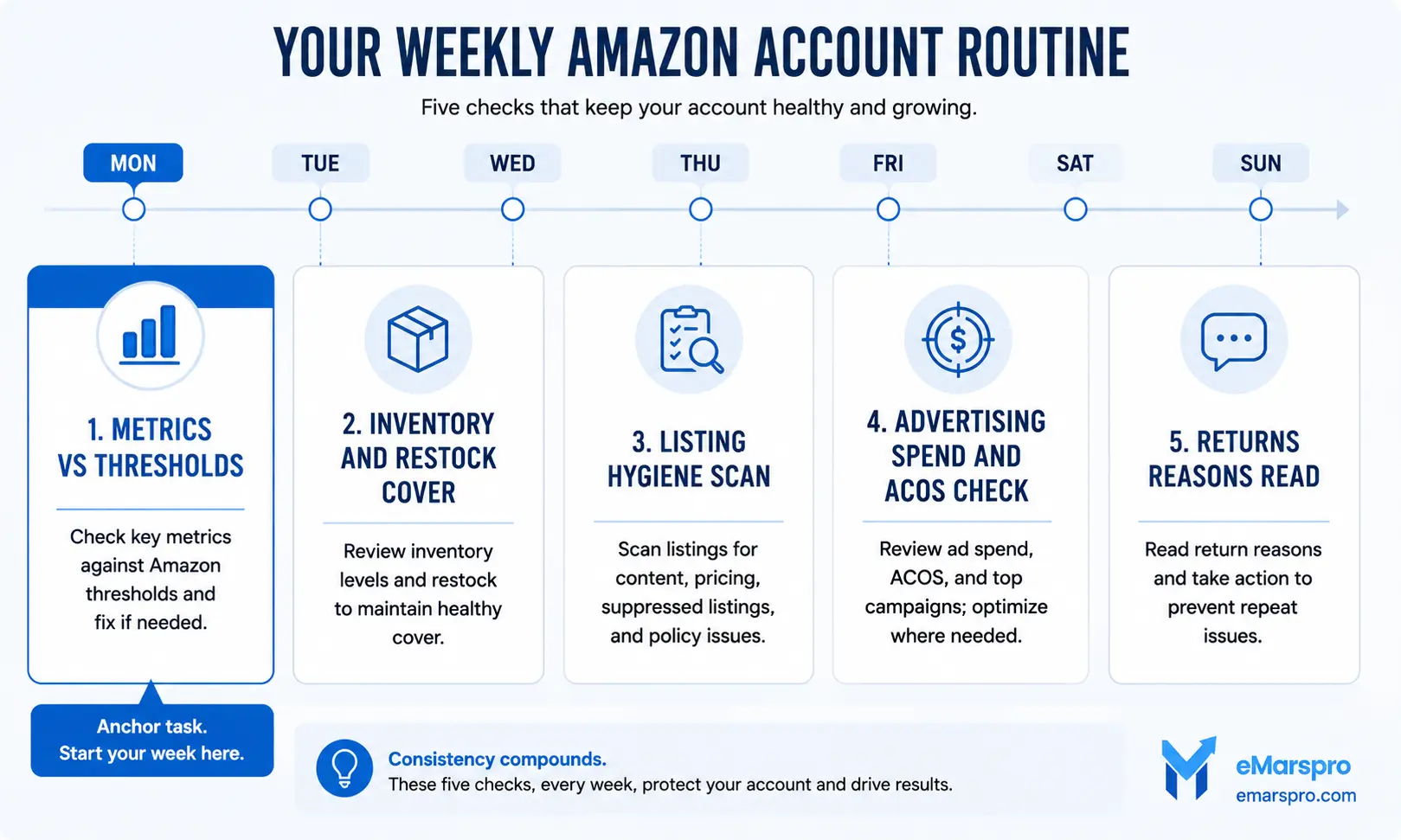
The weekly routine
Metrics against thresholds: the four numbers above, with a note on anything trending the wrong way.
Inventory and restock: weeks of cover per SKU; anything under four weeks gets an order or an inbound shipment this week.
Listing hygiene: suppressed or stranded listings cleared; stranded inventory is the quiet one, because the units sit in FBA with no live offer.
Advertising: budgets, search terms and anything with spend and no sales for two weeks.
Returns: read the return reasons; a repeated reason is a listing fix waiting to happen.
The monthly routine
Fee audit: compare FBA fees charged against the dimensions and weight Amazon has on file for each SKU.
Reimbursements: lost and damaged inventory claims inside Amazon’s filing windows.
Stale listings: delete or fix anything with no sales and no traffic for a quarter; new products follow the how to create a product listing guide so they publish clean.
Policy updates: read the month’s Seller Central news and note any change that touches your categories.
Trend review: sales, conversion and TACoS month over month, so a slow decline shows before it becomes a problem.
Which plan fits a managed account?
Amazon’s pricing page lists two plans. The Individual plan charges $0.99 per item sold with no monthly fee; the Professional plan costs $39.99 a month and removes the per-item fee. Past about 40 items a month the Professional plan is cheaper, and it is the one with the bulk listing tools.
Referral fees, which vary by category from 8% to 45%, and FBA fees apply on both plans. Those are the fees the monthly audit checks, because they move with Amazon’s fee schedule and with your own packaging.
What can Seller Assistant take off your desk?
Seller Assistant is Amazon’s agentic AI expert inside Seller Central. Amazon’s September 2026 announcement says it now keeps a memory of each seller’s pricing patterns, inventory cycles and growth goals, and runs automated workflows that monitor the business around the clock, including when nobody is signed in.
What it reads and drafts: account health questions with recommended actions, slow-moving stock before long-term storage fees, compliance documents, and workflows you describe in plain language, with guardrails you set and a choice between recommend-only and take-action modes.
What a person still decides: every action. Amazon states that sellers stay in control, reviewing and approving actions before they are carried out, with every action logged in an audit trail. In our accounts the assistant handles the reading; the account manager approves each listing change, each appeal and each bid change past a set limit.
Setting up vs managing: different jobs
Setup is a short task: registration, verification, plan, first listings. Our guide to what Seller Central is covers it. Managing is the ongoing job above, and it is where accounts are won or lost; most deactivations we see trace back to a routine that was skipped for a month, not to a bad setup.
Manage it yourself or get help?
Run it yourself while the daily and weekly lists fit into one person’s week. The signs it has stopped fitting: routines skipped two weeks running, a metric that drifts back after each fix, health warnings arriving faster than they are cleared, or an account past roughly $250,000 a year, where a missed week costs more than a month of help.
Frequently Asked Questions
Orders, buyer messages and the Account Health dashboard daily; metrics against their thresholds, inventory and advertising weekly; fees, reimbursements and stale listings monthly. Buyer messages are answered daily, weekends included.
Order Defect Rate under 1%, late shipment rate under 4%, pre-fulfillment cancellation rate below 2.5%, and the Account Health Rating, a color-coded score from 0 to 1,000. Amazon states the first three targets in its seller policies guide.
The Professional plan costs $39.99 a month and removes the $0.99 per-item fee, so the break-even is about 40 items a month. It also includes the bulk listing tools, which most growing accounts need before they reach that volume.
It can monitor, flag and draft, and since September 2026 it can run workflows you describe in plain language. Amazon’s own wording is that sellers review and approve actions before they are carried out. Treat it as an assistant with a memory, not a manager.
The Account Is The Asset
Nothing in this checklist is clever; it is simply done every day, every week and every month. If the routine has slipped, our account management team starts with a free 48-hour audit that reads the four metrics, the fee lines and the stranded units before anything else.



