
A Walmart seller account suspension is one of four actions Walmart takes when a seller breaks its policies or misses its performance standards: suppression, pause, suspension or termination. Walmart publishes an appeal route for a suppression and a suspension; a termination cannot be appealed. The notice tells you which one you have.
This guide gives the four statuses in Walmart’s words, the eight performance standards with their thresholds and windows, the causes behind most suspensions, the appeal path as Walmart describes it, and the prevention routine. Every threshold and rule comes from Walmart Marketplace Learn, checked for this update.
The four statuses, in Walmart’s words
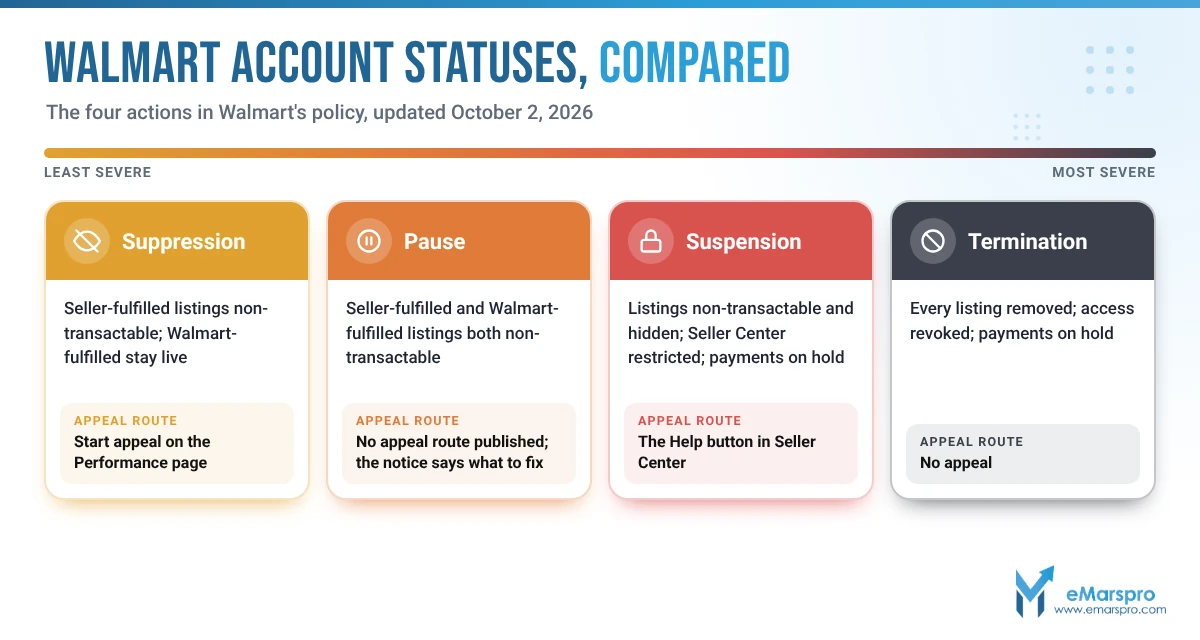
Walmart’s suppression, pause, suspension and termination policy, updated October 2, 2026, names four actions.
| Status | What happens to listings | What else happens |
|---|---|---|
| Suppression | Seller-fulfilled listings become non-transactable; Walmart-fulfilled listings stay on Walmart.com | Appeal route: Start appeal on the Performance page |
| Pause | Seller-fulfilled and Walmart-fulfilled listings both become non-transactable | No appeal route published for a pause; the notice says what to fix |
| Suspension | Listings non-transactable and non-discoverable | Seller Center access restricted; payments on hold; appeal route: the Help button |
| Termination | Every listing removed | Selling privileges and Seller Center access permanently revoked; payments on hold; no appeal |
Two lines decide the urgency. Walmart’s standards page says it notifies by email and in Seller Center and that a seller cannot unsubscribe from those notices. The statuses policy says Walmart may terminate an account suspended beyond a reasonable threshold; it does not define the threshold.
Our Walmart account management team treats a suspension as a dated problem for that reason: file the appeal within days, not weeks, because the clock Walmart does not publish is running.
The eight performance standards, with the thresholds
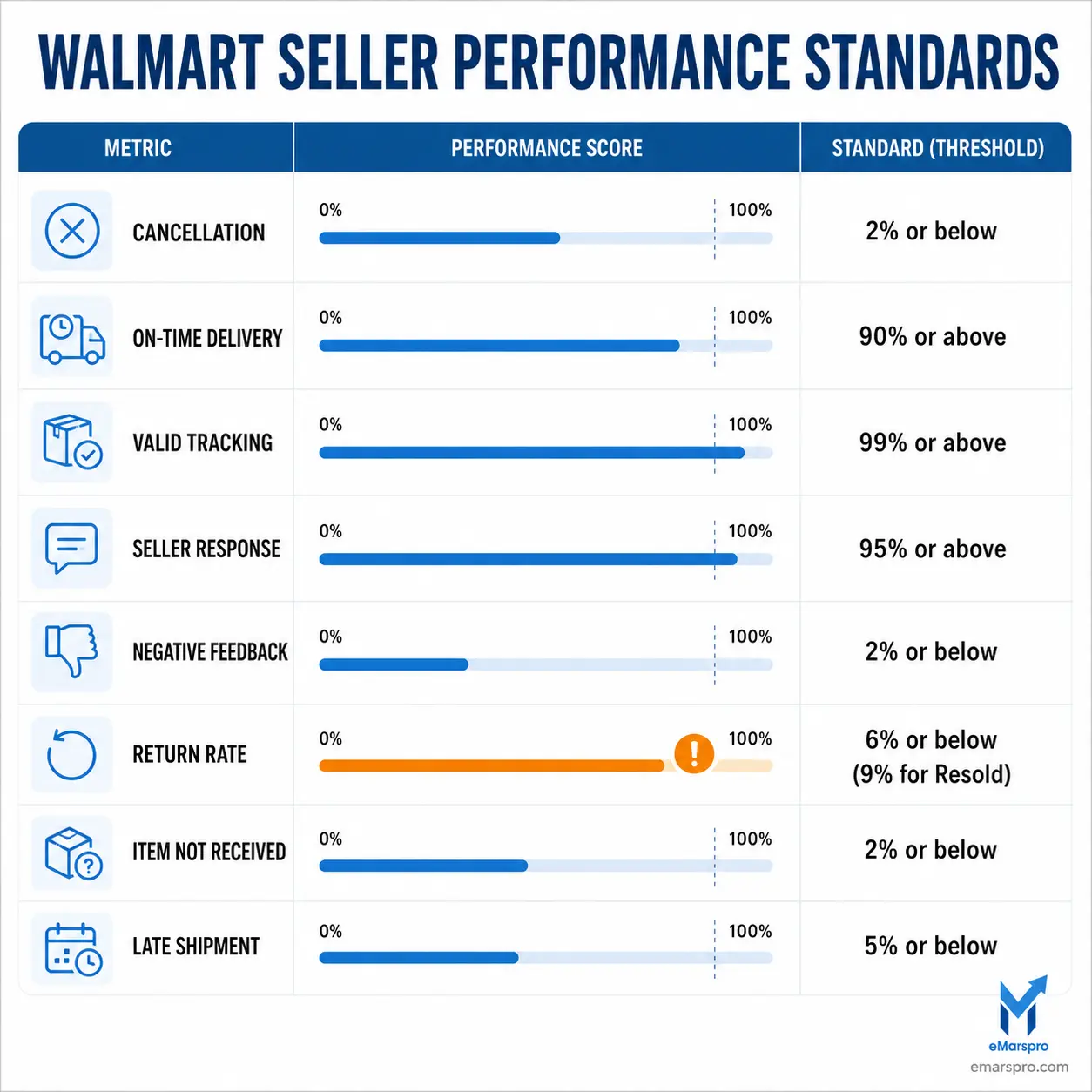
Walmart’s seller performance standards page, updated July 28, 2026, lists eight metrics and says they are evaluated over the last 30 or 60 days. Failing any of them, in Walmart’s words, may result in suppression, suspension or termination.
| Standard | Threshold | What it measures |
|---|---|---|
| Cancellation rate | 2 percent or below | Orders you cancel after receiving them |
| On-time delivery rate | 90 percent or above | Delivered on or before the expected delivery date |
| Valid tracking rate | 99 percent or above | Orders with valid tracking |
| Seller response rate | 95 percent or above | Customer inquiries answered within 48 hours |
| Negative feedback rate | 2 percent or below | Orders in the past 60 days with a 1- or 2-star rating |
| Return rate | 6 percent or below; 9 percent for Resold inventory | Orders delivered in the past 60 days that were returned |
| Item not received rate | 2 percent or below | Orders with an expected delivery in the past 60 days not delivered |
| Late shipment rate | 5 percent or below | Shipped after the expected ship date |
Walmart excludes what is not the seller’s fault: customer-requested cancellations, weather delays, carrier exceptions and customer fraud. For sellers on Walmart Fulfillment Services, Walmart says most of the metrics are met by WFS, with negative feedback the exception.
The Performance dashboard in Seller Center shows every metric; how to avoid a Walmart account suspension turns reading it into a weekly routine.
The causes behind most suspensions
The notice names one of two things: a standard you failed, or a policy you broke under the Marketplace Retailer Agreement. The performance side is the table above, and the metrics that drift first on the accounts we see are late shipment and on-time delivery in November, cancellations after a stockout, and response rate when one person handles messages.
The policy side, as the notices name it: counterfeit or unauthorized products, intellectual property complaints, listings that misdescribe the item, prohibited or restricted products, pricing that violates the policies, and unresolved trust and safety flags. These arrive as a case to answer, and an unanswered case becomes a suspension.
Two operating causes feed the standards table from outside the dashboard: stock and ads. A seller who runs out of stock after a sale cancels, and the cancellation rate does it; the Walmart inventory management system post covers the stock side.
A seller who buys traffic for a listing that cannot ship on time fails on-time delivery at volume; Walmart advertising strategies covers pacing ads to fulfillment.
How to appeal, as Walmart describes it
Walmart’s appeal guide, updated December 9, 2025, gives three steps.
- Step 1: Review your metrics on the Performance page. The notice cites the reason; the page shows the number behind it.
- Step 2: Write a business plan of action. Walmart asks for a description of the violation and the corrective steps; if the Marketplace Retailer Agreement was violated, also the steps that prevent a recurrence. Walmart may ask for current warehouse images, distributor or supplier invoices less than two months old, and intellectual property documents.
- Step 3: Submit it. For a suppression, a warning banner on the Performance page carries a Start appeal button. For a suspension, select the Help button in the Seller Center menu bar and follow the steps to submit the plan.
What Walmart says about what happens next: appeals are handled in the order received, and submitting one does not assure reinstatement. It publishes no response time.
The plan Walmart asks for is one page of facts: what the notice cited, the number or the case, what caused it, what changed and the date it changed, and the control that stops it recurring. An apology is not a corrective step, and a promise is not evidence; the invoice, the warehouse photo and the new handling-time setting are.
While the account is suspended
- Payments are on hold, in Walmart’s words, for a suspension and a termination. Plan cash for the length of the appeal.
- Keep fulfilling any open orders: on-time delivery and tracking are still measured, and the appeal is read against them.
- Answer every follow-up the day it arrives, with the document it asks for.
- Do not open a second account. Setting up a Walmart seller account covers what Walmart verifies at onboarding, and a related account during a suspension is a termination risk.
Preventing the next one
The standards are published, the windows are 30 and 60 days, and the dashboard updates. A weekly read of the eight numbers against their thresholds, with an owner for any metric inside a quarter of its limit (on-time delivery under 92.5 percent against the 90 percent line, say), catches the drift before the notice.
Walmart’s Pro Seller program rewards three of the same metrics at tighter levels (on-time delivery at 95 percent, cancellations at 1.5 percent for the Pro tier), so the routine that prevents a suspension is the one that earns the badge.
Where AI helps with a Walmart suspension, and what a person decides
On the accounts we run, ChatGPT or Claude read the Performance dashboard export and draft the exceptions: the metric closest to its threshold, the orders behind it, the handling-time or stock change that would move it. When a notice arrives, they draft the plan of action from the notice and the order data, in Walmart’s structure.
A person decides what goes to Walmart: that the invoices are real and dated, that the corrective step has been made before it is claimed, and that nothing in the plan promises what the operation cannot keep. Walmart reads the plan against the account; so should you. AI reads, people decide.
Frequently Asked Questions
Read the notice for the reason and the status it names, then open the Performance page and find the metric or policy behind it. Walmart’s appeal guide asks for a plan of action describing the violation and the corrective steps, with warehouse images, supplier invoices under two months old or IP documents where they apply. Fix the cause first.
No. Walmart’s appeal guide says a termination cannot be appealed and that Walmart is not required to give a reason. A suspension can be appealed; so can a suppression. The difference is why the first response to a suspension matters: Walmart says it may terminate an account suspended beyond a reasonable threshold.
Walmart’s policy names four. Suppression makes your seller-fulfilled listings non-transactable while Walmart-fulfilled ones stay up. Pause makes both non-transactable. Suspension makes listings non-transactable and non-discoverable, restricts Seller Center access and puts payments on hold. Termination removes every listing and revokes selling privileges and access permanently, with payments on hold.
Walmart does not publish a time. Its appeal guide says appeals are handled in the order received and that submitting one does not assure reinstatement. Keep the open orders shipping while you wait, and answer any follow-up the same day with the document it asks for.
Any of the eight on Walmart’s standards page, read over 30 or 60 days: cancellation 2 percent or below, on-time delivery 90 percent or above, valid tracking 99 percent or above, response 95 percent or above, negative feedback 2 percent or below, returns 6 percent or below, item not received 2 percent or below, late shipment 5 percent or below.
Read the status, fix the cause, write the facts
Four statuses, with a published appeal route for a suppression and a suspension; eight standards with published thresholds; one plan of action with documents, submitted through Start appeal or the Help button, every follow-up answered the same day.
If you would rather have the appeal written and the account read after it, our Walmart account team starts with a free audit, findings inside 48 hours.
Get Your Walmart Account Back on Track
Our Walmart account team reads the Performance page, finds the cause and prepares the appeal with you, starting with a free account audit, findings within 48 hours.