
Stranded inventory on Amazon is stock in an FBA fulfillment center with no active offer, so it is in the building, billable, and not for sale. Amazon attaches a reason to every stranded unit, and that reason, not the unit, decides the fix: an edit you make yourself, an approval case, or a removal order.
This post sorts stranded from the two problems it is confused with, shows where the list lives in Seller Central, maps each reason to its lane, prices the cost of leaving it, and gives the four habits that stop it recurring, with Amazon’s own pages checked for this update.
Stranded, unfulfillable or aged: three different problems
| Term | What it means | Where it shows | The fix |
|---|---|---|---|
| Stranded | Units in a fulfillment center with no active offer | Fix Stranded Inventory (FBA Inventory) | Reactivate the listing or remove the units |
| Unfulfillable | Units Amazon cannot ship: damaged, defective, expired, or returned in unsellable condition | The unfulfillable count in FBA Inventory | Remove or dispose; claim a reimbursement where the damage was Amazon’s |
| Aged | Sellable units that have sat too long, counted first in, first out across the network | Inventory age filter in the FBA Inventory tool | Sell through, discount or remove before the age-based charges |
A unit that is buyable on an active listing is not stranded, however slowly it sells; that is an aged-inventory problem with a different cost. A unit Amazon has marked unfulfillable cannot be reactivated by any listing edit. Fix the right problem first.
Where to find it in Seller Central
Amazon’s FBA Inventory tool page describes stranded inventory as a product in FBA fulfillment centers that does not have an active offer, says the tool monitors your stranded inventory percentage, and points sellers at the Fix Stranded Inventory tool to add or amend the listing. Open Inventory, then FBA Inventory, then the stranded filter.
Two rules make this fast. First, work from the reason column, not the product name: Amazon changes the labels, but each reason still routes to one of the three lanes below. Second, every stranded unit has exactly two endings, reactivation or removal; a unit you cannot reactivate this week is a unit to remove, not to revisit.
The weekly stranded pass is one of the first routines our Amazon FBA management team sets up on a wholesale account, because wholesale catalogs strand units in batches: one bulk file error, forty stranded ASINs.
Why inventory gets stranded: read the reason, then route it
| Reason Amazon shows | What usually happened | Lane | Effort |
|---|---|---|---|
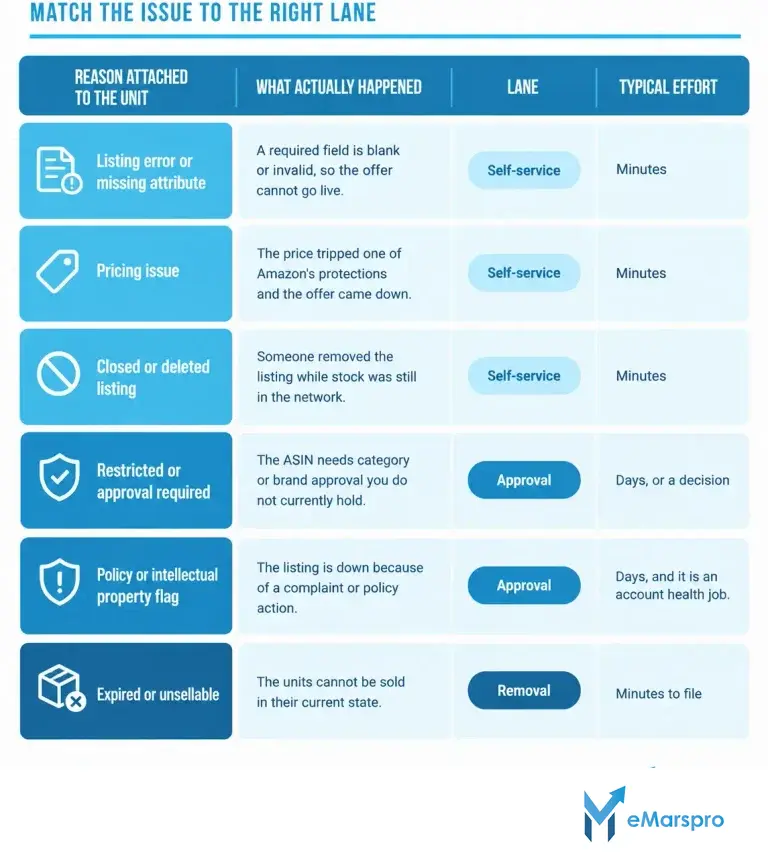
| Listing error or missing attribute | A required field is blank or invalid, often after a bulk upload or a category change | Self-service | Minutes per ASIN |
| Pricing | The price sits outside Amazon’s expected range or a price alert fired | Self-service | Minutes |
| Closed or deleted listing | Someone closed the offer or deleted the SKU while FBA units remained | Self-service (relist) or removal | Minutes, if the SKU can be recreated |
| Approval or brand gate | The ASIN now needs an approval you do not hold, or a brand restriction landed | Approval case | Days; needs documents |
| Policy or compliance flag | A safety, restricted-product or document requirement is unmet | Approval case | Days to weeks |
| Expired | A listing with an expiration date lapsed | Self-service or removal | Minutes |
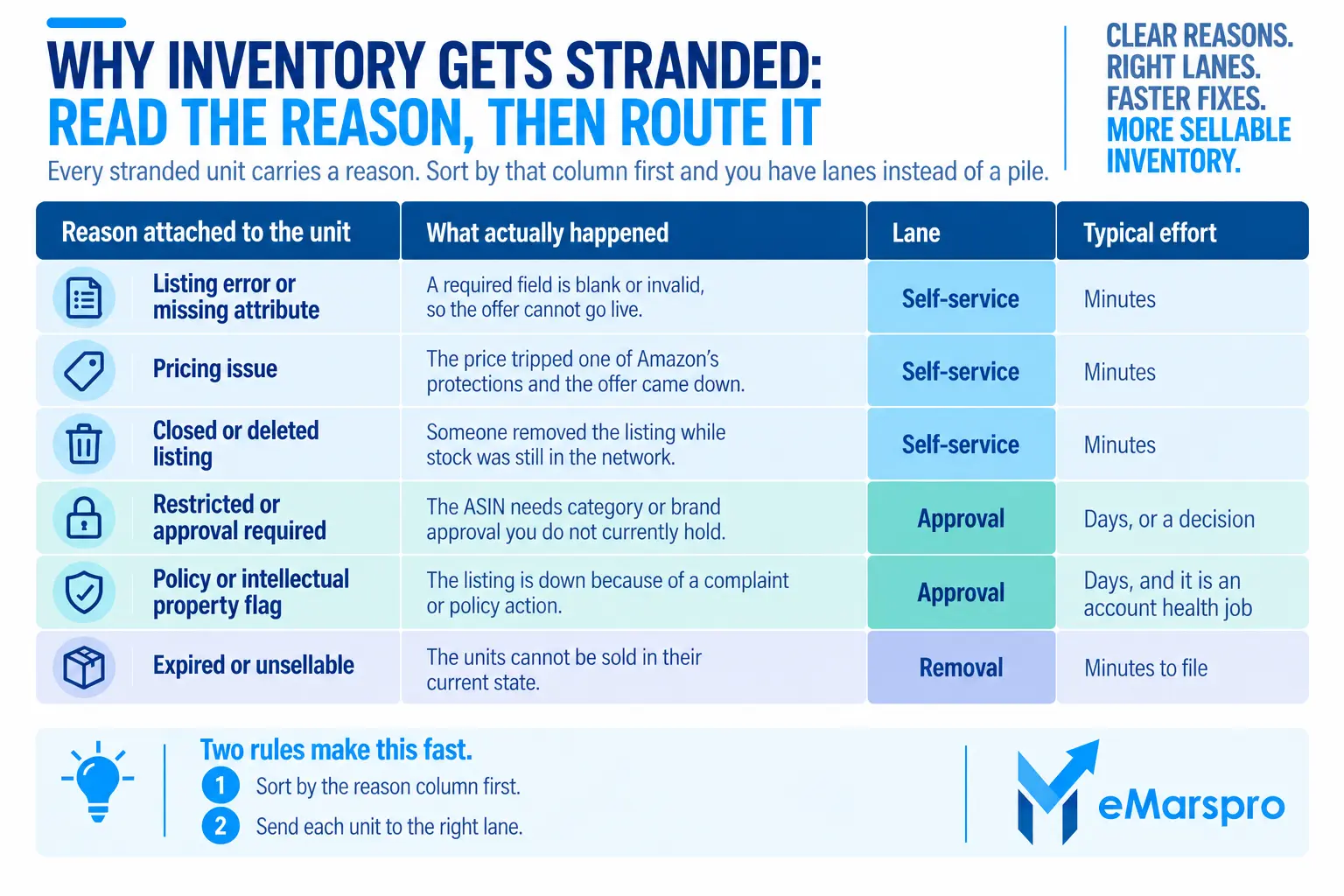
Clear the self-service lane first, in one sitting; it is most of the list. Then open the approval cases, one per root cause rather than one per ASIN. Do not let a single blocked ASIN eat the session: route it to removal if the case is not worth the documents.
Fixing each lane
1. Self-service. Open the stranded unit, read the reason, and edit the listing: the missing attribute, the price, the expiration. Relist a closed SKU under the same SKU where Amazon allows it, so the units reattach. Confirm the offer shows active before moving on.
2. Approval cases. Gather the documents the reason asks for before opening the case, and open one case per root cause. A stranded unit behind a policy flag is an account health matter as much as an inventory one: our plan of action post covers how to write the case so it is accepted first time.
3. Removal. Where the listing cannot or should not come back, create a removal order: return to you, dispose, or liquidate where Amazon offers it. Amazon also offers automated actions for stranded units; the options and timing in your console are the ones that apply, so read them there before you rely on them.
What it costs while you leave it
1. Storage fees. Amazon says you incur storage costs for all items you store with FBA; a stranded unit is stored. The long-term charges follow age, so a stranded unit gets more expensive every month it sits. Our hidden FBA fees post has the full list of charges that keep billing.
2. Lost sales. The unit is in the building and the buyer is on the page; the only thing missing is the offer.
3. Capacity. Amazon’s capacity management announcement states that the current system took effect March 1, 2023, replaced weekly restock limits with a single monthly capacity limit announced in the Capacity Monitor, and that the limits are influenced by your Inventory Performance Index. Stranded units occupy capacity without selling and weigh on the index that influences next month’s limit.
4. Capital. Stock you have paid for, sitting in someone else’s building, earning a fee instead of a margin.
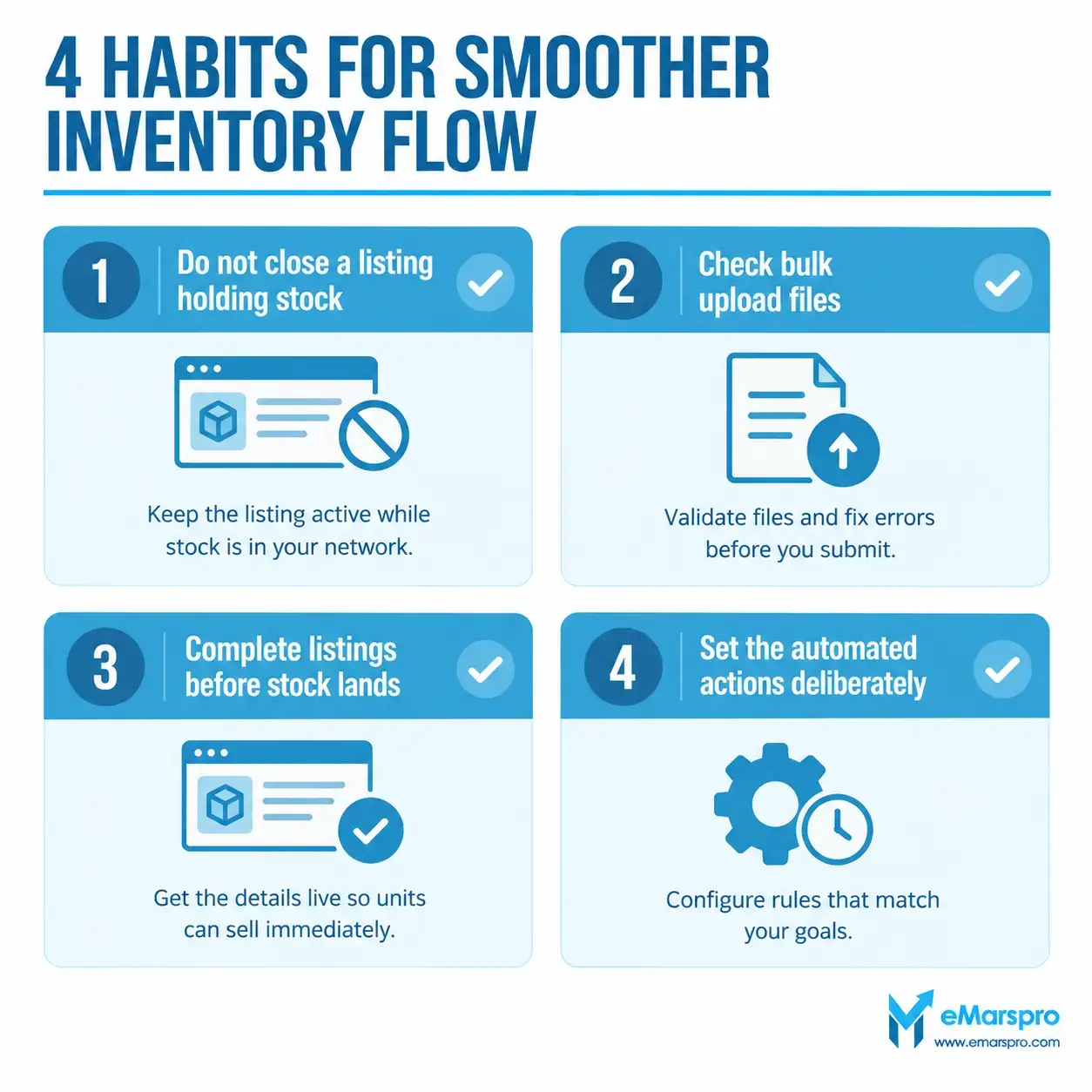
Four habits that stop units stranding again
1. Never close or delete a listing that still has FBA units behind it. Set the quantity to zero or let it sell through; a closed offer with stock strands the stock.
2. Treat bulk files as the main cause. Validate an inventory file on a handful of SKUs before the full upload, and keep the last good file so a bad one can be reversed.
3. Complete the listing before the stock lands. A shipment that arrives against an incomplete listing is stranded on day one. Our shipping to Amazon FBA guide puts the listing check before the shipment plan for that reason.
4. Set the automated actions deliberately. Open the settings, choose them, and review them quarterly, so an automated removal never surprises you in the week you fixed the listing. Inventory tools can watch the stranded count for you; our inventory management software post covers which ones do.
A weekly ten-minute pass through the stranded list keeps this a chore. Skipping it for a quarter turns it into a project.
How AI helps with stranded inventory
Amazon’s Seller Assistant in recommend mode, monitors the account continuously and surfaces what needs attention; Amazon names restocking and pricing adjustments among the routine tasks its workflows can run inside guardrails you set. Amazon’s pages do not say it fixes stranded listings, so treat the stranded list as yours and the assistant as the alarm.
For a listing error, ChatGPT or Claude can draft the missing attributes from the product facts you give it; a person checks every value against the product before the listing is saved. What stays with a person: the removal decision, the approval case, and any price change.
Frequently Asked Questions
In Amazon’s own words, stranded inventory is a product in FBA fulfillment centers that does not have an active offer. The units are physically there and billable, but no customer can buy them. Each stranded unit ends one of two ways: the listing is reactivated, or the units are removed.
Because the offer went inactive while the stock stayed: a listing error or missing attribute, a price outside Amazon’s expected range, a closed or deleted listing, an approval or brand gate you no longer hold, a policy flag, or an expired listing. Sort the Fix Stranded Inventory page by the reason column; the reason tells you which fix lane applies.
Yes. Amazon says you incur storage costs for all items you store with FBA, and a stranded unit is stored. Long-term storage charges and the aged-inventory surcharge follow the unit’s age, not its listing status, so the cost of leaving a stranded unit alone rises every month. The current rates are in the Seller Central fee schedule.
When to stop doing this yourself
A stranded list that refills every week is not an inventory problem; it is an upstream process problem in the catalog, the bulk files or the inbound plan, and it will keep refilling until someone owns that process.
If you would rather have a team run the weekly pass and fix the process behind it that is inside the FBA management work we do for wholesale sellers.