AI in Amazon PPC fails in a predictable pattern: it reads performance data perfectly and misses everything the data does not contain. Inventory, listing health, competition, and what a sale earns after fees all live outside the campaign reports.
Below are the failure modes we see on real accounts, anonymized, including one where the machine caught a collapse early and still could not explain it.
The Signal That Looked Simple
On a Canadian natural-health account we manage, a menopause-support supplement had been one of the efficient performers: ACoS in the healthy twenties. The daily machine read flagged it the moment its trend turned, weeks before a monthly review would have noticed anything.
By the time the deterioration ran its course, ACoS had gone from 29.7% to 73.21%. The machine had done its job: early flag, correct lane, spend pulled back ahead of the worst of it. What it could not do was answer the only question that mattered: why.
The why lived outside the data the AI reads. Conversion had weakened on the listing while competition pressed the category, and no bid change fixes either. Cutting spend was necessary and not sufficient. The decisions that actually mattered, on the listing, on pricing posture, on where the product fits the catalog now, came from people asking questions no model asked.
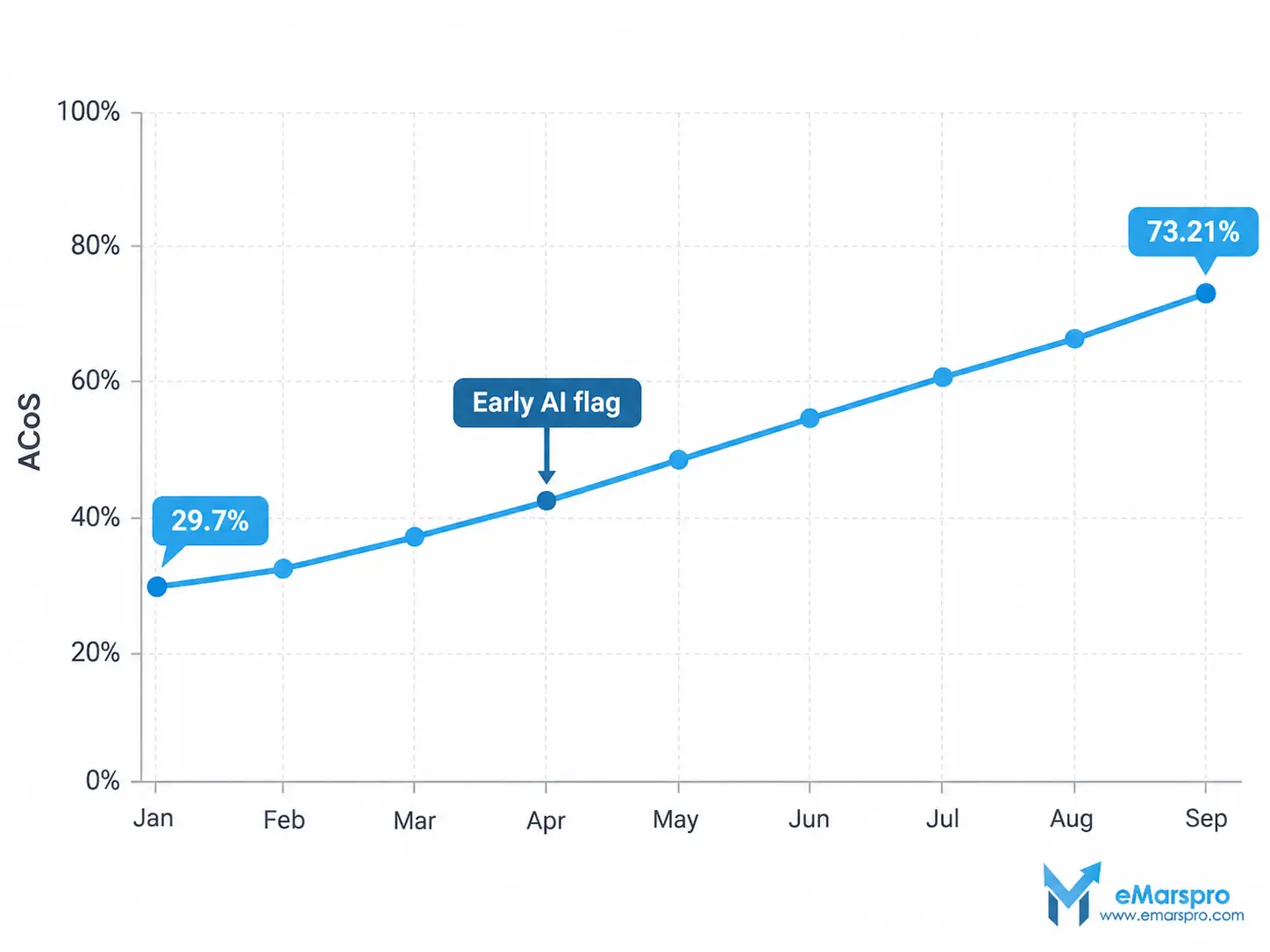
Worth stating plainly: the machine performed. The early flag alone was worth weeks of budget, and the staged spend reduction it recommended was the right first move. On a monthly review cadence, this product would have burned at full budget the whole way down.
That is the honest shape of AI in PPC today. It sees sooner than any human team. It still cannot see around corners the data never turns.
Four Things AI Cannot See in Amazon PPC
Every one of these has burned an account somewhere. None of them appears in a campaign report:
- Inventory. Scaling a winner into a stockout buys clicks for a listing about to go dark.
- Listing health. A suppression or a lost Buy Box reads to the machine as sudden ad failure, and the machine responds with bid logic.
- Competitive context. Sometimes the right move in a price war is not to win it. Models do not sit battles out.
- Unit economics after fees. A sale the dashboard celebrates can lose money after COGS, fees and returns. The ad metrics never know.
The Four Questions That Catch It
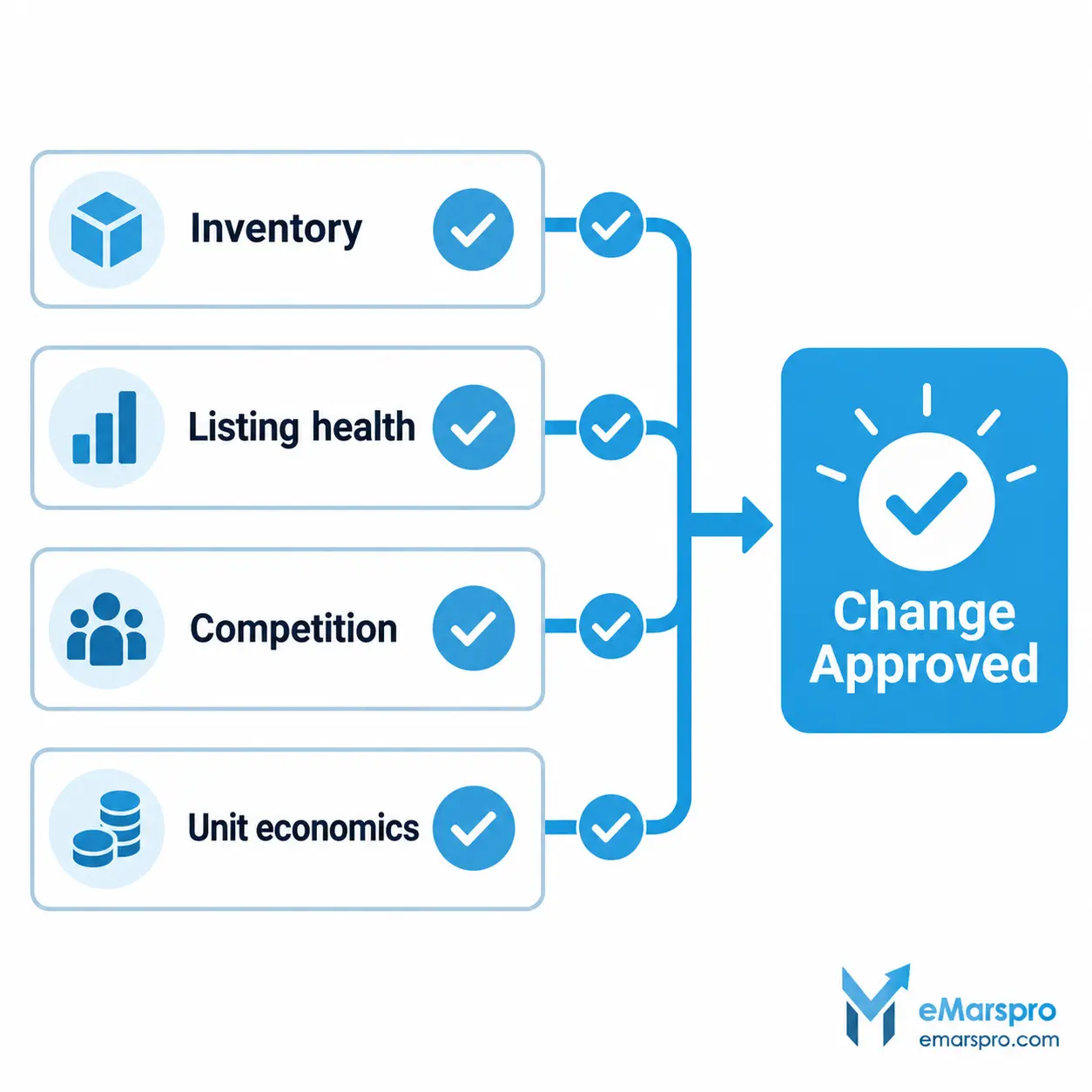
Before any machine recommendation becomes a change on our accounts, a person answers four questions:
- Can inventory support this move?
- Is the listing healthy enough to deserve more traffic?
- Is the competitive picture what the data implies?
- Do the unit economics survive the move?
Four questions, usually four minutes. They are cheap insurance against the expensive failure mode, which is executing a confident recommendation in a situation the model does not understand.
How Automation Failure Shows Up in Your Reports
You rarely catch this failure mode in the moment. You catch its fingerprints in the account:
- ACoS moves nobody on the team can explain in one sentence.
- Bids ratcheting down account-wide while sales drift the same direction.
- Winners that never scale because no rule was ever written for opportunity, only for waste.
- Hundreds of machine changes in the history log, and no note anywhere saying why.
Any two of those together mean the account is being executed, not managed. The fix is not better automation. It is putting judgment back between the recommendations and the money.
Rules Fail Differently Than AI Does
Rules-based automation fails loudly and mechanically: if ACoS breaches a threshold, cut the bid, even when the real cause is a suppressed listing or a seasonal dip that will pass. The rule knows one metric and acts on it forever.
AI-assisted reading fails more quietly. It finds true patterns and ranks real opportunities, and it presents them with equal confidence whether or not the world outside the data agrees. The failure is not wrong arithmetic. It is missing context, delivered convincingly.
Both failure modes have the same antidote: a person who knows the account, positioned between the recommendation and the money.
How to Use AI in Amazon PPC Anyway
None of this is an argument against AI. The same account produced wins no weekly routine would have found: underfunded products surfaced from under healthy averages, seasonal declines cut ahead of the curve. The machine reads everything, every day. That part is not in dispute.
The working model is a loop: AI reads at SKU level daily, findings land in lanes, and a person clears the changes after the four questions. We wrote up the full system, lanes and all, in our AI-powered PPC optimization breakdown.
If you are choosing tools or agencies, one test cuts through the marketing: ask who reverses the machine, how often, and on what grounds. An honest answer has names and examples. No answer means autopilot.
Frequently Asked Questions
It can execute on its own; it cannot be accountable on its own. The four blind spots above, inventory, listing health, competition and unit economics, sit outside every campaign report. Accounts run on pure automation execute confidently right up until one of them bites.
Usually the automation is responding correctly to a problem it cannot name: conversion fell, a listing lost the Buy Box, or competition moved. Check the listing and the search terms before blaming the tool, and before letting the tool cut its way out.
It reads campaign, search term, placement and sales data well. It does not read inventory positions, listing suppressions, competitor strategy, or your margins after fees. Everything it misses lives outside the ad console, which is exactly where account decisions get made.
Pull ninety days of change history and sample twenty changes. For each one, ask what problem it solved and whether a person would have made it knowing the inventory, listing and margin picture. If most changes have no answer, the account is running on confidence, not judgment. A structured audit does this at full scale.
Should I Stop Using AI for Amazon Ads?
No. Use it for what it does better than any team, reading everything daily, and pair it with a person for what it cannot do at all. The sellers losing money on AI are not using too much of it. They are using it unsupervised.
If your account runs on automation nobody questions, that is worth a look before Q4 raises the stakes. Our Amazon PPC management team runs the loop this post describes, and it starts with a free audit.
We review your listings, PPC and account health, and send findings within 48 hours