
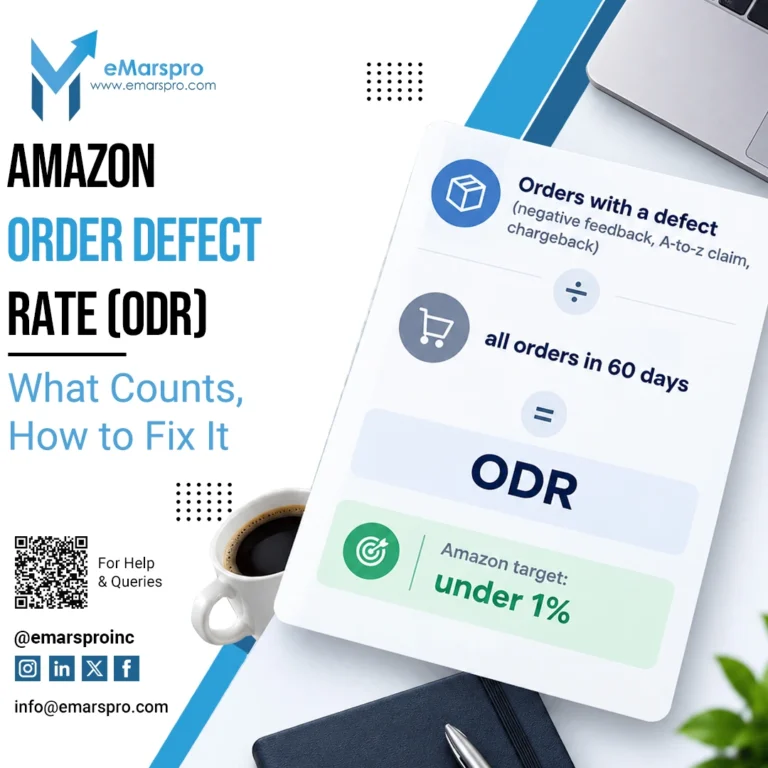
Amazon Order Defect Rate (ODR) is the share of your orders in a 60-day window that ended with negative feedback, an A-to-z Guarantee claim or a credit card chargeback. Amazon’s ODR policy asks sellers to keep it under 1% and says an ODR above 1% may result in account deactivation.
This post is the policy in plain words: what counts, what does not, what happens at 1%, and the order in which to fix it. The policy rules (what counts, the 60-day window, the 1% line) are from Amazon’s policy document, checked on 9 October 2026; where we add our own experience, we say so.
How does the Amazon ODR work?
Amazon takes every order placed in a 60-day period, counts the ones with at least one defect, and divides by the total. Three orders with a defect out of 100 is an ODR of 3%: three times the target.
The date that matters is the order date. Feedback that arrives today about an order placed 61 days ago does not count, because that order is outside the window; feedback about an order placed 50 days ago does. Amazon counts chargebacks the same way.
| Component | What counts | What does not count |
|---|---|---|
| Negative feedback | One- and two-star ratings, counted against the order they were left on | Feedback the buyer withdraws; it can take up to 48 hours to disappear from the metric |
| A-to-z Guarantee claims | Claims granted and debited from your account; claims you refunded after the claim was filed; claims pending a decision; claims on orders you or Amazon canceled | Claims granted and paid for by Amazon; claims denied; claims withdrawn by the buyer; claims you win on appeal |
| Credit card chargebacks | Service chargebacks: the buyer acknowledges the purchase but tells the card issuer there was a problem. The issuer decides, not Amazon | Fraudulent transaction chargebacks |
One correction to a common belief, and to an earlier version of this post: chargebacks are not refunds. A refund on its own is none of the three defects, so a refund issued before any claim is filed does not count. A refund issued after the buyer files an A-to-z claim still counts, because the claim does.
What happens if your ODR reaches 1%?
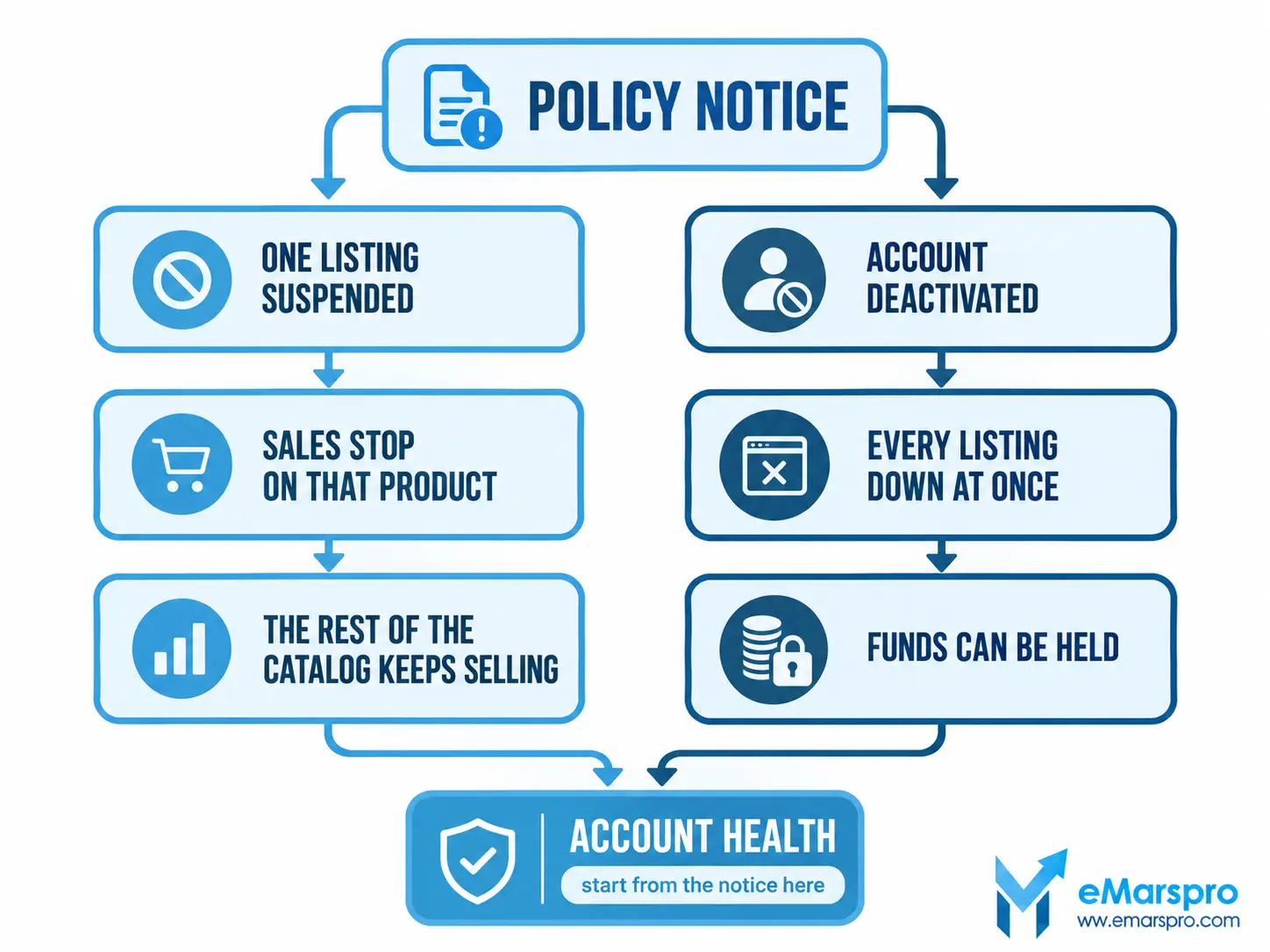
Amazon’s policy says an ODR above 1% “may result in account deactivation”, and the target is under 1%, so 1% itself is already outside it. The policy promises no grace period and names no second threshold, so the figures you will see quoted elsewhere, such as automatic termination at 3%, are not in the policy.
In our experience the first thing you see is a warning on the Account Health page about the risk of deactivation. Treat it as the start of the plan below: the warning does not lift until the window has rolled past the defects, which can take up to 60 days, so the fix starts the day it appears.
If the warning becomes a deactivation, the appeal is an Amazon plan of action submitted in Account Health: root cause, corrective actions, preventive measures. Our Amazon suspension appeal team handles those cases.
If Amazon blocks a single listing over the complaints behind the defects, that is a listing case rather than an account case, and the appeal path is different: see Amazon listing reinstatement .
ODR is one of the account health thresholds Amazon enforces; the metrics post covers the others and their targets.
How can you improve your Order Defect Rate?
The rate is a count divided by a count, so every fix is a defect removed or prevented. Work the defects in this order.
First, sort the defects by cause
Open the Account Health page and list every defect in the window with its component and its reason. Late delivery, item not as described, damaged in transit and “never arrived” each point at a different process, and the fix for one does nothing for another.
• Negative feedback: reply to the buyer and fix the problem first; a buyer who is made whole sometimes withdraws the rating. In our experience, feedback that breaks Amazon’s feedback rules can be reported from Feedback Manager, and feedback Amazon strikes through stops counting. Do not ask buyers to change ratings in exchange for anything.
• A-to-z claims: answer buyer messages inside the window Amazon gives, and refund or replace before the buyer escalates, because a refund after the claim is filed still counts. Appeal claims you can document, because a claim you win on appeal leaves the metric.
• Chargebacks: match the order, the delivery scan and the buyer’s messages before you respond to the chargeback notice. Service chargebacks usually trace back to the same two causes as the claims: a late delivery or a product that did not match the listing.
Second, fix the delivery promise
Late delivery feeds all three components. Set handling time to what the warehouse keeps on its busiest day, confirm shipments with valid tracking, and stop offering a delivery speed you cannot keep on a Friday. If delivery is the recurring cause, move the affected SKUs to FBA for the season; it changes who carries the delivery risk.
Third, watch the window on low volume
One defect on 80 orders is 1.25%, already over the target, while the same defect on 800 orders is 0.125%. A new or seasonal seller is one bad order away from the line, so on low volume every defect gets a root cause and a fix, not a note.
How AI helps you keep ODR under 1%
• Seller Assistant, Amazon’s AI agent inside Seller Central, runs workflows that monitor account health continuously and surface recommendations with the reasoning behind them . Its own example is an alert when a top product drops below a 4-star rating: an early signal of the problems that later arrive as negative feedback. Actions wait for your approval.
• For our own work we use Helium 10 and Jungle Scout to read review patterns across a catalog, and ChatGPT for first drafts of buyer replies that a person edits before sending.
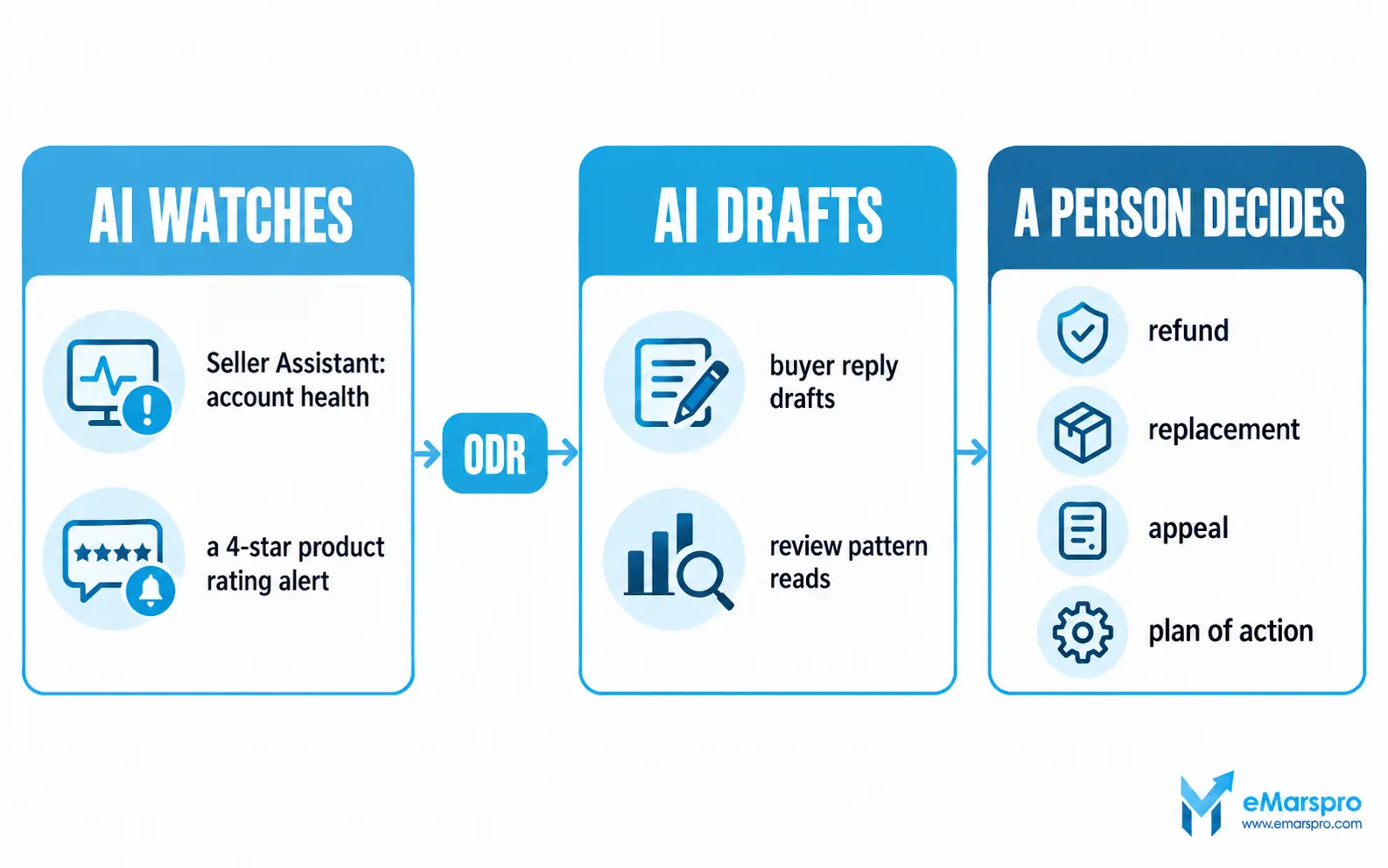
What a person decides: every refund, replacement, appeal and plan of action. The metric moves on those decisions.
Frequently Asked Questions
Three things, each tied to an order: negative feedback (one- and two-star ratings); A-to-z Guarantee claims granted and debited from your account, pending, refunded after the claim was filed, or on an order you or Amazon canceled; and service chargebacks, where the buyer acknowledges the purchase but reports a problem. All over a 60-day window.
In our experience the Account Health page reports ODR across FBA and seller-fulfilled orders alike. What changes with FBA is who handles delivery and most of the customer service, so the delivery-driven defects usually fall, and Amazon strikes through feedback that is about its own FBA fulfillment when you request it, which stops it counting.
As long as its order date sits inside the rolling 60-day window. A defect on an order placed 61 days ago drops out, even if the feedback arrived last week, because Amazon counts by order date, not by the date the feedback came in.
Yes, in the case Amazon’s policy describes: if the buyer withdraws it, it stops counting, which can take up to 48 hours. In our experience, feedback that breaks Amazon’s feedback rules can be reported from Feedback Manager, and feedback Amazon strikes through stops counting. Claims are separate: one you win on appeal is removed from ODR.
Count the defects, not the days
ODR looks like a number but behaves like a list. Each defect has an order, a cause and a fix, and the rate takes care of itself when the list is worked in order. If your Account Health Rating has already moved, start there; it tells you how close the account is to deactivation.



