
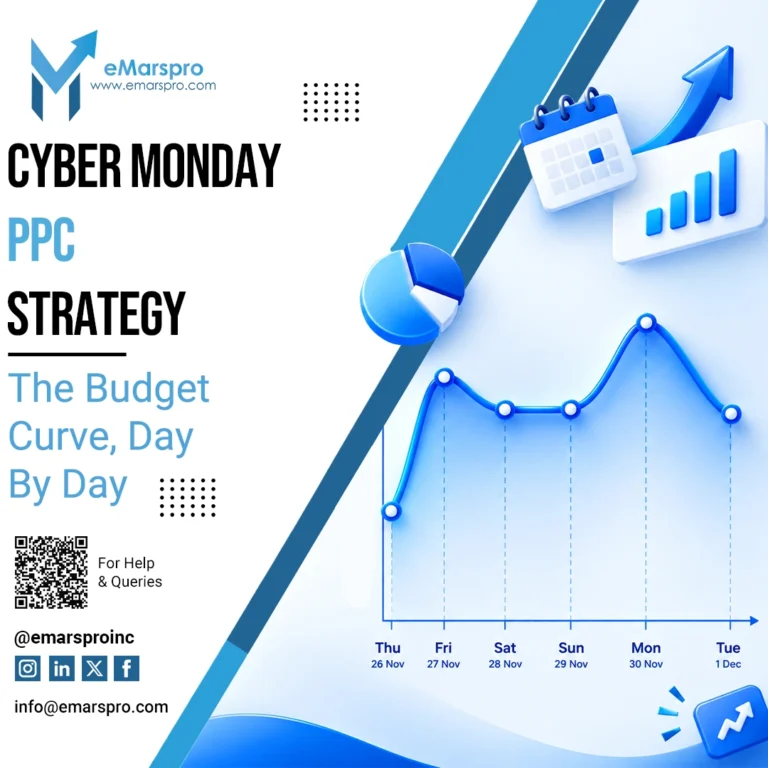
A Cyber Monday PPC strategy is a five-day budget curve, Thanksgiving to Cyber Monday, with a second peak on the Monday and a controlled ramp down into December. Most accounts plan the Friday and let the Monday run on whatever is left. This guide gives the curve by day, the bid steps, the dayparting call and the ramp down.
The dates and Amazon’s rules come from Amazon’s holiday notice on Seller Forums and Amazon Ads’ guide to budget rules , checked for this update. The budget total comes from our Q4 PPC budget planning post; this post spends it.
Why Cyber Monday is its own PPC day
On the accounts we run, Black Friday builds from Thursday evening, peaks on Friday and fades through the weekend. Cyber Monday starts again: a separate peak, later in the day, with shoppers who waited for it.
Treating the five days as one weekend produces the common failure: budgets spent by Sunday, campaigns out of budget on the Monday afternoon, and a Tuesday nobody planned for.
In 2026 the days are Thursday, November 26 (Thanksgiving), Friday, November 27 (Black Friday), the weekend, Monday, November 30 (Cyber Monday) and Tuesday, December 1. Amazon’s peak fulfillment fees run through the whole window, from October 15 to January 14, so every click is paid for at the higher cost.
Start from the Prime Big Deal Days report
The best input to Cyber Monday is the event you just ran. Pull the search term report for Prime Big Deal Days and mark three things: the terms that converted, the ASINs that converted, and the hours the orders landed.
Our Prime Big Deal Days PPC strategy post covers the curve for that event; its report is the draft of this one.
On the accounts our Amazon PPC management team runs, the converting terms from that report move into exact-match campaigns in the week after the event, so Cyber Monday runs on terms with history behind them rather than on discovery.
The curve, Thursday to Tuesday
| Day | Budget | Bids | What to watch |
|---|---|---|---|
| Week before Thanksgiving | First step up, on the exact-match campaigns only | Unchanged | Campaigns that hit their cap before 6 pm: raise the next step earlier |
| Thursday, November 26 | Second step; the evening is the start of the event | Up on the deal ASINs’ exact terms | Out-of-budget flags after 8 pm |
| Friday, November 27 | Full event budget | Hold; raise only on terms converting at the deal price | Deal badge live on every deal ASIN |
| Saturday and Sunday | Hold, do not cut | Hold | Stock on the deal ASINs: a child running out on Sunday changes Monday’s plan |
| Monday, November 30 | Full event budget again, loaded Sunday night | Evening bids up where the hourly data says so | Out-of-budget by hour; top up before the evening peak |
| Tuesday, December 1 | Hold | Back to pre-event bids | Conversions still landing from Monday clicks |
Two rules make the table work. Budgets step up, never jump: a campaign that doubles overnight spends the first morning learning. And the Monday budget is loaded on Sunday night, not Monday morning, because a campaign that starts the day out of budget starts the day out of the auction.
Dayparting on Cyber Monday
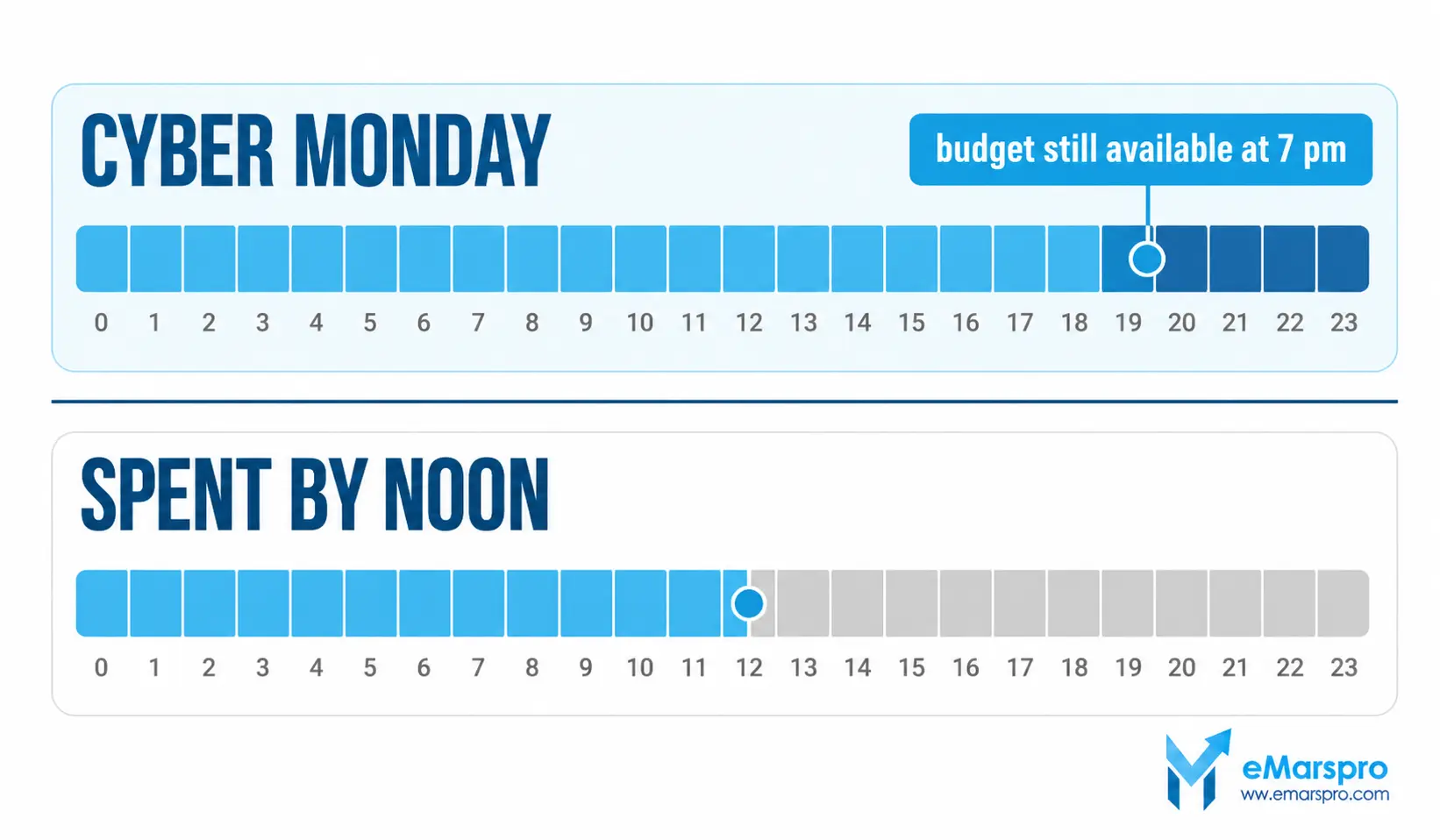
Cyber Monday is the one day in the year where the hour matters more than the day. On most categories we run, the orders cluster in the evening; a daily budget spent by noon buys the quiet hours and misses the peak. The fix is not a bigger budget. It is a budget that is still there at 7 pm.
• Take the hourly order pattern from Prime Big Deal Days and from last year’s Cyber Monday if the account has it.
• Set the bid steps for the peak hours only, and cap the morning.
• Do it with a rule, not by hand: a person cannot sit on the console for 24 hours, and does not need to.
Campaign structure for deal ASINs
• One exact-match campaign per deal ASIN, so the budget and the bid for the badge traffic are separate from everything else.
• Own-ASIN targeting on the deal ASINs, so a competitor does not buy the placement under your badge.
• The coupon and the deal decided together: a coupon on top of a deal price is a second discount, and the ad is paying to show it. Our Amazon coupons vs Lightning Deals post has the margin math.
• The listing checked before the budget is raised; the phases in our Amazon Black Friday strategy post run before this one.
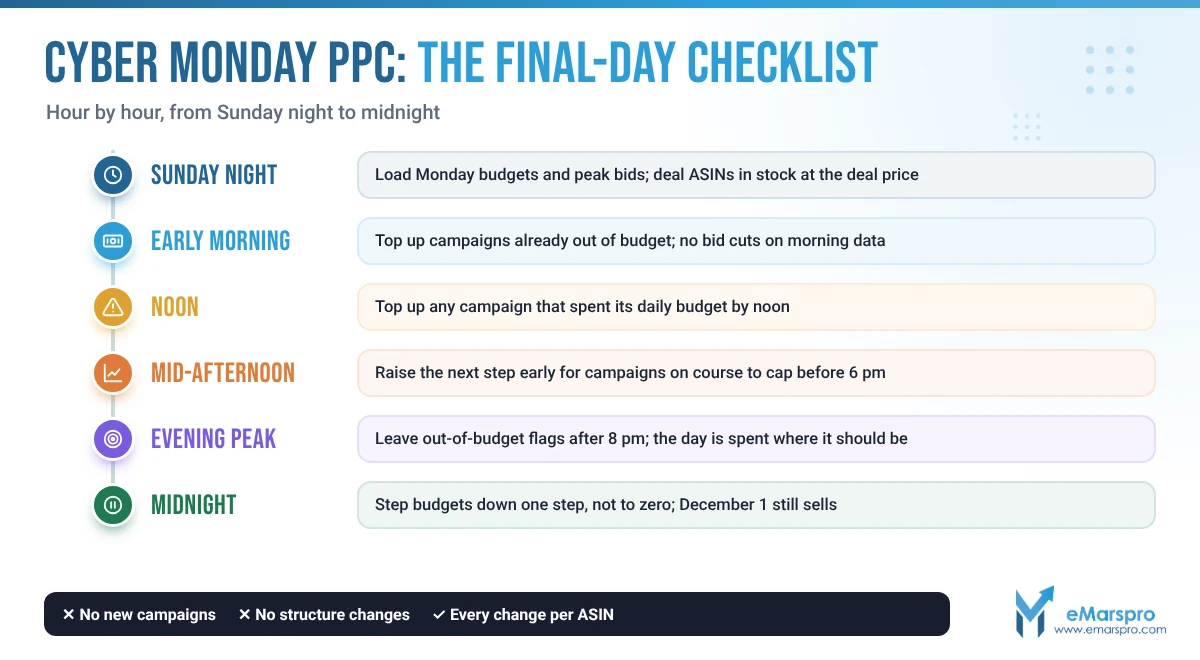
The final-day checklist: Cyber Monday, hour by hour
The curve above sets the budgets; this is the order of the reads on the day itself, checked for this update. Times are your account’s local time (the deal drop is 8 a.m. Pacific). Amazon’s event runs through Monday, November 30, with a second deal drop that morning, so the Monday plan starts on Sunday night.
| When | Read | Do |
|---|---|---|
| Sunday night | Monday budgets loaded, bids at the peak-hour step, every deal ASIN in stock and priced at the deal price | Load the budget tonight, not Monday morning; the morning spends what you set now |
| Early morning | Overnight spend against the cap; out-of-budget flags from the night; the morning deal drop live on the deal ASINs | Top up any campaign already out of budget; no bid cuts on the morning data |
| Noon | Campaigns that have spent the daily budget by noon | Top up now; a budget spent by noon buys the quiet hours and misses the peak |
| Mid-afternoon | Campaigns on course to hit their cap before 6 pm | Raise the next step early; the evening is the point of the day |
| Evening peak | Budget still there at 7 pm; out-of-budget flags after 8 pm | Leave the flags after 8 pm; the day is spent where it should be |
| Midnight | The Tuesday step-down | Budgets down one step, not to zero; December 1 still sells |
Three things not to do on the day: no new campaigns (they spend the morning learning), no structure changes, and no decision for the whole account. Every top-up and every pause is made per ASIN. The Turkey 5 day-by-day plan carries the same rule for the five days together.
The ramp down: December 1 to the shipping cutoffs
Cutting on Cyber Monday night is the second most common failure. Conversions keep landing on the Tuesday, and the gift window runs to the shipping cutoffs Amazon publishes for December; our Amazon holiday selling guide has the season calendar.
The ramp down is steps again:
• Bids back to pre-event levels on Tuesday.
• Budgets down a step at a time through the first week of December.
• Converting campaigns on until the cutoffs pass.
• The January budget set from the search term report, not from exhaustion.
How AI helps with Cyber Monday PPC
• Amazon Ads’ budget rules: a schedule-based rule raises a campaign budget by a set percentage for a shopping event or a date range (Amazon’s own example is a Black Friday increase), and a performance-based rule raises it when the campaign crosses a threshold such as a return on ad spend or a conversion rate.
• Pacvue, for dayparting and pacing rules across accounts, so the evening budget is there without a person watching the console.
• Amazon’s Ads Agent, as Amazon describes it, is an assistant inside Amazon Marketing Cloud that builds audiences and answers questions in plain English; Amazon does not describe it as setting Sponsored Products bids, so nothing in this plan depends on it.
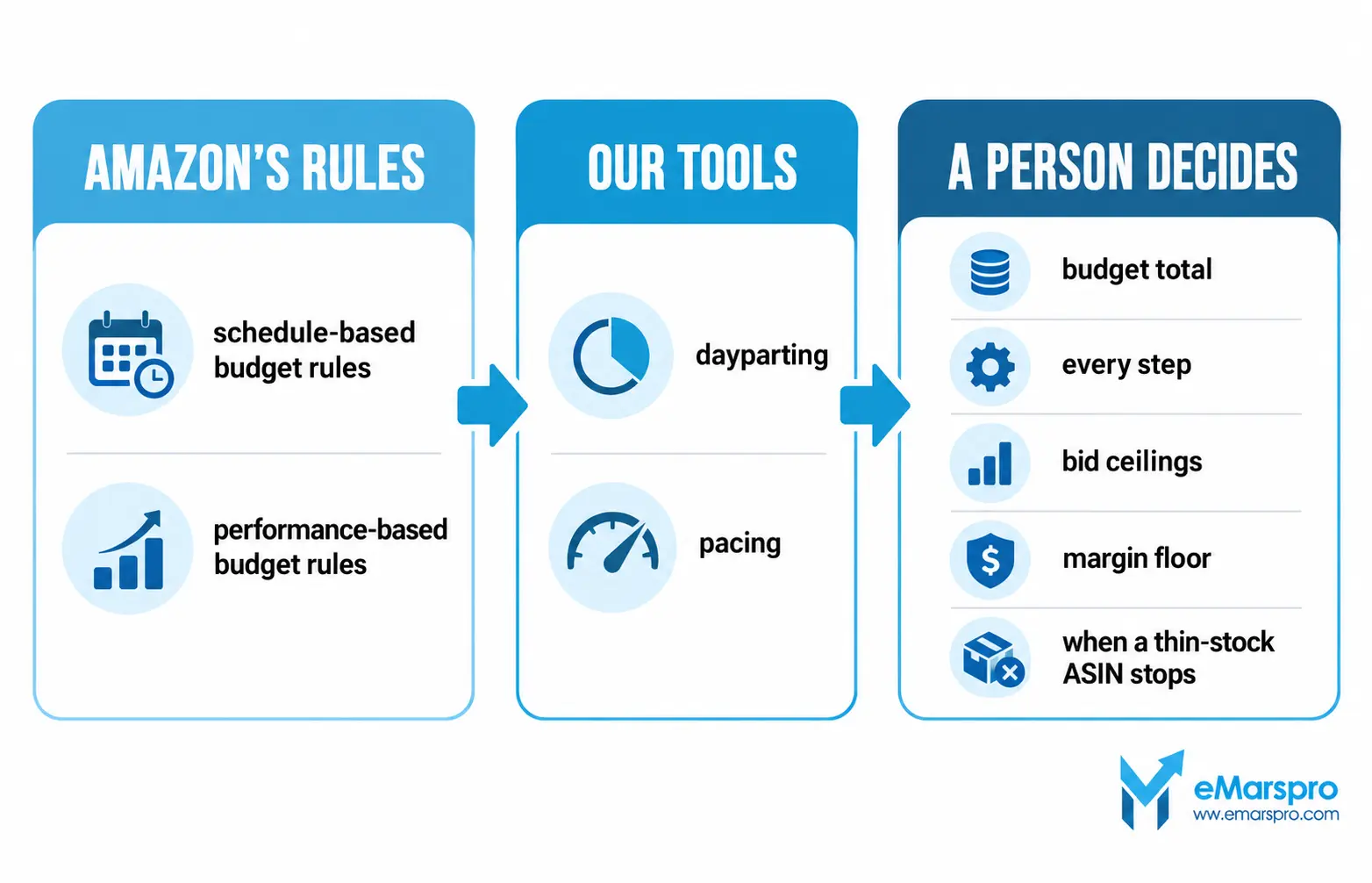
What a person decides: the budget total, every step, the bid ceilings, the margin floor, and when a deal ASIN with thin stock stops advertising. The rules move the budget; the seller decides where it stops.
Frequently Asked Questions
On the accounts we run, Black Friday traffic builds from Thanksgiving evening and peaks on the Friday. Cyber Monday is one day with its own peak, later in the day, and a Tuesday after it that still converts. Campaigns that spend their budget by Sunday night miss the second peak, so the plan treats the five days as one curve.
In steps, starting the week before Thanksgiving, with the last step on the Sunday night before Cyber Monday. Amazon’s budget rules can schedule the increase to the event date; the size of each step comes from margin and stock, not from a percentage copied from someone else’s account.
Yes, where the account has hourly data to support it. Cyber Monday orders cluster in the evening in most categories we run, so a daily budget that is spent by lunchtime pays for the cheapest hours and misses the most expensive ones. The hourly pattern comes from your own past event data, not from a rule of thumb.
Not on Cyber Monday night. Conversions keep landing on the Tuesday, and the December gift window runs to the shipping cutoffs Amazon publishes. Step budgets down over the first week of December and keep the converting campaigns on until the cutoffs pass.
It can run parts of it. Amazon’s budget rules raise a campaign budget on a schedule or when it hits a performance threshold, and tools such as Pacvue set dayparting and pacing rules. A person sets the caps, the bid steps and the margin floor, because no rule knows how much stock is left on the deal ASIN.
Two peaks, one plan
Cyber Monday PPC is a curve, not a switch: steps up from the week before Thanksgiving, two full-budget days with a hold between them, an evening budget on the Monday, and steps down into December. Build it from the Prime Big Deal Days report and the account runs the event on data instead of nerves.
If you would rather have the curve set and the rules run for you, our Amazon PPC team starts with a free audit of your listings, PPC and account health, with findings within 48 hours.