

Amazon advertising costs have no single price tag: ads are sold per click through auctions, so your cost is set by bidding, not by a rate card. Sponsored Products carries no monthly or upfront fees, per Amazon’s own documentation.
Five things decide what you actually pay: category competition, targeting quality, listing conversion, placement, and season. The worksheet below turns those into your own number.
How Amazon Advertising Pricing Works
Every sponsored ad on Amazon is sold through an auction. You tell Amazon the most you are willing to pay, Amazon weighs your bid against relevance, and the winning ads show. On the core click-billed formats you are charged when someone clicks, not when your ad appears.
There is no entry fee for the core ad types. Amazon states it plainly for Sponsored Products: campaigns have no monthly or upfront fees. Your only required spend is the daily budget you choose, which caps what a campaign can spend.
Your true ceiling is your margin math, and our Amazon PPC management team can run that math against your real account.
The Three Sponsored Ad Types and How Each Is Billed
| Ad type | Who can run it | How it is billed |
|---|---|---|
| Sponsored Products | All professional sellers | Cost per click, no monthly or upfront fees |
| Sponsored Brands | Brand-registered sellers | Cost per click |
| Sponsored Display | Brand-registered sellers | Cost per click by default; reach-focused options bill by viewable impressions |
Amazon DSP sits above these for programmatic reach and is typically a managed product with its own budget requirements. Treat it as a later-stage tool, not a starting point. For most sellers, Sponsored Products carries the bulk of spend and produces the most attributable sales.
What Actually Drives Your Cost Per Click
Published average CPCs are averages of other people’s accounts. Yours is driven by five things you can partly control:
- Category competition. Supplements and beauty bid harder than niche hobby gear. You cannot change your category, but you can pick your battles inside it.
- Targeting quality. Broad, overlapping targets force you to outbid more competitors than necessary. Tight targeting buys the same shopper for less.
- Listing conversion. Amazon rewards ads that convert. A listing that turns clicks into orders earns better effective costs over time.
- Placement. Top of search costs more than product pages. Placement multipliers let you pay premium prices only where the data says it pays back.
- Season. Bids climb across Q4 and around Prime events, when every competitor wants the same shopper.
Set Your Budget From Margins, Not From a Guess
Generic advice hands you a round number per day. The operator way starts from unit economics and works backward. Here is the arithmetic with clean example numbers:
| Step | Example |
|---|---|
| Selling price | $30 |
| Contribution margin before ads, after COGS and fees | 30%, which is $9 per unit |
| Break-even ACoS (your margin) | 30% |
| Target ACoS, leaving profit per order | 20%, which is $6 of ad spend per order |
| Conversion rate from your own reports | 12.5%, meaning 1 order per 8 clicks |
| Affordable cost per click: $6 divided by 8 clicks | $0.75 |
| Daily budget for 5 target orders: 40 clicks at $0.75 | $30 per day |
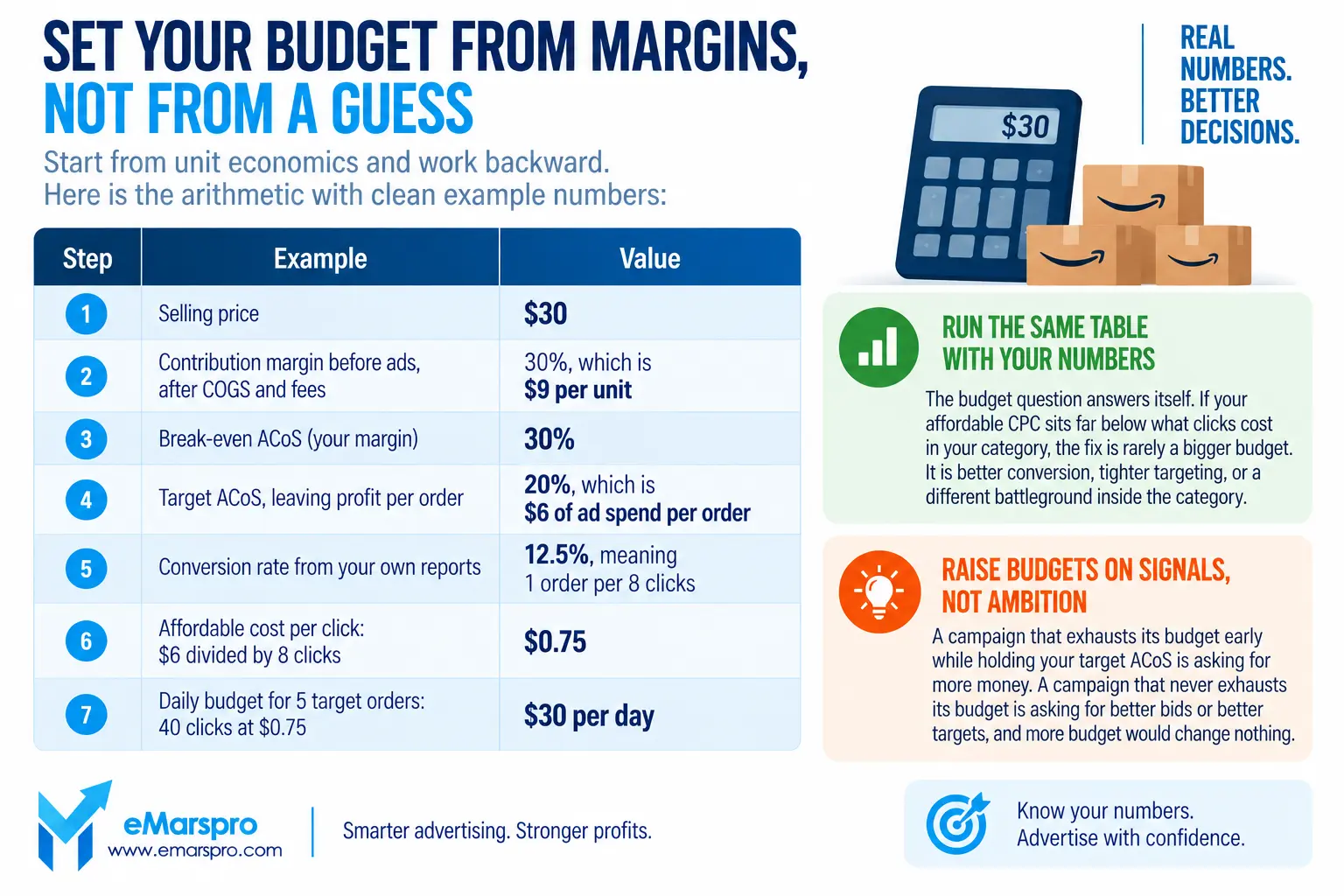
Run the same table with your numbers and the budget question answers itself. If your affordable CPC sits far below what clicks cost in your category, the fix is rarely a bigger budget. It is better conversion, tighter targeting, or a different battleground inside the category.
And raise budgets on signals, not ambition: a campaign that exhausts its budget early while holding your target ACoS is asking for more money. A campaign that never exhausts its budget is asking for better bids or better targets, and more budget would change nothing.
Reading Your Own Cost Data
Every number this guide describes is already in your account. Three reports carry almost everything that matters:
- Campaign reports: your real average CPC, spend pacing, and which campaigns exhaust their budgets early.
- Search term report: the exact queries you paid for, and which of them ever convert. This is where wasted spend is found, line by line.
- Placement report: what top of search costs you versus product pages, and whether the premium converts.
A weekly hour in these three reports, read at SKU level rather than as account totals, replaces most of the guesswork that makes Amazon advertising feel expensive. The sellers who think costs are out of control are usually reading totals; the accounts under control read line items.
Seasonal Swings: Budget for the Calendar You Sell In
Costs are not flat across the year. Competition concentrates around Prime events and the fourth quarter, and bids move with it. Sellers who stay efficient through Q4 lock budgets and bid plans in September and October, ahead of the pressure, not inside it.
If Q4 matters to your catalog, plan the advertising budget alongside inventory, not after it. An ad that wins the click for a product about to run out of stock buys nothing.
Four decisions to write down before October:
- Which products get scaled through the season.
- The budget each one is allowed at peak.
- The ACoS you will tolerate on event days.
- The date budgets step back down.
Written down in September, those four stop the mid-November panic edits that burn margin.
Where Amazon Advertising Costs Actually Leak
Cost problems are usually allocation problems wearing a pricing costume. The waste hides in predictable places:
- Overlapping campaigns splitting data for the same targets, so nothing reads clean.
- Search terms with clicks and no orders, left running for months.
- Winners capped by small budgets while losers spend freely.
- Seasonal products still carrying last quarter’s budgets.
The scale surprises sellers. In our published audit checklist we note that on accounts arriving without a recent audit, zero-conversion spend commonly runs between 8 and 20 percent of total spend. Finding it is mechanical. Someone just has to look.
Keeping Amazon Advertising Costs Down Without Killing Growth
This is where AI-assisted management earns its keep. Machine reads across every SKU, every day, surface the reallocations a weekly review misses, and a person decides what changes. Your target advertising cost of sale anchors all of it.
Frequently Asked Questions
There is no fixed price. Amazon charges per click through an auction, so your cost is your average CPC times the clicks you buy. Sponsored Products has no monthly or upfront fees, and your daily budget caps the spend. The margin worksheet above turns this into your own number.
The formal entry bar is low: no monthly or upfront fees on Sponsored Products, and campaign daily budgets start at trivial amounts. The practical minimum is different: a budget that buys enough clicks to produce readable data in your category. Your first weeks of reports show what that costs, and reading them beats guessing.
Usually one of three causes: more competitors bidding on your targets, seasonal auction pressure, or falling relevance because conversion slipped. Check conversion first. When a listing converts worse, ads work harder for every order, and that reads as rising costs.
Only with the arithmetic done first. Break-even ACoS equals your margin, so a 15% margin product breaks even at 15% ACoS, which is demanding. Low-margin catalogs often win by advertising the products that pull organic sales along, not every SKU equally.
Substantially. Click prices track how many sellers compete for the same shopper, so crowded, high-margin categories bid clicks up while niche categories stay cheap. That is why category benchmarks make poor budgets: the only average that should set your spend is your own, from your own reports. Costs come down when someone reads the account at the level where the money moves. Our Amazon PPC management services start with exactly that read.
Get Your Free Amazon Account Audit
Costs come down when someone reads the account at the level where the money moves. Our Amazon PPC management services start with exactly that read.
We review your listings, PPC and account health, and send findings within 48 hours.



