

Direct answer: Fifteen checks, run in this order, tell you whether an Amazon PPC account is healthy. Five on structure, five on targeting, five on waste.
Every check below carries the threshold we use to decide pass or fail, so you can run the whole thing yourself.
Most audit pages name the areas and keep the numbers. The numbers are the audit.
Run it in order. Structure problems make targeting numbers unreadable, and targeting problems make waste numbers unreadable, so working backwards produces conclusions you cannot trust.
Everything below applies to Sponsored Products, which Amazon runs as cost-per-click with a bid set per keyword.
Section 1: structure
| # | Check | Threshold |
|---|---|---|
| 1 | One product per ad group | Any ad group carrying more than one child ASIN fails. You cannot read a search term report that blends two products |
| 2 | Campaign naming is systematic | You should be able to tell match type, targeting type and product from the name alone, without opening it. If you cannot, fails |
| 3 | Exact, phrase and broad are separated | Mixed match types in one campaign fails. Budgets cannot be steered when broad eats the exact budget |
| 4 | Auto and manual are separated | Auto campaigns exist to discover terms. Mixed with manual, they compete with you for your own placements |
| 5 | Every campaign has a stated job | Discovery, defence, scale or harvest. A campaign nobody can name the job of fails, and there are usually three or four |
The commonest structural failure is check 1, and it is the one that invalidates everything after it.
Section 2: targeting
| # | Check | Threshold |
|---|---|---|
| 6 | Harvested terms are actually harvested | Any search term with 2 or more conversions still sitting only in auto or broad fails. It should be in exact by now |
| 7 | Negatives are applied at the right level | Negatives sitting only at ad group level, when the same term wastes across campaigns, fails |
| 8 | Branded and non-branded are separated | Blended into one campaign, your branded ACoS hides your non-branded performance. Fails |
| 9 | Competitor targeting is deliberate | Running or not running is both fine. Running it without knowing you are running it fails |
| 10 | Bid strategy matches the campaign job | Down-only on a discovery campaign fails. Up-and-down on a defensive branded campaign usually fails too |
Section 3: waste
[IMAGE 2]
This is where the money is, and it is the section people run first and should run last.
| # | Check | Threshold |
|---|---|---|
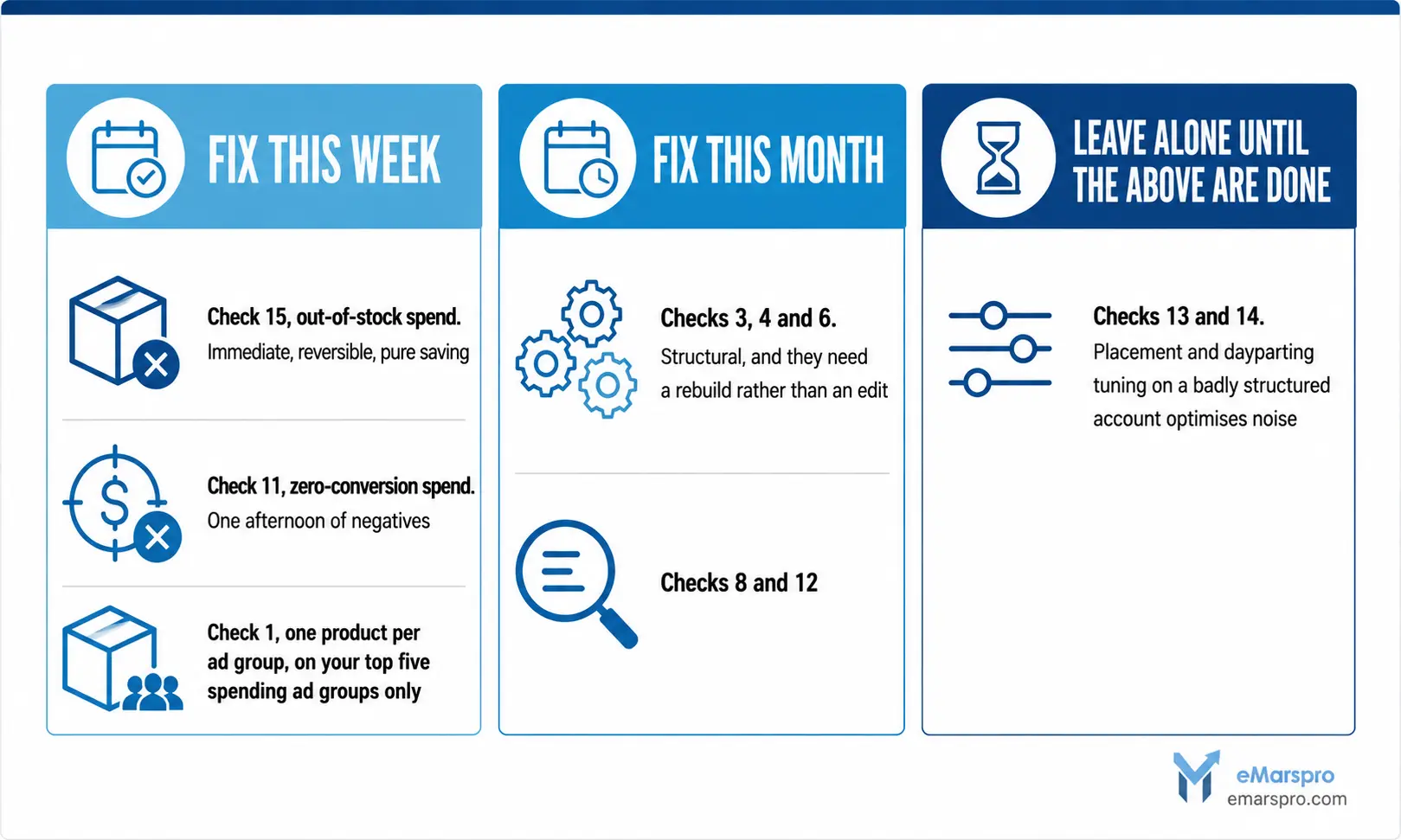
| 11 | Zero-conversion spend | Any search term with spend above 2x your target CPA and zero conversions in 60 days fails. Negative it |
| 12 | Search term to keyword ratio | If more than 30 percent of spend is on terms that are not keywords you chose, your negatives are behind |
| 13 | Placement multipliers are set | Default multipliers everywhere fails. Top-of-search converts differently and should be bid differently |
| 14 | Dayparting matches the conversion curve | If spend is flat across hours and conversions are not, fails |
| 15 | Out-of-stock SKUs are not spending | Any spend at all on an out-of-stock or low-cover SKU fails. This is the purest waste in the account |
Check 15 is the one to run today if you run nothing else, and it matters more in Q4 than at any other time of year. More traffic to a low-stock SKU brings the stockout forward and risks the organic rank you spent the money building.
Check 11 is usually the biggest single number. On most accounts we see, it is between 8 and 20 percent of spend, and it takes an afternoon to clear.
If the waste section is where your account is failing and you would rather it were handled continuously than audited quarterly, that is what Amazon PPC management is for.
What to do with the failures
Fifteen checks will usually surface eight or nine failures on an account nobody has audited. Do not fix them in the order you found them.
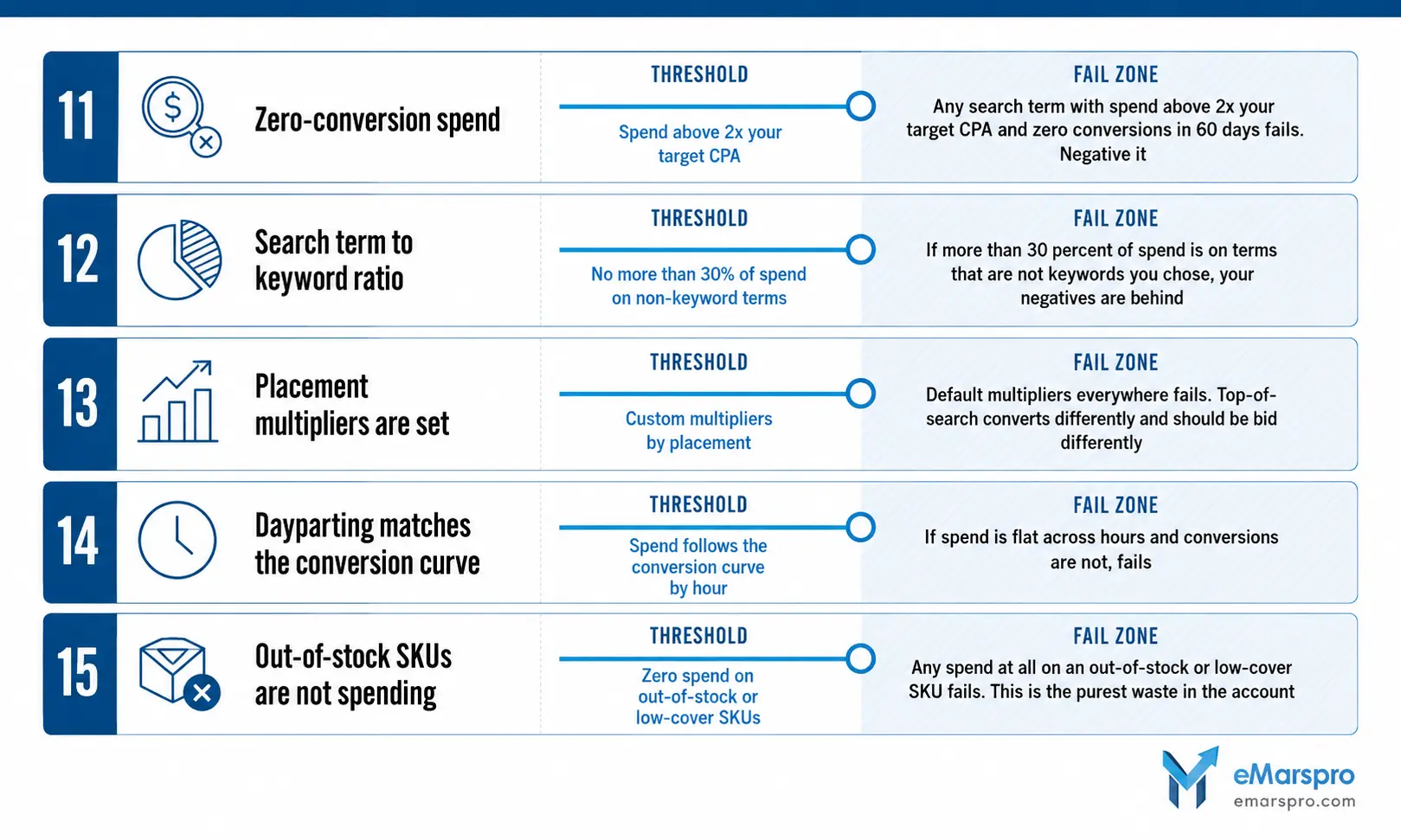
Fix this week:
- Check 15, out-of-stock spend. Immediate, reversible, pure saving
- Check 11, zero-conversion spend. One afternoon of negatives
- Check 1, one product per ad group, on your top five spending ad groups only
Fix this month:
- Checks 3, 4 and 6. Structural, and they need a rebuild rather than an edit
- Checks 8 and 12
Leave alone until the above are done:
- Checks 13 and 14. Placement and dayparting tuning on a badly structured account optimises noise
Do not restructure the whole account in Q4. Rebuilding campaign structure resets the performance history that bidding runs on, and late September is the worst possible time to do that. Fix the waste now, restructure in January.
Frequently Asked Questions
Quarterly for the full fifteen, monthly for the five waste checks. The waste checks change weekly, the structure checks change only when someone changes the structure.
There is no universal figure, and any number quoted without your margin attached is meaningless. The useful version is your break-even ACoS, which is your contribution margin percentage. Above it you are buying volume, below it you are buying profit.
On accounts arriving without a recent audit, zero-conversion spend commonly runs between 8 and 20 percent of total spend. That is our own observed range across accounts we take over, not a published industry figure.
Yes. Every threshold is in this post for that reason. The parts that are hard to do alone are check 6, which needs a full search term history, and checks 13 and 14, which need enough data to be significant.
Where That Leaves You
The fifteen checks aren’t secret, and neither are the thresholds. What makes an audit valuable is running it in order, in full, on a cadence, rather than checking the three things that are easiest to look at. Our Amazon PPC management team starts every new account with a free 48-hour audit.