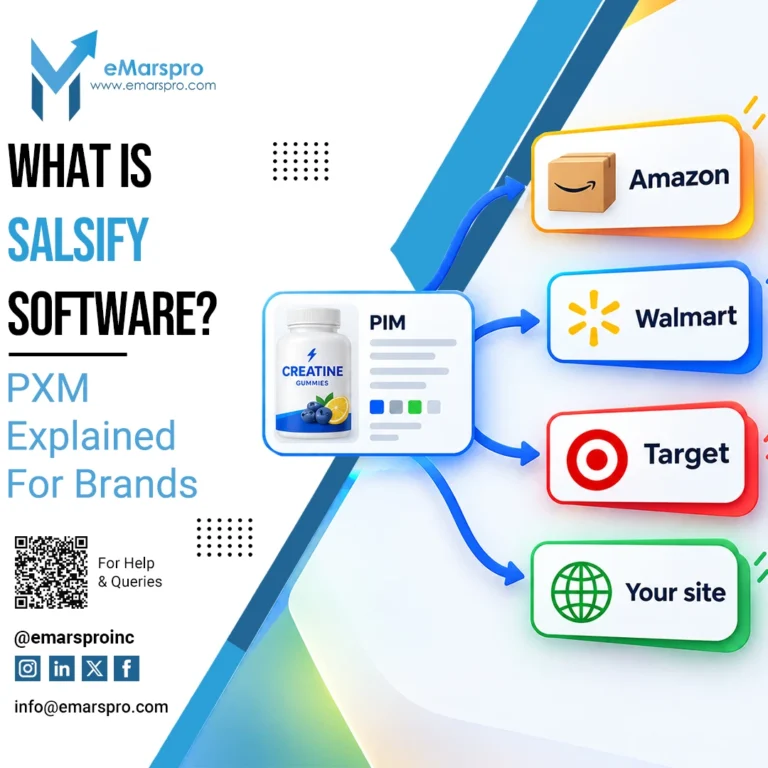
Salsify is product experience management (PXM) software. Brands use it to keep product content, such as titles, attributes, images and rich media, in one place and publish it to retailers like Amazon, Walmart and Target. It combines a product information management (PIM) system with syndication, enhanced content and digital shelf analytics.
Search “salsify” on its own and most results are about the root vegetable. This guide is about the software: what it does, who needs it, what it costs, its AI tools and the alternatives.
What does Salsify do?
Salsify describes its platform as intelligent product experience management . In practice it is a set of modules around one central product record:
| Module | What it does |
|---|---|
| PIM | One central record for every product’s data and digital assets |
| Syndication | Publishes product content to retailer and marketplace channels |
| Enhanced Content | Builds rich content, such as Amazon A+ pages and retailer rich media |
| Digital Shelf Analytics | Tracks how product pages perform on retailer sites |
| SXM (Supplier Experience Management) | For retailers: onboarding suppliers and their product listings |
| Intelligence Suite and Angie | AI features inside the workflows (covered below) |
Module names are as listed on salsify.com, checked 9 October 2026.
How Salsify connects to Amazon and Walmart
• Amazon: Salsify says it connects directly to the Amazon Selling Partner API, publishes Basic and Premium A+ content through its Enhanced Content Experience Builder, and runs a Readiness Report against Amazon’s data requirements.
• Walmart: Salsify says it has a direct connection for item setup, rich media publication and content refresh on Walmart’s 1P and 3P channels, including Walmart’s OmniSpec API Suite.
What it does not do: run your ads, manage account health or win the Buy Box. Salsify sends the content. Whether that content converts on Amazon is the work our Amazon listing optimization covers, whichever tool holds the data.
Who needs Salsify, and who does not
| Your situation | Does a PXM tool like Salsify make sense? |
|---|---|
| A large catalog sold through several retailers, each with its own content rules | Yes: one source of content, many outputs |
| You sell to retailers as a supplier as well as on marketplaces | Often yes: retailer portals each want content their way |
| A small catalog on one or two marketplaces | Usually no: the marketplace’s own tools and flat files cover it |
| Your main problem is ads, pricing or account health | No: content software does not fix those |
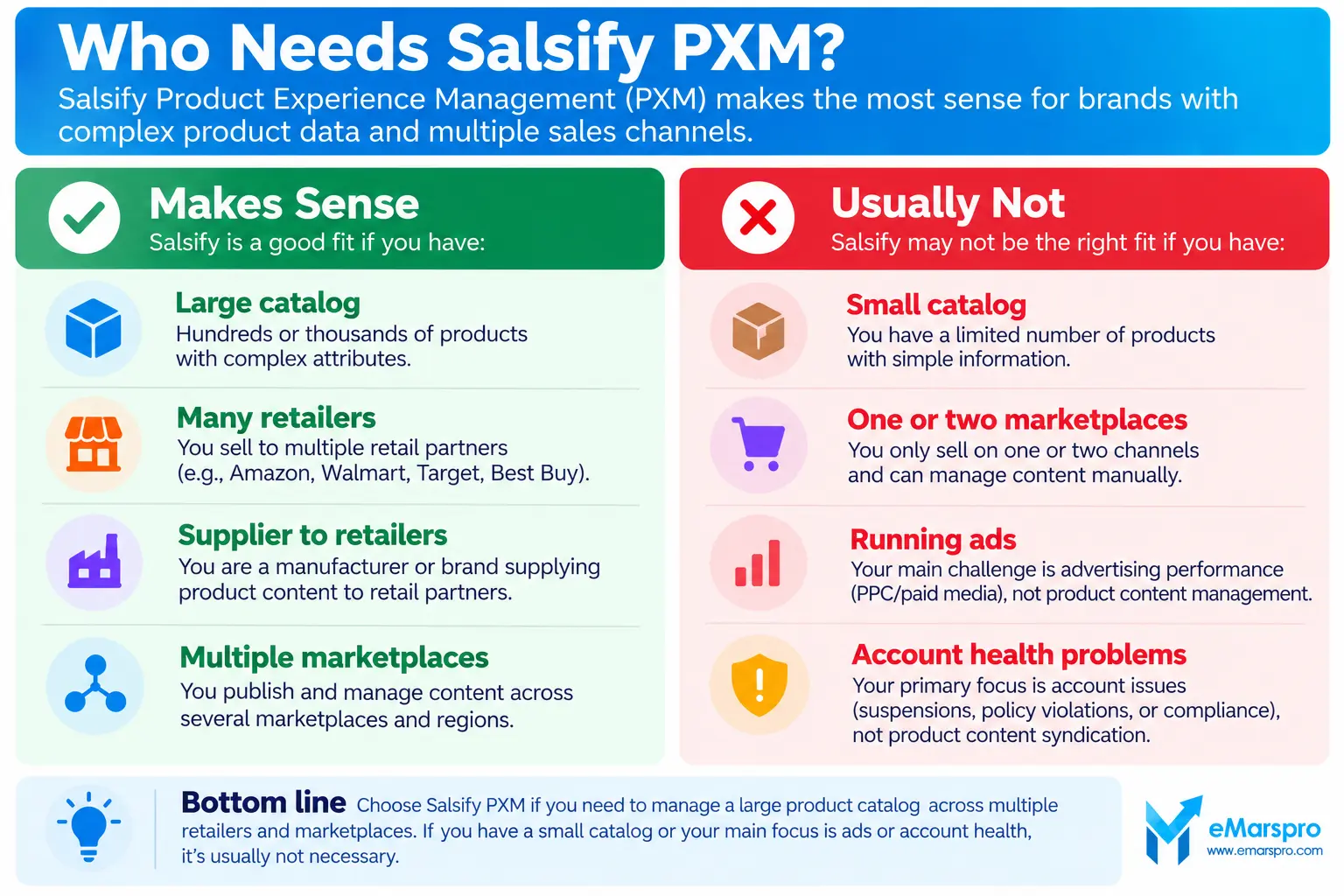
The deciding question is how many places the same product content has to go, in how many formats. One or two: a spreadsheet and Seller Central will do. Many: a central record saves the rework and the errors of keeping each copy by hand.
What does Salsify cost?
Salsify does not publish prices; its site routes buyers to a guided demo. Capterra lists a starting price of $1,500 a month for a basic tier. Treat that as a third-party figure and ask for a quote that matches your catalog, your channels and the modules you need.
Salsify’s AI tools
• Angie: a conversational AI assistant built into the platform, which Salsify calls its AI-powered PXM assistant.
• Intelligence Suite: adds AI-powered task types to Salsify’s workflow engine, for work at catalog scale.
• SalsifyIQ: what Salsify calls a unified intelligence layer across the platform.
Salsify lists the jobs it puts AI to: translating content, tailoring content for different uses, pulling content out of digital assets, and keeping data governed.
Amazon has its own AI here too. Its listing tools can start a listing from a few words, an image or a URL, and Amazon says sellers review, edit and approve each draft before submitting it.
What a person still decides: every claim, size and compliance attribute before it goes live. The tools draft fast, but the brand, not the software, answers for accuracy.
Salsify alternatives
Salsify competes with other product content and PIM platforms. The names brands compare most often:
• Syndigo: product content management and syndication. Our Syndigo explainer covers it.
• Akeneo: a PIM platform. Our Akeneo guide covers it.
• Informatica PIM: an enterprise PIM. Our Informatica PIM overview covers it.
• Stibo Systems STEP and Productsup: Salsify publishes its own comparison pages against Stibo and Syndigo.
Compare them on the channels you sell through, the retailers each one connects to directly, and the cost at your catalog size.
Frequently Asked Questions
Keeping product content in one place and publishing it to retailers and marketplaces. Brands use it to manage product data and images, build enhanced content such as Amazon A+ pages, send content to channels like Amazon and Walmart, and track how product pages perform.
It includes one. Salsify calls its platform product experience management (PXM): a PIM plus syndication, enhanced content, digital shelf analytics and AI features in one system.
Salsify does not publish prices; buyers request a demo and a quote. Capterra lists a starting price of $1,500 a month for a basic tier. Your quote depends on your catalog, channels and modules.
Yes. Its platform includes Angie, an AI assistant inside the platform, the Intelligence Suite, which adds AI tasks to workflows, and SalsifyIQ, which Salsify describes as a unified intelligence layer.
Content in one place, then make it sell
Salsify, or any PXM tool, holds and sends the content. Getting that content to convert on Amazon is a separate job. If you want your Amazon pages checked, our listing optimization team starts with a free 48-hour audit.