

Most “best Amazon agency” lists are written by an agency that ranks itself first. This one is written by a team that runs marketplace accounts every day, and it is built to help you choose well even if you never talk to us.
The honest answer is that the best Amazon agency is the one whose model, price structure, and reporting match your revenue stage and your margin math.
Below are the five agency models, the eight criteria that separate the good from the loud, the four pricing structures, and the red flags worth walking away from.
Quick answer: there is no single best Amazon agency for every brand. Match the model to your stage. Freelancers and specialists fit narrow needs and tight budgets. Full-service and marketplace-native models fit brands that want one team accountable for the whole account. In-house only pays off at scale.
Score any candidate on coverage, transparency, pricing fit, proof, platform expertise, credentials, contract terms, and team fit before you sign.
The five Amazon agency models, and the trade-off in each
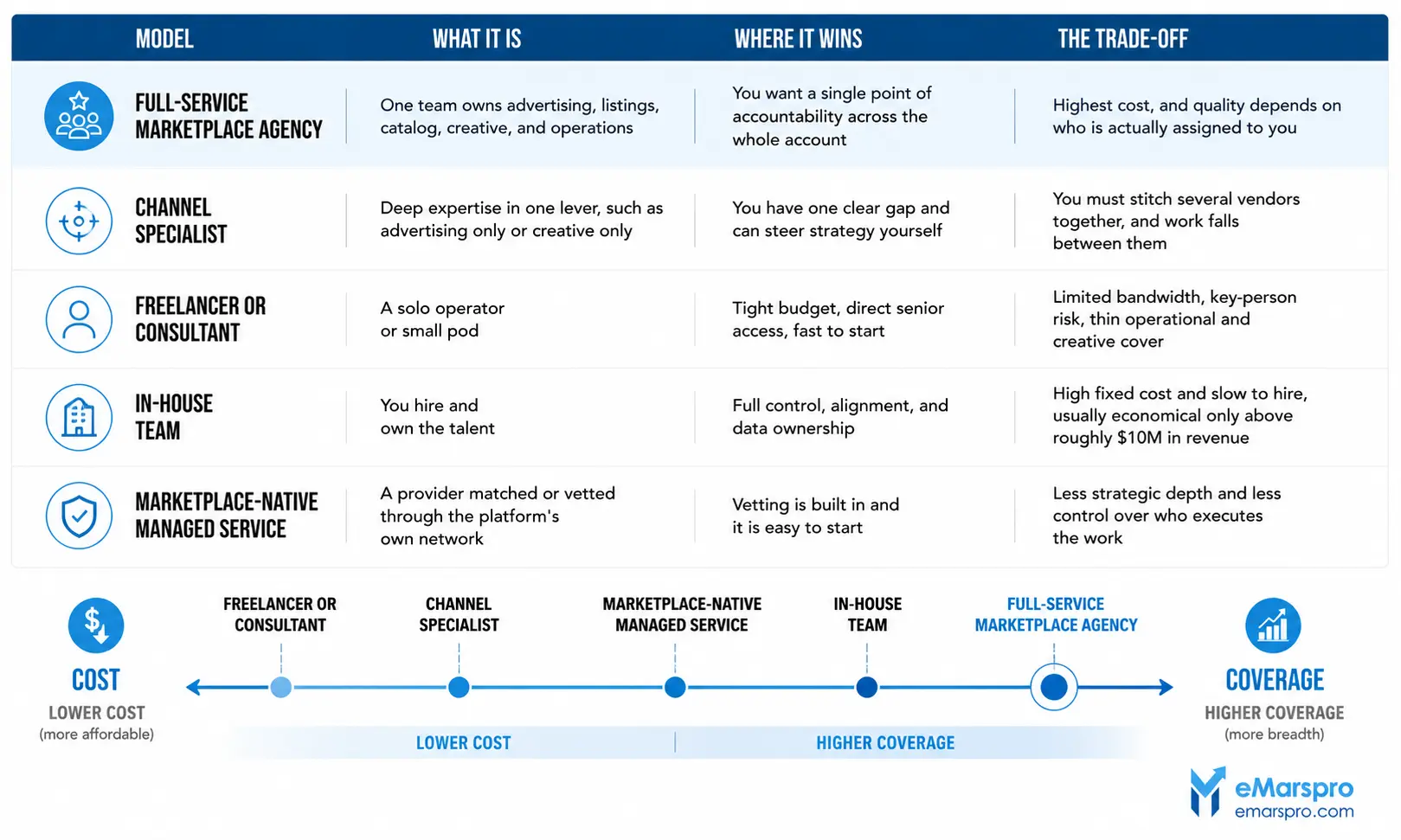
Every brand owner is really choosing between five ways of getting the work done, not fifty logos. Each model has a real trade-off, and the “best” one depends on what you can staff yourself.
| Model | What it is | Where it wins | The trade-off |
|---|---|---|---|
| Full-service marketplace agency | One team owns advertising, listings, catalog, creative, and operations | You want a single point of accountability across the whole account | Highest cost, and quality depends on who is actually assigned to you |
| Channel specialist | Deep expertise in one lever, such as advertising only or creative only | You have one clear gap and can steer strategy yourself | You must stitch several vendors together, and work falls between them |
| Freelancer or consultant | A solo operator or small pod | Tight budget, direct senior access, fast to start | Limited bandwidth, key-person risk, thin operational and creative cover |
| In-house team | You hire and own the talent | Full control, alignment, and data ownership | High fixed cost and slow to hire, usually economical only above roughly $10M in revenue |
| Marketplace-native managed service | A provider matched or vetted through the platform’s own network | Vetting is built in and it is easy to start | Less strategic depth and less control over who executes the work |
If you are between $250k and $5M on marketplaces, the honest read is that a full-service or a strong specialist plus your own oversight will usually beat a full in-house build, because the fixed cost of a capable internal team rarely clears at that revenue.
The 8 criteria that actually separate agencies
Score every candidate on these eight. The scorecard graphic is printable, so you can rate two or three agencies side by side.
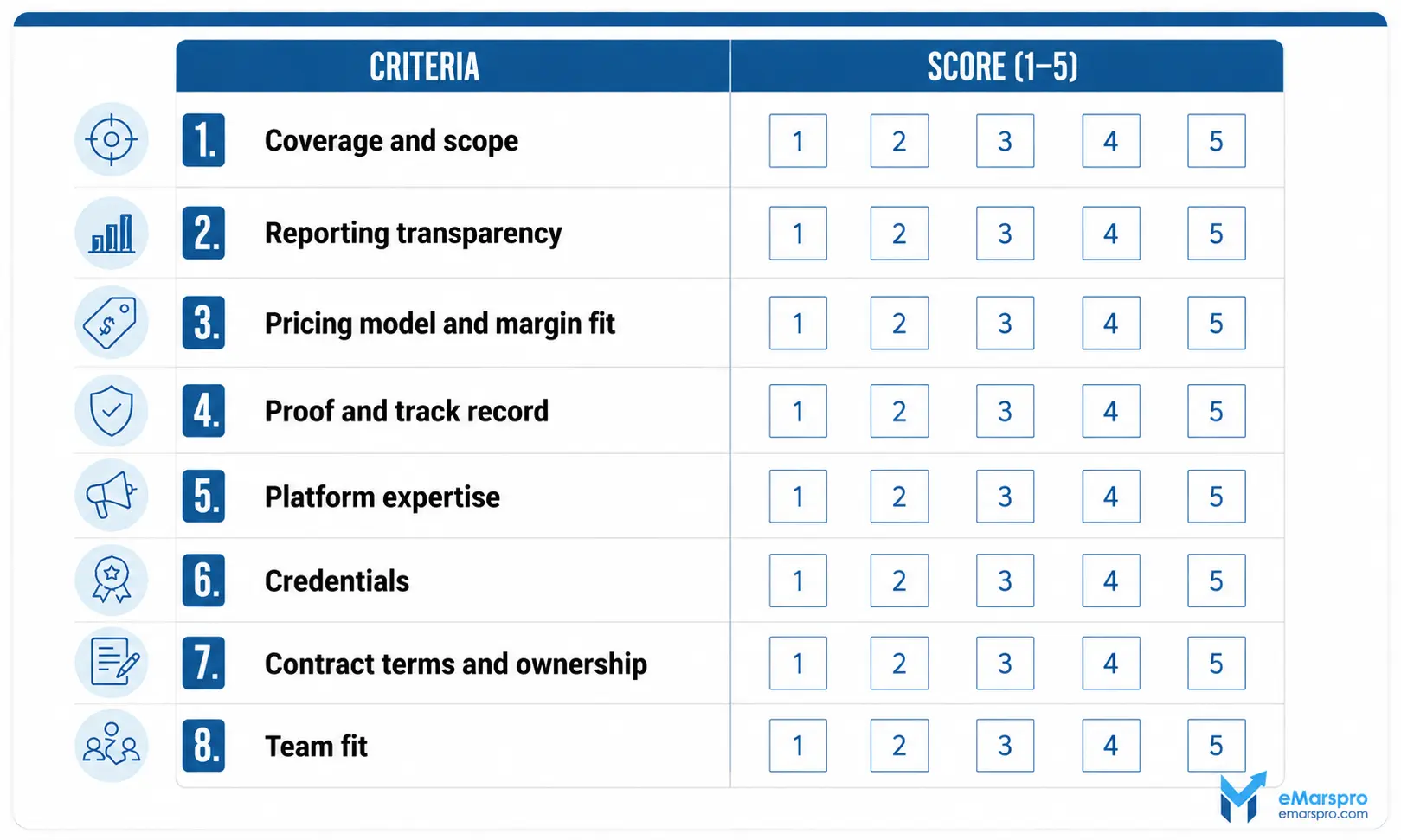
- Coverage and scope. Full-service across advertising, listings, catalog, and operations, or a single lever? Does it cover both Seller Central and Vendor Central, and Walmart or TikTok Shop if you sell there?
- Reporting transparency. Clear dashboards, a set reporting cadence, and plain-English context, not a raw metric dump. Ask to see a real client report with the names removed.
- Pricing model and margin fit. Flat retainer, percent of ad spend, percent of revenue, or hybrid. Work out which one protects your contribution margin at your scale.
- Proof and track record. Verifiable case studies and references at your brand size and category, not only enterprise logos.
- Platform expertise. A real advertising method, negative-keyword discipline, campaign structure, and operational competence on account health, FBA, and suppressed listings. Not tool-only automation.
- Credentials. Verify partner status in the Amazon Service Provider Network and third-party review presence, rather than trusting a badge claim on a homepage.
- Contract terms and ownership. Contract length, exit terms, and who owns the advertising account and the data if you leave.
- Team fit. The account-manager-to-client ratio, the seniority of who actually runs your account, and whether their goals match yours, contribution margin rather than a vanity return number.
You can confirm partner credentials yourself in the Amazon Service Provider Network, Amazon’s own directory of vetted providers.
Pricing models, and which one protects your margin
Cost is the single most searched question about agencies, and the trap is looking at the headline number instead of the incentive behind it. Four structures dominate.
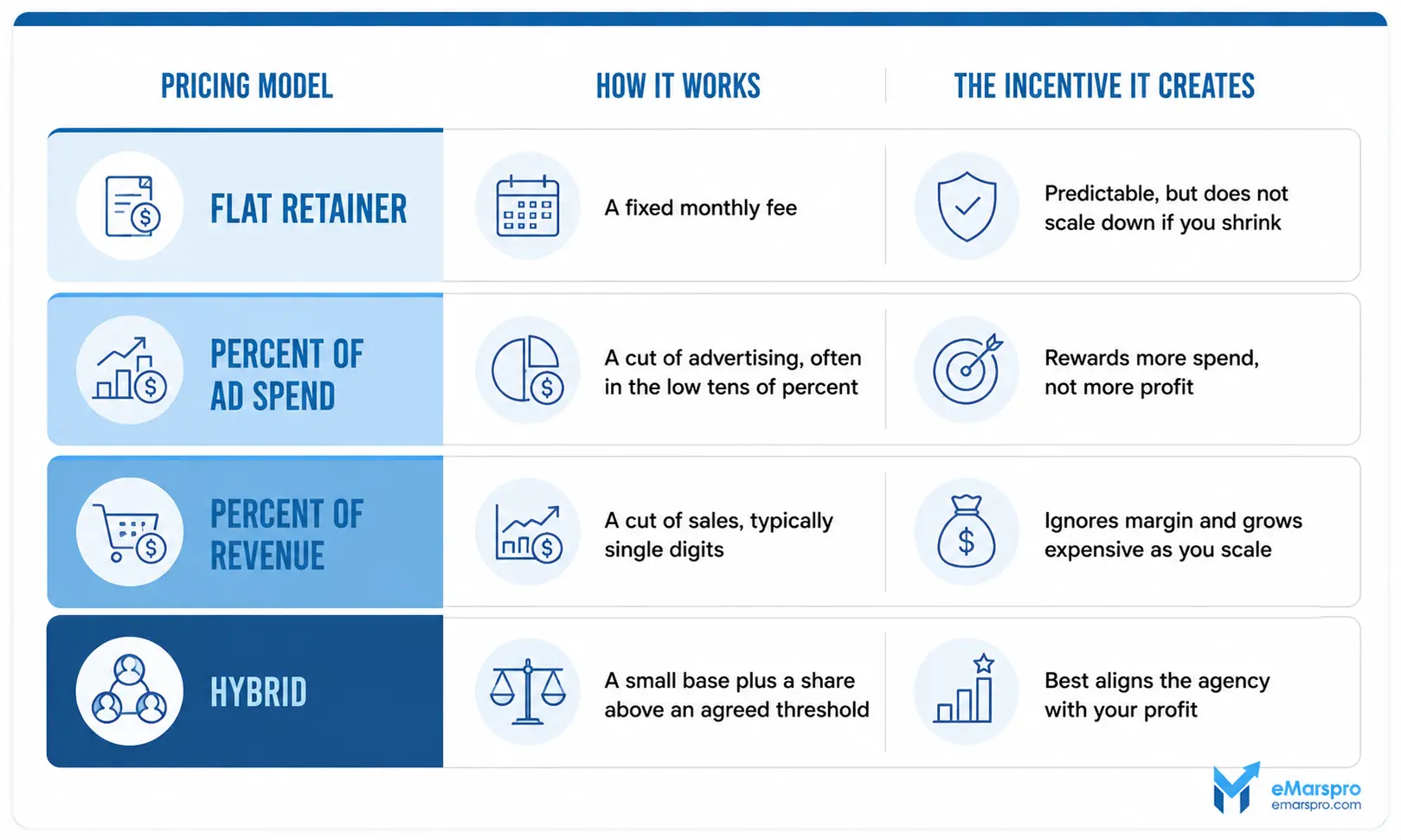
| Pricing model | How it works | The incentive it creates |
|---|---|---|
| Flat retainer | A fixed monthly fee | Predictable, but does not scale down if you shrink |
| Percent of ad spend | A cut of advertising, often in the low tens of percent | Rewards more spend, not more profit |
| Percent of revenue | A cut of sales, typically single digits | Ignores margin and grows expensive as you scale |
| Hybrid | A small base plus a share above an agreed threshold | Best aligns the agency with your profit |
What actually drives the price is scope, not the logo: how many channels, how much advertising, how complex your catalog is, and how much creative and operational work you hand over.
We do not publish a rate card, because the right number depends on that scope. With any agency, including us, the fee and the inclusions belong in your SOW, in writing, before you start.
Agency, freelancer, or in-house: a straight answer
- Under about $250k in marketplace revenue: a freelancer or a single specialist is usually the right spend. A full-service retainer is hard to justify.
- $250k to $5M: the band most brands sit in. A full-service agency or a lead specialist plus your own light oversight tends to give the best coverage per dollar.
- Above roughly $10M: in-house starts to pay off, often alongside a specialist for advertising or creative.
The mistake is buying enterprise-style full service at $300k in revenue, or trying to run everything with one freelancer at $4M. Match the model to the stage.
Red flags worth walking away from
- A badge claiming official Amazon approval or certification that you cannot verify in the Service Provider Network.
- No named account manager, or a ratio so high your account is clearly one of dozens.
- A contract that locks you in with no clear exit, or that keeps your advertising account and data on their side.
- Reporting that shows return on ad spend but never contribution margin or total advertising cost of sales.
- A “multichannel” pitch that turns out to mean running TikTok as paid social, not operating a TikTok Shop.
- Guaranteed rankings or guaranteed sales. No one controls the algorithm.
Where we lose, honestly
We are not the right fit for every brand, and saying so is the point.
If you want the cheapest possible option, a freelancer will beat us on price. If you need one narrow lever done and nothing else, a specialist will go deeper than a generalist team. If you are pre-revenue or testing a single product, you do not need a managed account yet.
We are built for brands doing $250k to $5M that want one team accountable for the whole marketplace account, across Amazon, Walmart, and 60+ marketplaces.
When that is the fit, our Amazon account management and Amazon PPC management teams run the whole operation. Brands on more than one channel move to eCommerce management services or Walmart account management.
How to run the decision this week
- Write down your marketplace revenue and your target: growth, profit, or a specific fix.
- Pick the two models that fit your stage from the table above.
- Score two or three candidates on the eight criteria.
- Ask each one, in writing, for pricing model, account-manager ratio, contract exit terms, and data ownership.
- Verify credentials in the Service Provider Network.
- Choose the one whose incentives match your margin, not the loudest list.
Frequently Asked Questions
It depends on scope, not the logo. The cost is driven by how many channels you run, how much you spend on advertising, and how much work you hand over. Agencies price as a flat retainer, a percent of ad spend, a percent of revenue, or a hybrid. Ask for the model and inclusions in writing before you sign.
They are worth it when the model matches your stage and the fee is justified by scope. A good agency should add more in profit than it costs. If you are under about $250k in revenue, a freelancer or single specialist is often the better spend.
Match the agency model to your revenue stage, then score candidates on coverage, reporting transparency, pricing fit, proof, platform expertise, credentials, contract terms, and team fit. Verify partner status in the Amazon Service Provider Network rather than trusting a homepage badge.
One full-service team gives you a single point of accountability across the whole account. Several specialists can go deeper on each lever, but you have to coordinate them and own the strategy yourself, and work can fall between vendors.
Under roughly $250k, a freelancer or specialist. Between $250k and $5M, a full-service agency or a lead specialist plus your own oversight. Above roughly $10M, an in-house team starts to pay off, often alongside a specialist for advertising.
Ready To See Where You Stand?
Our Amazon account management team starts every engagement with a free account audit and findings in 48 hours.