
eCommerce product management is the ongoing ownership of a product across every channel it sells on: its catalog data, its listing on each marketplace, its price, its stock and its performance.
For a brand on Amazon, Walmart, eBay, TikTok Shop and its own store, the job is six recurring tasks, graded by scores the marketplaces publish, and increasingly drafted by their AI tools.
This post sets out the six jobs, the scores and rules a product manager answers to, where AI now does the drafting, and the weekly routine. Walmart’s Listing Quality page and Amazon’s seller AI page were both checked for this update.
What eCommerce product management covers
On a single website, product management was a merchandising job: the right products, described well, priced right, in stock. On marketplaces the same job has a referee. Each marketplace grades the listing, ranks the offer and, on Walmart, discounts your referral fees for a good one.
The product manager’s work is to keep every product’s record, listing, price and stock in the state the referee rewards, on every channel at once.
That is the layer our eCommerce management services team runs for brands: one product record, one set of rules, and a listing on each marketplace that meets that marketplace’s standard.
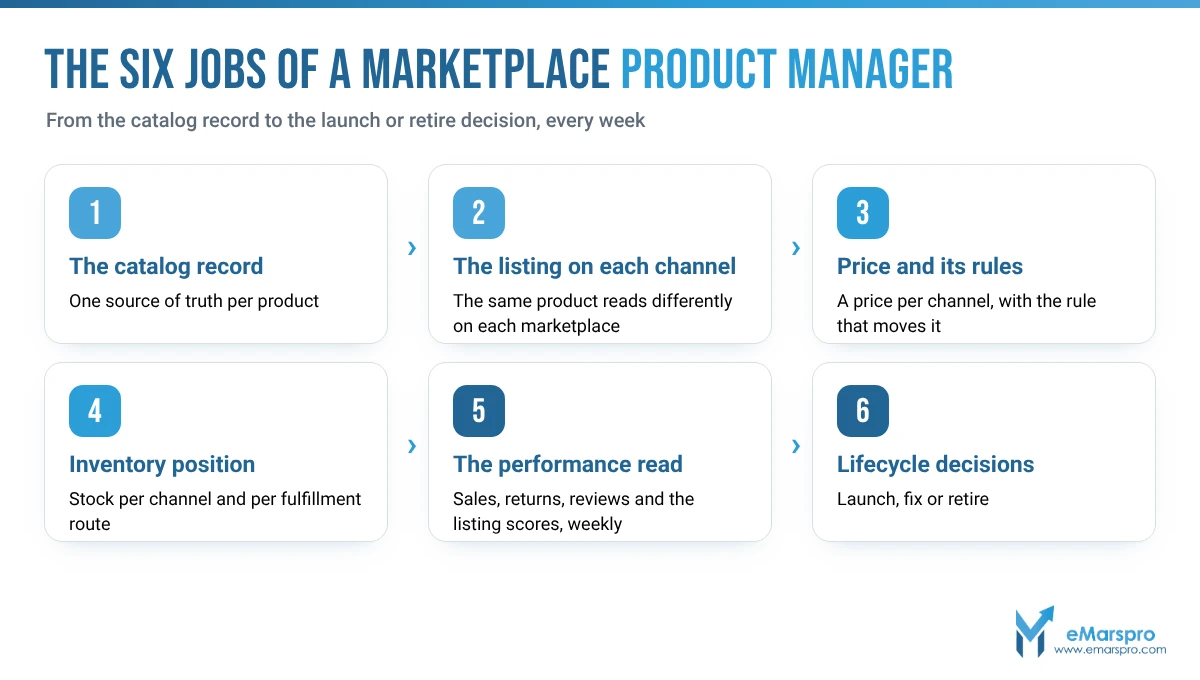
The six jobs of a marketplace product manager
1. The catalog record
One source of truth per product: identifiers (GTIN or UPC, brand, model), dimensions and weight, attributes, images, and the copy. Every marketplace listing is built from it, so an error here is an error everywhere.
How to create an Amazon product listing shows what Amazon asks for; Walmart asks for its own attribute set, and the record has to carry both.
2. The listing on each channel
The same product reads differently on each marketplace. Amazon’s product title requirements cap the title at 75 characters, with the rest of the detail in a 125-character item highlights field; Walmart grades content, discoverability, offer, ratings and reviews in one score. The listing is written per channel from the shared record, not copied across.
3. Price and its rules
A price per channel, with the rule that moves it: the margin floor after each marketplace’s fees, the parity rule you choose between channels, and the promotion calendar. Price is the one field a product manager changes most and documents least; write the rule down before the first change.
4. Inventory position
Stock per channel and per fulfillment route (your warehouse, FBA, WFS), with the reorder point for each. A stockout on one marketplace costs that listing its rank; an overstock on another costs storage. Amazon inventory management software, compared covers the tools when the SKU count outgrows the spreadsheet.
5. The performance read
Weekly: sales by product and channel, conversion where the marketplace shows it, returns and their reasons, reviews and ratings, and the listing quality scores. The read is the same every week so that a change stands out.
6. Lifecycle decisions
Launch, fix or retire. A product whose score is low and whose returns are high is a fix; a product with sales falling on every channel at once is a retire decision; a demand signal without a product is a launch brief. These are the decisions the data informs and a person makes.
The scores that grade your listings
Walmart’s Listing Quality page says the score considers content, discoverability, offer, ratings and reviews; is provided at the catalog and item level; and lives in the Listing Quality & Rewards dashboard.
Walmart’s own list of what improves it: the correct category and back-end attributes, a title with relevant keywords, detailed descriptions, high-resolution photos, expedited shipping, competitive prices, and positive ratings and reviews. Walmart SEO for product listings works through that list.
Walmart ties the score to money: the page names the Pro Seller Badge and the Pro Listing Savings program, which it describes as discounts on referral fees. The amount is not stated on the page.
Amazon’s grade is less visible: its title rules, its A+ eligibility and its search placement reward the same completeness, and a suppressed listing is its loudest verdict.
Where AI drafts the work, and what a person decides
Amazon’s seller AI page, last updated August 2026, names the tools a product manager now has inside Seller Central: Enhance My Listing, which uses generative AI for product titles and attributes; the A+ Content Generator; Product Opportunity Explorer, which reads customer demand for new product ideas; and Seller Assistant, an agentic assistant that can act on a seller’s behalf.
Walmart named an AI-Powered Listing Tool and a Smart Assistant for sellers at its 2025 Marketplace Seller Summit (checked for this update).
What they do: draft the title, the attributes and the A+ page, size the demand for a launch, answer the policy question. What a person decides: whether the draft matches the product in hand, the price and its rule, the reorder quantity, and the launch or retire call.
On the accounts we run, an AI tool such as ChatGPT or Claude reads the weekly exports across channels and drafts the exceptions; a product manager decides. AI reads, people decide.
The weekly routine, by day
| Day | Task | Output |
|---|---|---|
| Monday | Read last week: sales by product and channel, returns, reviews, suppressed listings | The exceptions list |
| Tuesday | Listing quality: Walmart score changes, Amazon title and attribute flags, A+ gaps | Listing fixes queued, drafted with the marketplace tools, approved by a person |
| Wednesday | Price and promotions: margin floors against current fees, parity check across channels, the deal calendar | Price changes with their rule written next to them |
| Thursday | Inventory: stock per channel and route, reorder points, inbound status | The restock list |
| Friday | Lifecycle: products to fix, launch briefs, retire candidates; the record updated | Decisions logged |
Frequently Asked Questions
The ongoing ownership of a product’s data, listing, price, stock and performance across every channel it sells on. For a marketplace brand that means the catalog record, the listing on each marketplace, the price and its rules, the inventory position, the weekly read of what sold and why, and the decision to launch, fix or retire a product.
Reads the exceptions and decides. Daily: stock, price and suppressed-listing alerts. Weekly: listing quality scores, sales by product, returns and reviews, the restock list. Monthly: what to launch, what to retire, what to fix. The drafting and the data pulls are where AI tools now help; the decisions are the job.
Walmart’s grade for how complete and competitive a listing is. Its Listing Quality page says the score considers content, discoverability, offer, ratings and reviews, at the catalog and item level, in the Listing Quality & Rewards dashboard. Improving it is a path to the Pro Seller Badge and to Pro Listing Savings, which Walmart describes as discounts on referral fees.
The marketplaces’ own tools first: Amazon’s seller AI page names Enhance My Listing, the A+ Content Generator, Product Opportunity Explorer and Seller Assistant; Walmart named an AI-Powered Listing Tool and Smart Assistant for sellers at its 2025 Seller Summit. Then general tools such as ChatGPT or Claude for reading exports. A person approves every change they draft.
One record, every channel, one owner
The job is not ten tools; it is one product record kept true, six tasks run on a cadence, and a person who decides. If you want that routine run across your marketplaces, our eCommerce management team opens with a free account audit; findings come back within 48 hours.
Get Every Channel Working From One Record
If you want the record kept, the listings scored and the weekly routine run across your marketplaces, our eCommerce management team starts with a free account audit, findings within 48 hours.