
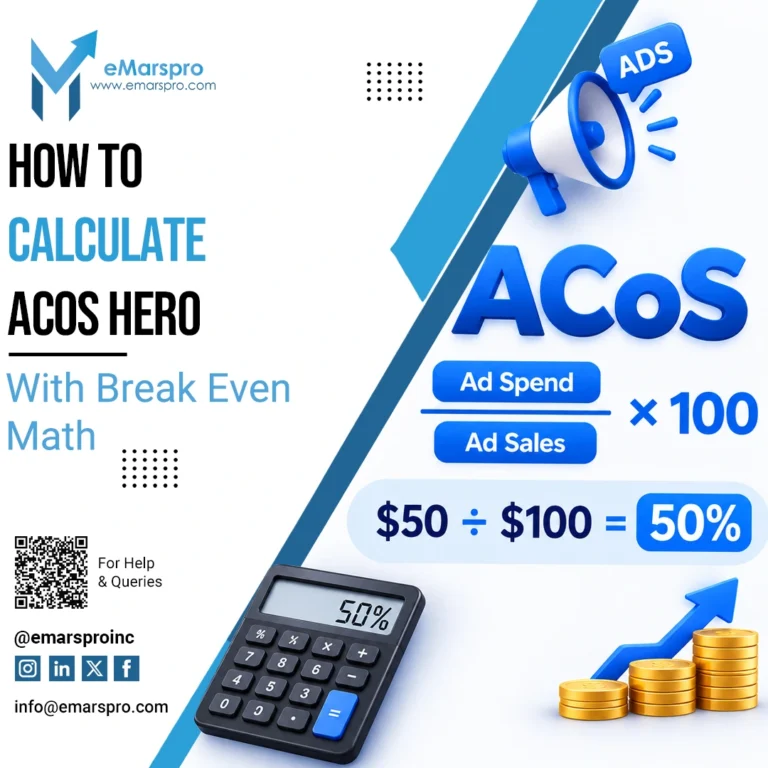
To calculate ACoS, divide your ad spend by the sales Amazon attributes to those ads and multiply by 100. Amazon Ads states the formula as ACOS = (ad spend ÷ ad revenue) × 100: spend $50, earn $100 in attributed sales, and the ACoS is 50%.
Whether 50% is good depends on one number Amazon cannot see, your margin before ad spend, and this post shows how to find it.
Every definition below comes from Amazon Ads’ guide to ACOS, checked for this update. The worked figures are hypothetical examples, labeled as such, so you can replace them with your own.
What ACoS measures, in Amazon’s words
Amazon Ads defines advertising cost of sales as the metric used to measure Amazon pay-per-click campaigns. It is the share of attributed sales that went back out as ad spend. A lower ACoS means each attributed dollar cost less to win; a higher ACoS means the campaign is buying sales at a higher price.
Two words in the formula carry the meaning. “Ad revenue” is the sales attributed to the ad within Amazon’s attribution window, not the account’s total sales. “Ad spend” is the clicks you paid for, whether or not they converted. Confusing attributed sales with total sales is the most common way sellers make a losing campaign look profitable.
How to calculate ACoS: the formula and a worked example
| Step | Hypothetical example |
|---|---|
| Ad spend for the campaign in the period | $800 |
| Attributed sales for the same period | $3,200 |
| ACoS = (800 ÷ 3,200) × 100 | 25% |
| ROAS = 3,200 ÷ 800 | 4 |
Read it at the level you manage: the account, a campaign, an ad group or a single keyword. The account ACoS hides what matters, because a 25% account can hold a 12% campaign that is under-funded and a 60% campaign that is paying for the difference. The 15-point Amazon PPC audit walks the levels in order.
One period rule: compare like with like. A seven-day ACoS read on a Monday includes weekend conversions that have not finished attributing; a 30-day read smooths it. Our Amazon PPC management team reads ACoS on a trailing 30 days and acts on the campaign level, not the account average.
Break-even ACoS: the number that makes ACoS mean something
Amazon Ads puts it plainly: break-even ACoS is directly linked to your profit margin, and to maintain a profit your ACoS needs to be lower than your profit margin. The margin in question is the margin before ad spend, per unit, with every Amazon fee already taken out.
| Line (hypothetical) | Amount |
|---|---|
| Selling price | $40.00 |
| Product cost landed at Amazon | $12.00 |
| Referral fee at a 15% category rate | $6.00 |
| FBA fulfillment fee | $6.50 |
| Margin before ads | $15.50, or 38.75% of the price |
| Break-even ACoS | 38.75% |
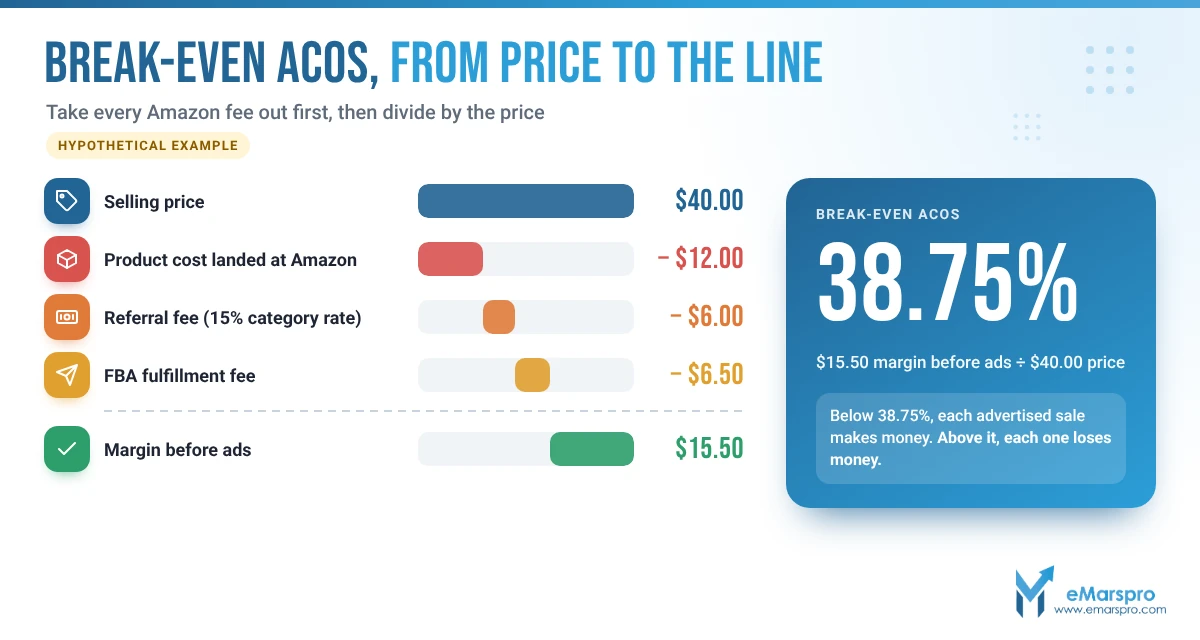
At 38.75% the advertised sale makes nothing. Below it, the gap is profit; above it, each advertised unit loses money that organic sales have to cover. A target ACoS is a choice made against that line: a launch can run near break-even to buy ranking, and a mature product should sit well under it.
Two mistakes hide here. Using the gross margin (price minus product cost) overstates the room by the whole fee stack, which in this example is $12.50 of the $40.00.
And using last year’s fees understates the peak: Amazon’s holiday fulfillment fees run from October 15, 2026 to January 14, 2027, so a Q4 break-even ACoS is lower than the September one. Q4 PPC budget planning sizes the spend against that.
What a good ACoS looks like
Amazon Ads says there isn’t a definitive number for a good Amazon ACoS; it depends on industry, company size and campaign frequency, among other variables. Any blog that gives you a universal range is guessing. The honest version has three parts:
- Against break-even: good is below your own line, with room for the fees you have not counted yet.
- Against the goal: a launch campaign and a defense campaign on your own brand terms have different good numbers, and the same ACoS can be right for one and wrong for the other.
- Against TACoS: ad spend over total sales. When TACoS falls while ACoS holds, ads are lifting organic sales, which is the point of paying for them.
ACoS and ROAS: one ratio, two directions
ROAS = ad revenue ÷ ad spend. Amazon Ads calls it the inverse of ACoS, and the two say the same thing: 50% ACoS is ROAS 2, 25% is ROAS 4, 20% is ROAS 5. Amazon’s own budget rules use ROAS as a threshold, so a seller who thinks in ACoS has to translate when setting a rule.
ROAS is used across ad platforms, and ACoS is the same ratio under Amazon’s name. What differs between platforms is attribution, which is why an Amazon ACoS and a Google ROAS on the same product are not comparable.
The levers that bring ACoS down
- Negative keywords: the search terms that spend without converting come out of the campaign on every read. This is the lowest-risk lever.
- Match types and bids: exact-match on the terms that convert, with bids set from the target ACoS, not from the suggested bid.
- Campaign structure: one goal per campaign, so the launch terms and the defense terms do not share a budget or a read.
- Budget rules: Amazon Ads’ budget rules raise a budget on a schedule (its example: a Black Friday increase of 50%) or when a campaign hits a performance threshold (its example: a 20% increase when ROAS reaches 5). They move money toward what is working without a manual change.
- The listing: a conversion rate problem shows up as ACoS. If clicks are steady and sales fall, the fix is on the detail page, not in the bid.
Where AI reads the numbers, and what a person decides
The AI facet of ACoS work is the reading, not the deciding. On the accounts we run, an AI tool such as ChatGPT or Claude reads the week’s search term report and the campaign export and drafts the exceptions: terms past the target ACoS with no sales, campaigns out of budget before the day ends, keywords whose conversion rate moved.
Amazon’s own rule-based automation, the budget rules above and its bidding rules, acts on thresholds a person sets.
What a person decides: the break-even line, the target ACoS per campaign goal, which negatives to add and when a listing, not a bid, is the problem. What AI gets wrong in Amazon PPC covers the failure modes. AI reads, people decide.
Frequently Asked Questions
ACOS = (ad spend ÷ ad revenue) × 100, as Amazon Ads states it. Spend $50 on ads that produce $100 in attributed sales and the ACoS is 50%. Ad revenue means the sales Amazon attributes to the ad, not your total sales.
Amazon Ads says there isn’t a definitive number for a good ACoS. The useful answer is your own: a good ACoS sits below your break-even ACoS, which is your profit margin before ad spend. A 38% margin makes 30% a good ACoS and 45% a loss on every advertised sale.
Take the selling price, subtract the product cost, the referral fee, the fulfillment fee and any other per-unit cost, and divide the result by the price. That percentage is your margin before ads, and it is your break-even ACoS: advertise at that rate and the advertised sale makes nothing.
They are the same ratio read from opposite ends. ROAS = ad revenue ÷ ad spend, and Amazon Ads calls it the inverse of ACoS. A 50% ACoS is a ROAS of 2; a 25% ACoS is a ROAS of 4.
Total advertising cost of sales: ad spend divided by total sales, organic included. Amazon’s ACoS guide does not define it, but sellers use it to see whether ads are growing the whole account or only the advertised sales. A falling TACoS with a steady ACoS means organic sales are growing.
ACoS is a ratio; the margin is the judgment
The formula takes a minute. The work is the break-even line, read against every campaign on a set cadence, with the fees current. If you want that read done for you, the PPC team that runs these reads will audit the account free and send findings within 48 hours.
Get Your Campaigns Read Against Your Margin
Our Amazon PPC team reads every campaign against your break-even line, and starts with a free account audit, findings within 48 hours.



