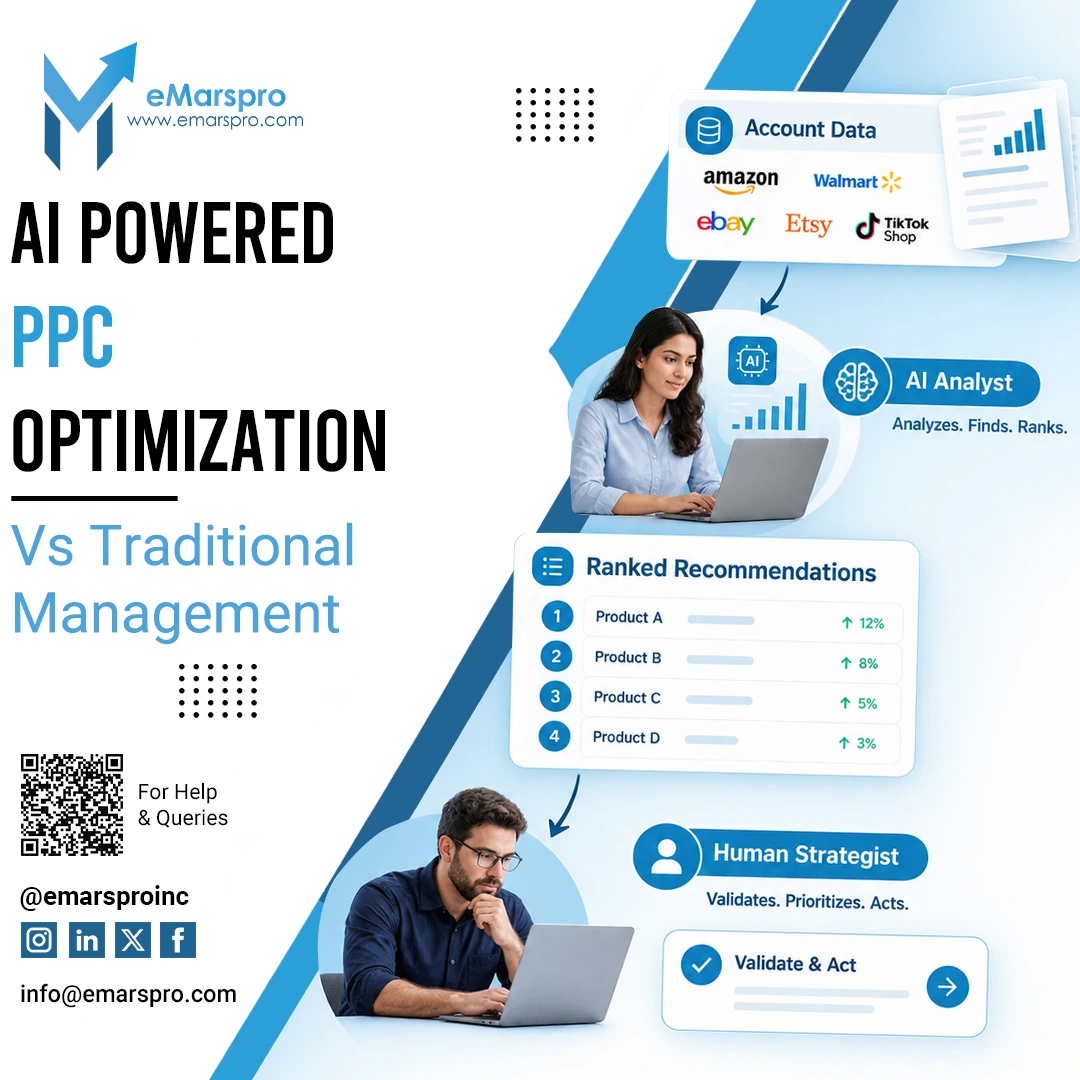
Amazon advertising no longer runs on simple keyword bidding. The platform now operates on advanced machine learning systems that adjust bids, placements, and targeting in real time. Sellers who once managed campaigns manually now operate in a system form by automation and constant data analysis. Each search, click, and purchase helps Amazon refine how ads are shown to the users. This change has led many brands and agencies to ask a serious question, that is, is artificial intelligence taking over Amazon PPC management and overall Amazon marketing strategy?
The direct answer is no, but the reality goes deeper. AI is changing how Amazon PPC marketing works, not removing human control. It shifts attention away from daily manual tasks and toward planning and decision-making. In the past, advertisers focused on keywords and bids. Today, success depends on clear goals, smart budget control, and profit awareness. Automation handles execution, but people still define direction within a broader Amazon marketing framework.
How Amazon PPC Has Changed Over Time
Amazon PPC began as a simple auction system. Sellers chose keywords, set bids, and monitored performance manually. Amazon sponsored products dominated the space, and competition remained super manageable.
As more sellers entered the marketplace, Amazon expanded its ad ecosystem. Sponsored brands and sponsored displays emerged as core Amazon advertising services. Placement adjustments became available. Audience targeting improved too.
At the same time, Amazon integrated machine learning into its advertising engine. And today, the system evaluates:
- Shopper browsing behavior
- Purchase history
- Device usage
- Geographic signals
- Time-of-day patterns
- Conversion probability
Amazon now predicts which shopper will likely convert and show ads accordingly. This predictive layer results in a major shift in how Amazon SEO optimization, product ranking, and overall Amazon listing optimization strategies work.
What AI Currently Controls In Amazon Advertising?
Artificial intelligence already influences almost every stage of campaign delivery within modern Amazon PPC management.
When you choose dynamic bidding, Amazon adjusts your bids based on predicted conversion likelihood. When you launch automatic campaigns, Amazon selects keywords using machine learning. When you use audience targeting, Amazon matches ads based on behavior signals rather than exact keywords.
AI also helps determine:
- Which ads appear in top-of-search positions
- Which placements convert better
- How budget spreads across campaigns
- How search terms match listings
This means AI does not sit in the background. It drives campaign mechanics across Amazon PPC marketing systems.
The Strengths of AI In Amazon PPC Management
AI performs extremely well in areas that require speed and scale.
Real-Time Bid Adjustments
Campaign performance changes constantly. Conversion rates fluctuate throughout the day. AI systems react instantly. They increase bids during high-conversion windows and reduce them during low-performing periods. Humans cannot match this speed.
Massive Data Processing
Large brands and any experienced Amazon marketing agency may manage thousands of keywords across multiple products and markets. AI processes this data efficiently. It identifies patterns across campaigns that manual reviews may overlook.
Automated Budget Allocation
AI distributes budgets toward high-performing campaigns while limiting waste. It analyzes return on ad spend and reallocates spend dynamically, supporting brands looking at how to increase Amazon sales profitably.
Continuous Testing
Automation runs multiple tests simultaneously. It evaluates placement performance, audience segments, and bid variations without fatigue.
Why Does AI Still Need Human Oversight?
Profit Margin Awareness
AI optimizes toward conversion likelihood. It does not fully understand contribution margin unless guided by human input. If margins shrink due to rising costs, automation may continue aggressive bidding without adjusting profitability goals.
Inventory Management Alignment
AI may scale ads during high demand. If inventory runs low, this can damage Amazon product rankings once stockouts occur. Human oversight ensures advertising aligns with supply planning.
Brand Positioning Decisions
Premium brands often protect pricing and image. AI may push discount-heavy strategies to increase short-term conversions. A human strategist protects long-term brand equity within a structured Amazon marketing strategy.
Competitive Market Context
AI reacts to internal data. It does not fully interpret external events such as competitor launches, price wars, or seasonal shifts in consumer demand.
The Role of Amazon PPC Strategies
Traditional Amazon PPC strategies focused heavily on manual keyword research and bid adjustments. That approach no longer defines competitive advantage.
Modern Amazon PPC marketing strategies prioritize:
- Campaign architecture
- Data segmentation
- Profit modeling
- Brand defense strategy
- Market expansion planning
For example, separating branded campaigns from non-branded campaigns remains a strategic decision. Allocating higher budgets for new product launches requires business judgment. Defining acceptable TACOS thresholds involves financial analysis beyond algorithmic adjustments, especially for sellers learning how to sell products on Amazon.
The Rise of AI Tools In PPC Management Agencies
Every serious Amazon marketing agency now integrates automation tools into its Amazon advertising services stack. These platforms offer:
- Rule-based bid automation
- Predictive revenue modeling
- Search term harvesting
- Budget pacing algorithms
- Advanced reporting dashboards
However, tools alone do not guarantee results. Agencies differentiate themselves through interpretation. They translate raw data into business decisions that powers overall Amazon marketing performance.
Predictive Advertising and the Next Phase of AI
The next stage of Amazon PPC management will likely move from reactive optimization to predictive scaling.
Instead of adjusting bids after performance shifts, AI will forecast demand surges before they occur. It will analyze seasonal trends, competitive intensity, and historical sales velocity to recommend proactive scaling.
Predictive systems may soon:
- Suggest budget increases before holidays
- Identify emerging search trends
- Detect early signals of declining conversion rates
- Forecast inventory shortages
This shift will allow brands to improve Amazon product ranking while protecting margins.
Audience Targeting Outgrowing Keyword Dependence
Keyword-based targeting defined early Amazon PPC. However, AI-driven audience signals are gaining importance within modern Amazon marketing strategy.
Amazon collects behavioral data that extends beyond keyword intent. It studies browsing sessions, purchase frequency, and product comparisons.
Future Amazon PPC marketing will likely rely more on:
- In-market audiences
- Product view retargeting
- Cross-category behavior signals
- Lookalike modeling
This transition reduces dependence on static keyword lists and powers behavioral targeting aligned with Amazon seo optimization and listing performance.
Will AI Reduce the Need for Human Advertisers?
AI will reduce manual tasks. It will automate repetitive bid adjustments and keyword harvesting. It will streamline reporting.
However, it will not eliminate strategic roles.
Human advertisers will focus on:
- Financial planning
- Cross-market expansion
- Brand growth strategy
- Product portfolio scaling
- Risk management
Instead of daily bid changes, PPC professionals in Amazon PPC management will analyze trends and guide investment decisions.
This evolution mirrors other industries where automation handles execution while humans manage direction.
Risks of Relying Too Heavily on AI
Margin Compression
If automation prioritizes revenue over profitability, margins may decline gradually. Without monitoring contribution margin, sellers may scale unprofitable campaigns despite strong Amazon PPC marketing metrics.
Brand Dilution
Excessive discounting strategies driven by conversion optimization can weaken brand positioning within competitive Amazon marketing categories.
Data Misinterpretation
AI analyzes historical data. Sudden market disruptions may reduce predictive accuracy. Sellers must review performance weekly and align automation with clear profitability targets.
How Sellers Should Prepare for the Future
To stay competitive in an AI-driven environment, sellers should take practical steps.
- Strengthen Amazon listing optimization to improve conversion rates before scaling ads.
- Define clear break-even ACOS and TACOS thresholds.
- Segment campaigns by objective rather than by convenience.
- Align advertising budgets with inventory planning.
- Monitor contribution margin, not just ad revenue.
- Invest in brand building beyond PPC.
These steps support long-term for brands asking how to increase Amazon sales sustainably.
The Integration of AI Across Amazon’s Ecosystem
Amazon continues to expand its advertising ecosystem. The company integrates ads into streaming services, off-site placements, and advanced audience retargeting.
AI will likely power:
- Dynamic creative variations
- Real-time personalization
- Cross-device targeting
- Multi-channel attribution
This expansion will blur the lines between retail media and full digital advertising networks.
Final Perspective: Is AI Taking Over?
AI already dominates operational aspects of Amazon PPC management. It adjusts bids, selects audiences, optimizes placements, and processes vast datasets at speeds no human can match. However, AI does not replace strategic thinking. It does not define brand positioning. It does not manage business risk. It does not create vision.
The future of Amazon PPC strategy belongs to sellers and agencies who understand how to collaborate with automation. A strong Amazon marketing agency will use AI as a performance engine while maintaining strategic control. Artificial intelligence will continue to reshape Amazon advertising services. It will increase efficiency and raise the competitive standard. Yet human guidance will remain essential for profitable growth.
AI will not take over completely. Instead, it will become a powerful partner for disciplined advertisers who focus on long-term brand success and financial sustainability.