Amazon FBA product sourcing is the work of finding a product, a supplier and a price that still leaves a margin after Amazon’s fees, and it fails on the last part more than the first. Six methods exist, from retail arbitrage to private label.
The method matters less than the three checks: the supplier verified, the invoices kept, and the margin computed on landed cost.
Every Amazon fee and customs rule here was checked for this update against Amazon’s FBA costs page and CBP’s USMCA page. The post compares the six methods, walks the supplier checks, covers the invoices Amazon asks for, the Canada route few sourcing guides mention, the landed cost test, and the failures we see most.
The six Amazon FBA sourcing methods, compared
| Method | What you buy | Cash needed | Control of supply | Where it breaks |
|---|---|---|---|---|
| Retail arbitrage | Clearance stock from stores | Lowest | None | Re-sourcing every week; brand gating |
| Online arbitrage | Discounted stock from other sites | Low | None | Price wars on the same ASIN |
| Wholesale | Bulk from a brand or distributor | Medium | Some | Invoice quality; brand restrictions |
| Private label | Your brand, made to order | Higher | High | The first order size; the landed cost |
| Dropshipping | Supplier ships direct | Low | None | Amazon’s dropshipping policy (read it before listing); speed |
| Handmade or own manufacture | What you make | Varies | Full | Scale and your own time |
The brands we manage sit in the wholesale and private label rows, because those are the two methods that build something Amazon cannot take away with a policy change. The other four are ways to learn the fee structure with small money, which is a fair reason to use them.
Step 1: Research demand before you touch a supplier
Research is the search results page, read for a week: how many sellers, how many reviews the top listings carry, where the price sits, and whether the best sellers are brands or resellers. Product research tools help with volume estimates; they do not replace reading the page.
The number to write down is the price the market will pay, because every later decision is subtracted from it. An Amazon FBA management team runs this step before any supplier conversation, since a supplier’s quote only means something against a price that exists.
Step 2: Verify the supplier before any money moves
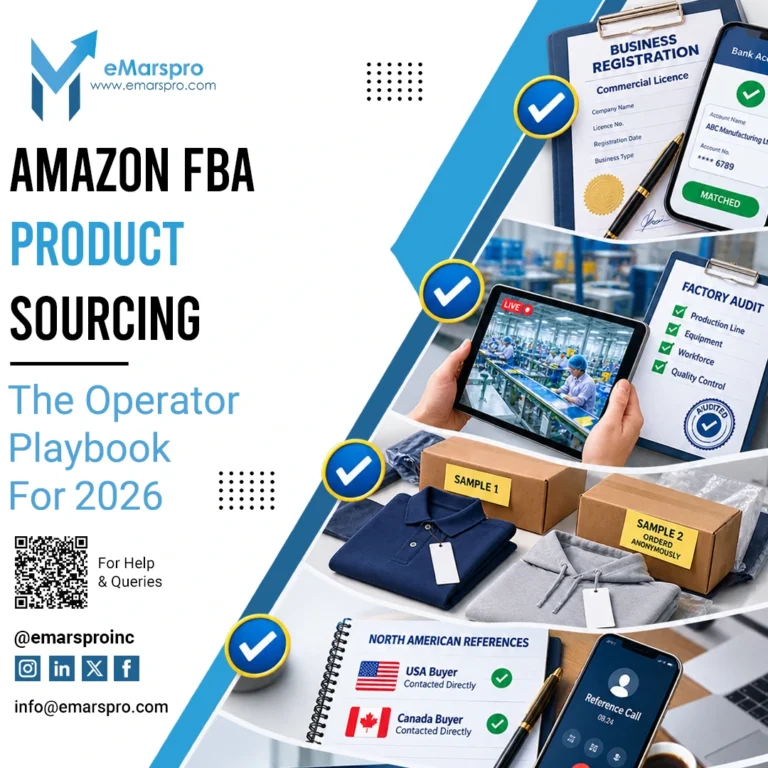
- Business registration, and the registered name against the bank account you are asked to pay. A mismatch ends the conversation.
- A live video walk of the production line, not a recorded tour.
- Samples twice, weeks apart, from the production line and not the showroom.
- Two references in your own market, called.
- A first payment with recourse: escrow, a trade-assurance program, or a card.
Repeat the first two before a large reorder. A factory that passed in March can be a trading company by September.
Step 3: Negotiate quantities around your demand, not their minimum
A minimum order quantity is the supplier’s number. Yours is the units that sell in the first eight to twelve weeks at the price you wrote down in step 1, plus the lead time of the next order. Buying three times that for a unit discount puts the saving into storage fees and, after 181 days, the aged inventory surcharge.
Amazon inventory management software covers the forecasting tools that size the reorder; stranded inventory covers what happens to units that arrive and cannot be sold.
Step 4: Keep purchase invoices like Amazon will ask for them
Amazon’s approval and review requests ask for commercial invoices, and in the cases we have handled the document that passes looks like a transaction between two businesses: supplier name and address, your name and address as on the account, the products, the quantities, the date. Pro-forma invoices, receipts and marketplace screenshots are usually declined.
Set this up on the first order: one folder per supplier, one invoice per shipment, the invoice matched to the shipment ID. The day Amazon asks, the answer takes ten minutes instead of a week.
The Canada route: USMCA sourcing almost nobody covers
Sourcing from Canada is the lane most guides skip. Goods that qualify under the USMCA enter the US under its preferential treatment, and CBP’s USMCA page says the certification of origin can be in “any format,” provided it carries the nine minimum data elements of Annex 5-A; CBP publishes a suggested template.
The operating case is simpler than the customs one: a factory in the same time zone, a two-day freight lane instead of a six-week one, and a visit that costs a flight rather than a fortnight. Whether a product qualifies is a rules-of-origin question for a customs broker, not a guess.
Landed cost: the number that decides everything
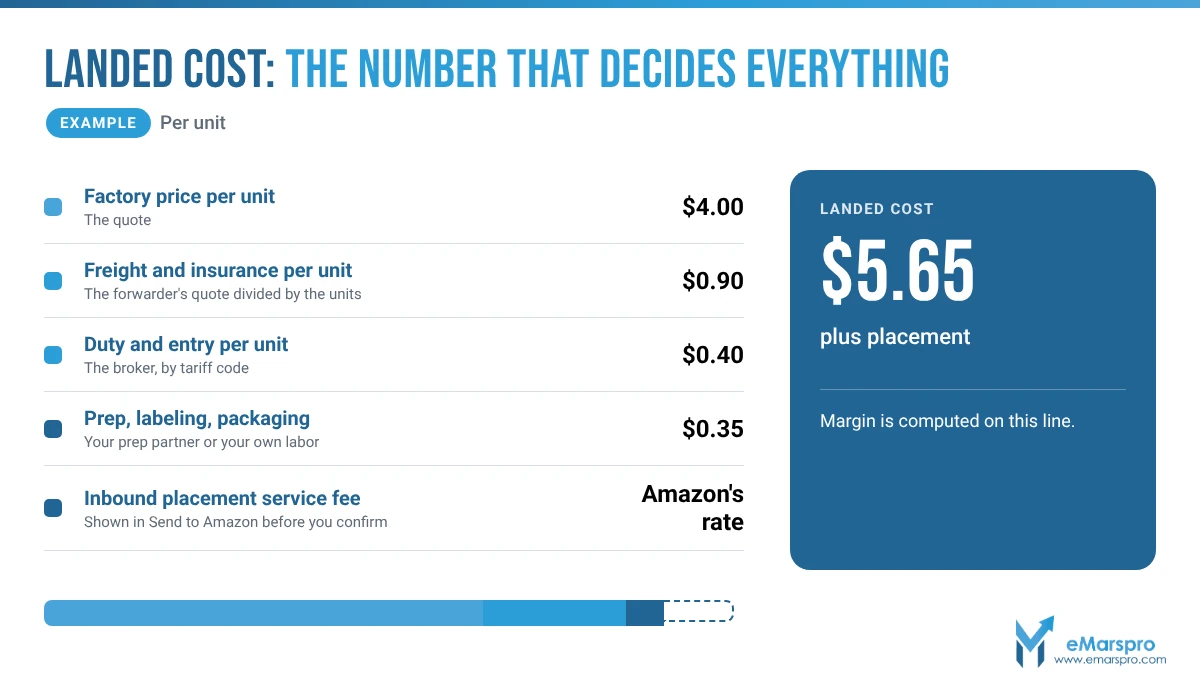
Landed cost is every dollar it takes to put one sellable unit on Amazon’s shelf. Computed on the factory quote alone, most products look profitable; computed on landed cost, a share of them are not. An example, to show the shape rather than any real product:
| Line | Example | Where the number comes from |
|---|---|---|
| Factory price per unit | $4.00 | The quote |
| Freight and insurance per unit | $0.90 | The forwarder’s quote divided by the units |
| Duty and entry per unit | $0.40 | The broker, by tariff code |
| Prep, labeling, packaging | $0.35 | Your prep partner or your own labor |
| Inbound placement service fee | Amazon’s rate for the size tier | Shown in Send to Amazon before you confirm |
| Landed cost | $5.65 plus placement | Margin is computed on this line |
Then the Amazon FBA calculator takes the landed cost and the selling price and returns the fees Amazon can see; the hidden Amazon FBA fees post covers the ones it cannot, including the holiday peak fee and returns processing. A product that needs the discount in step 3 to clear is not a product.
Common sourcing failures and the fix
| Failure | What it looks like | The fix |
|---|---|---|
| Margin on the quote | Profitable on paper, negative after freight and duty | Landed cost before the deposit |
| The minimum order | Three thousand units when demand supports eight hundred | Twelve weeks of demand plus lead time |
| The showroom sample | A perfect sample, a different production unit | Two samples from the line, weeks apart |
| The invoice that fails | A receipt or a pro-forma when Amazon asks | One compliant invoice per shipment, from the first order |
| The single supplier | One factory, one strike, one empty listing | A second verified source for the top two SKUs |
Where AI now does the sourcing research, and what you still decide
Amazon’s Product Opportunity Explorer, listed on Amazon’s AI information page updated August 2026, is Amazon’s own tool to “determine customer demand for new product ideas,” and it reads Amazon’s search data rather than a scraped estimate. Outside Amazon, ChatGPT and Claude draft supplier shortlists, translate the negotiation, and turn a quote sheet into a landed-cost table in a minute.
What a person still decides: whether the demand is a trend or a category, whether to pay the deposit, and which factory to trust after the video walk. The tools shorten the research; the risk is still yours to take.
Frequently Asked Questions
Retail and online arbitrage, because you buy small quantities of products that already sell. The cost is paid later: no brand, no control of supply, and a new sourcing job every week. Wholesale is the usual next step once you can fund a bulk order and hold the invoices Amazon asks for.
Four checks before any money moves: the business registration, with the registered name matching the bank account you are paying; a live video walk of the production line; samples ordered twice, weeks apart; and a payment method with recourse on the first order. Repeat the first two before a large reorder, because factories change hands.
Keep them as if Amazon will ask, because for category approvals and account reviews it does. In the requests we have handled, the invoice that passes names the supplier and you, lists the products and quantities, and is dated inside the period Amazon asks about; receipts and screenshots are usually declined.
Yes. Goods that qualify under the USMCA, in force since July 1, 2020, enter the US under its preferential treatment with a certification of origin; CBP says any format is acceptable if it carries the nine data elements of Annex 5-A. Shorter freight lanes and same-time-zone factory visits are the operating advantages.
Every cost to get one sellable unit into Amazon’s warehouse: the factory price, freight, duty, prep and labeling, and Amazon’s inbound placement fee. Margin is computed on that number, never on the factory quote. A product that clears at the quote and fails at landed cost is the commonest sourcing mistake we see.
Sourcing is one decision inside a larger operation
The product, the supplier, the reorder size and the landed cost are one chain, and the weak link is usually the arithmetic rather than the factory. If you want that chain run for you, our Amazon FBA management team starts with a free audit of the account, findings within 48 hours.
Source Products That Still Make Money After Fees
If you want the landed cost, the supplier checks and the restock plan run for you, our Amazon FBA management team starts with a free account audit, findings within 48 hours.