
The hidden Amazon FBA fees are the ones outside the per-unit fulfillment fee: the aged inventory surcharge on units stored more than 181 days, the holiday peak fulfillment fee from October 15, 2026 to January 14, 2027, the inbound placement service fee, the returns processing fee, and the removal, disposal and liquidation charges.
Amazon names every one of them on its FBA costs page; the rates sit on its fee help pages, not on the public pricing page.
Every fee on this page was checked for this update against Amazon’s own FBA costs page and its fee announcements. What follows is the full list with the trigger for each charge and the report where it shows, the four fees that cost the most margin, the money Amazon owes sellers, and a fee audit you can run this week.
Why Amazon FBA fees stay hidden
Amazon’s public pricing page carries the selling plan, the referral fee and the media closing fee. The FBA charges are listed by name on the FBA costs page, but the rate card itself is on Amazon’s fee help pages, not reprinted here, and each charge lands as its own line in Payments rather than as one fulfillment cost.
So a seller who watches the fulfillment fee in the Revenue Calculator sees one number, and the account pays seven. Amazon’s 2026 fee announcement said FBA fees would rise by an average of $0.08 per unit sold from January 15, 2026, with no new fee types; the fees below are the existing types, not new ones.
That is where an Amazon FBA management team earns its fee: the fee lines on the account get read every month, and the SKUs that pay twice get moved, repriced or removed before the surcharge lands again.
The full list: what triggers each FBA fee and where to see it
| Fee | What triggers it (Amazon’s own description) | Where it shows on your account |
|---|---|---|
| FBA fulfillment fee | Every order Amazon picks, packs and ships; set by the product’s price, weight and dimensions. Up an average of $0.08 per unit from January 15, 2026 | The fee line on each order in Payments; the Fee and Economics Preview report |
| Holiday peak fulfillment fee | Every unit shipped from October 15, 2026 to January 14, 2027; the same per-unit increase over non-peak rates as last year, an average of $0.32 per unit, with the 3.5% fuel and logistics surcharge on top | The fulfillment fee line, which rises for the window without a separate name |
| Monthly inventory storage fee | The space your inventory occupies, from your daily average volume in cubic feet; higher in October to December | The monthly storage charge in Payments, billed the following month |
| Aged inventory surcharge | Every unit stored in a fulfillment center for more than 181 days, charged monthly on top of storage | A separate monthly line; the aged inventory view in Inventory |
| FBA inbound placement service fee | Standard and large bulky products, for distributing a shipment to fulfillment centers close to customers | The shipment’s fee line in Send to Amazon, before you confirm it |
| Returns processing fee | Orders where Amazon gives the customer free return shipping | The return’s fee line in Payments, after the refund |
| Removal, disposal and liquidation fees | A per-item charge whenever you ask Amazon to return, dispose of or liquidate inventory | The removal order’s fee line in Payments |
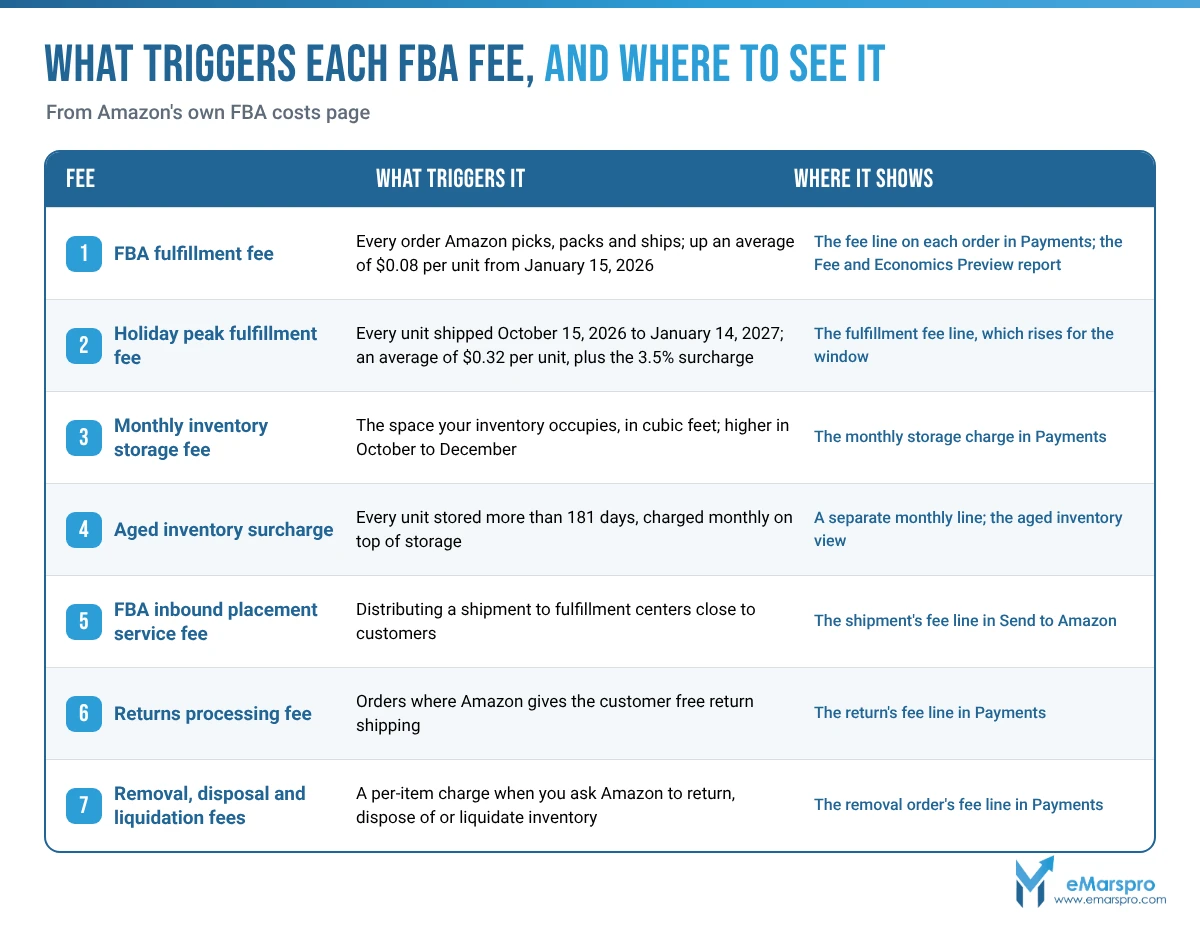
Two charges in the table have no separate name on a statement. The peak fee is the fulfillment fee at a higher rate for thirteen weeks, which is why sellers who compare November to August see the fee rise and cannot find the line. The FBA holiday deadlines post carries the window and the inbound dates that go with it.
The four FBA fees that quietly eat margin
The aged inventory surcharge
A unit that sits 181 days pays the monthly storage fee and the surcharge, and the surcharge repeats every month it stays. The fix is a decision at day 120, not day 181: discount it, remove it, or let Amazon liquidate it. Stranded inventory ages the same way, and is not even for sale while it does.
The holiday peak fulfillment fee
From October 15 to January 14 every unit costs more to ship, and the 3.5% surcharge applies on top. A product priced on its August fulfillment fee loses that margin for a quarter. Reprice the slow Q4 SKUs before October 15, and keep the deal-window inventory to what sells in the window.
The inbound placement service fee
Amazon charges it to spread a shipment across fulfillment centers near customers. The fee depends on the placement option you pick in Send to Amazon, so it is the one charge you see before you pay it. Minimal shipment splits cost more per shipment and arrive at fewer buildings; Amazon-optimized splits cost less and need more boxes.
The returns processing fee
When Amazon gives a customer free return shipping, the seller pays a processing fee on top of the refund. On a low-priced item with a high return rate the two together can exceed the margin on the sale. The Fee and Economics Preview report shows it per SKU; how to reduce Amazon FBA fees covers the packaging and sizing fixes.
Amazon owes sellers money too: the claim windows
Most fee guides stop at the charges. The other side of the ledger is reimbursement: units lost or damaged in a fulfillment center, inbound shipments that arrive short, refunds issued without a return, and units measured at the wrong dimensions. Amazon’s reimbursement claim windows changed on October 15, 2025, and the windows are now short.
| Claim type | Window (from October 15, 2025) |
|---|---|
| Lost or damaged in a fulfillment center | Within 60 days of the reported loss or damage |
| Customer returns (refund with no return, or a damaged return) | Between 45 and 105 days after the refund or replacement |
| Removal order, lost | Between 15 and 135 days from the shipment creation |
| Removal order, damaged | 120 days from the shipment delivery date |
| Removal order, grading | 120 days from the date the item left Amazon’s network |
| Re-evaluation of a claim | Within 90 days of the initial claim |
A 60-day window means a yearly reconciliation forfeits ten months of claims. The check is monthly: the inventory ledger against the units received, the refunds against the returns received, and the recorded dimensions against a tape measure on a sample.
Run a fee audit on your own account this week
Start with ten orders. Open the transaction detail for ten recent FBA orders in Payments and write down every fee line, not the total. Then do three more things:
- Open the Fee and Economics Preview report and sort by fee as a share of price; any SKU above a third needs a line-by-line check.
- Open the aged inventory view and list every SKU with units past 120 days, with a decision for each before day 181.
- Re-run your five best sellers through the Amazon FBA calculator at the holiday peak rate, and compare the result with the price you set in August.
If the stock side is the problem, Amazon inventory management software covers the tools that forecast and replenish so the surcharge never starts.
Where AI reads your FBA fees now, and what you still decide
Amazon’s own Seller Assistant, listed on Amazon’s AI information page updated August 2026, answers account questions inside Seller Central, including questions about charges on an order.
Outside Amazon, ChatGPT and Claude will read a transaction export and group the fee lines by type in a minute, and the inventory tools now sell “AI rules” that reorder before a stockout while keeping storage fees low.
What a person still decides: whether a SKU that pays the surcharge is discounted, removed or liquidated; whether a claim is worth the evidence it needs; and whether the holiday peak margin is taken from price or from inventory depth. The tools surface the fee; the decision is still yours.
Frequently Asked Questions
Open the transaction detail for ten recent FBA orders in Payments and read every fee line, not the total. Then open the Fee and Economics Preview report and Profit Analytics, which Amazon names in its 2026 fee announcement, and look for the lines that are not the fulfillment fee: aged inventory, inbound placement, returns processing and removals.
The aged inventory surcharge. Amazon charges it monthly on every unit stored more than 181 days, on top of the monthly storage fee, so a slow SKU pays twice to sit still. Second is the holiday peak fulfillment fee, October 15, 2026 to January 14, 2027, with a 3.5% fuel and logistics surcharge on top.
Often, yes. Lost or damaged units, refunds without a return, short inbound receipts and wrong recorded dimensions are all claimable. Since October 15, 2025 each claim type has its own window, starting at 60 days for units lost or damaged in a fulfillment center, so the check has to be monthly, not yearly.
No. Amazon raised FBA fulfillment fees by an average of $0.08 per unit from January 15, 2026, storage costs more in October to December, and the holiday peak fulfillment fee applies from October 15 to January 14. Amazon says there are no new FBA fee types in 2026, so the list on this page is the list.
Not all of them at first. Amazon’s FBA page lists incentives for new Professional sellers: $100 off Partnered Carrier shipments, a $200 credit toward Amazon Global Logistics, a $400 credit for inbound placement, and free storage and customer returns through the FBA New Selection program. The fees start when the incentives run out.
The fee you cannot see is the one you keep paying
Every charge above is on Amazon’s own page; what makes it hidden is that nobody on the account reads the lines. If the first ten orders you open show a fee you did not price for, our Amazon FBA management team starts with a free audit of the account, findings within 48 hours.
Find The Hidden Fees Before They Find Your Margin
If you want every fee line read against the products and margins you priced for, our Amazon FBA management team starts with a free account audit, findings within 48 hours.



