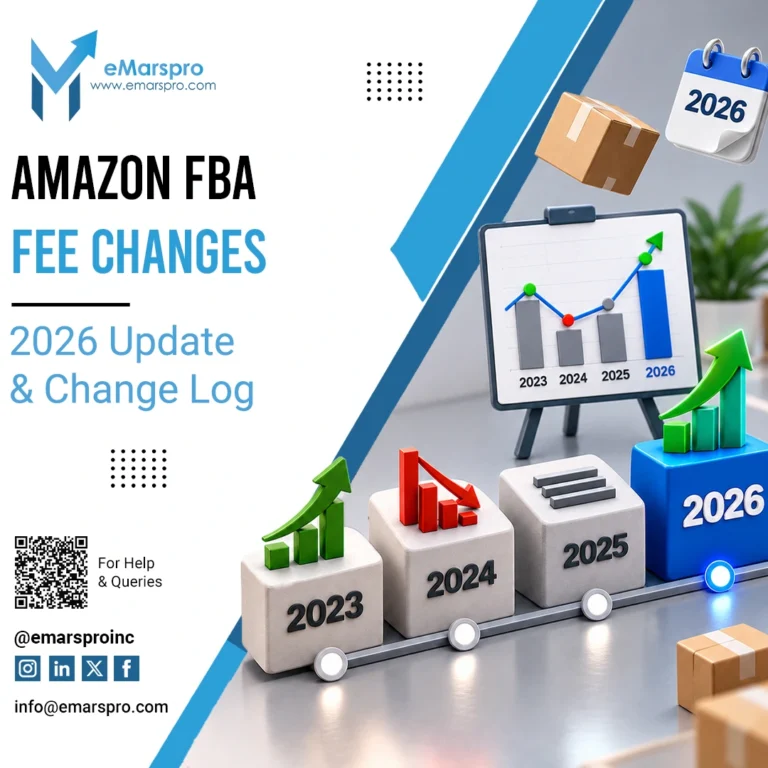
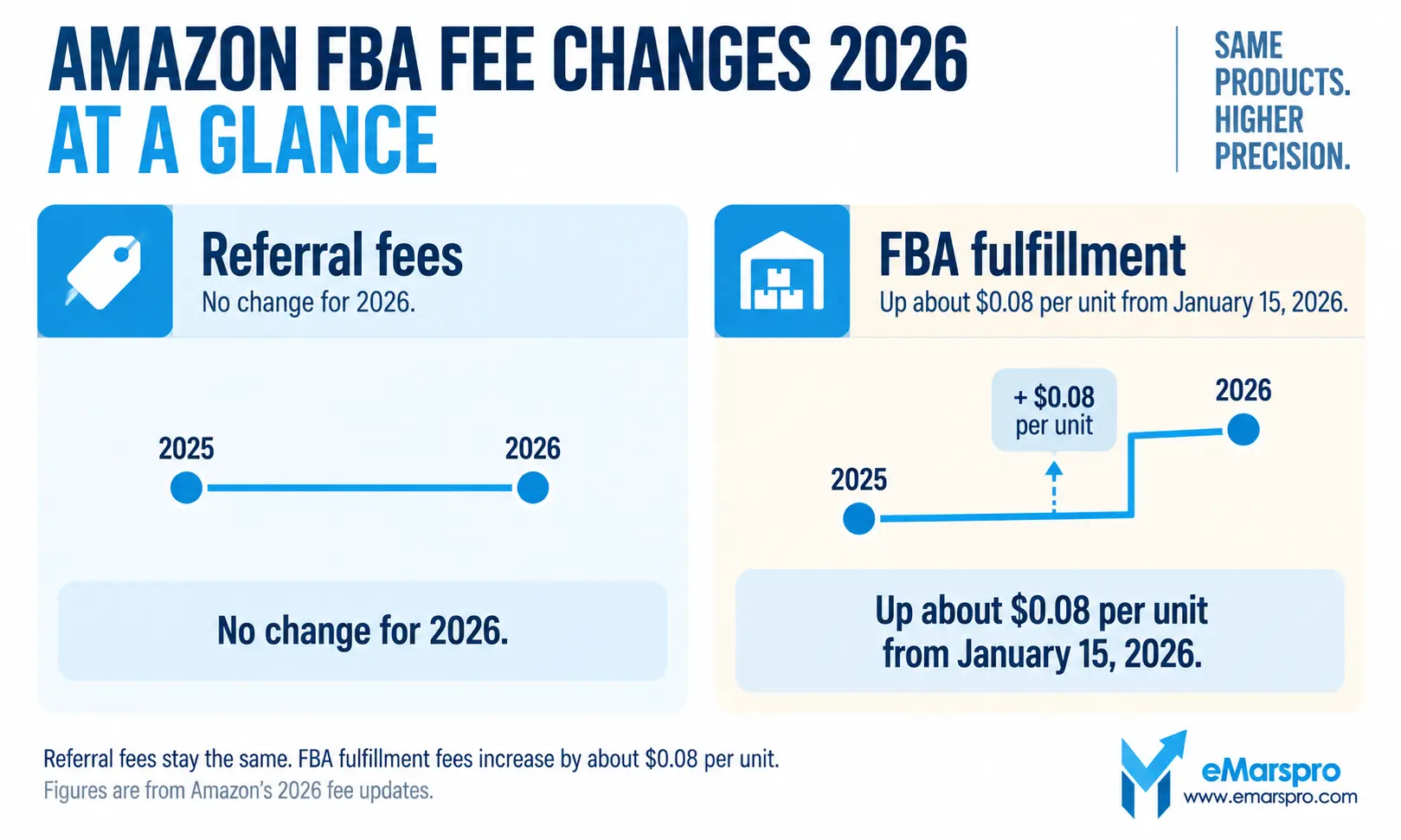
Short Answer. For 2026, Amazon left US referral fees unchanged and raised FBA fulfillment fees by about $0.08 per unit sold, effective January 15, 2026. No new fee types were introduced. Amazon published the decision on October 15, 2025.
What is true right now for 2026
Checked against Amazon’s published fee pages and Amazon’s 2026 fee announcement on August 16, 2026.
| What | Where it stands for 2026 | Source checked today |
|---|---|---|
| US referral fees | No change for 2026. Most categories sit at 15%, the full range runs 5% to 45%, and most categories carry a $0.30 minimum per item. | Amazon’s 2026 announcement and sell.amazon.com/pricing |
| FBA fulfillment fees | Up about $0.08 per unit sold from January 15, 2026. Amazon puts that at under 0.5% of an average item’s selling price. | Amazon’s 2026 announcement |
| New fee types | None introduced for 2026. | Amazon’s 2026 announcement |
| Selling plans | $0.99 per item sold on the Individual plan, or $39.99 per month on the Professional plan. | sell.amazon.com/pricing |
| Media closing fee | $1.80 per item on media. | sell.amazon.com/pricing |
| Storage, aged inventory, placement, returns, removals | All still in force as named fee types. Amazon lists each on its FBA cost page, and the aged inventory surcharge still starts after 181 days in a fulfillment center. | sell.amazon.com/fulfillment-by-amazon |
| Anything changed since January? | No. Amazon’s announcements hub carries no fee announcement after the January 2026 change, checked today. | sell.amazon.com/blog/announcements |
Amazon does not publish a flat public rate card for fulfillment and storage. Size tier, weight, category and season all move the number, so your own rate card in Seller Central is the only figure that matters for your SKUs.
That is also why a rate change of eight cents is rarely what actually moves a bill. Product dimensions, storage age and placement choices move it far more, which is what an Amazon FBA management routine watches week to week.
The change log, by year
Every row below comes from Amazon’s own announcement for that year, each one fetched and read on August 16, 2026. This log records what Amazon announced in each cycle. It is not a current rate card.
| Year | What Amazon announced | Announced | Effective |
|---|---|---|---|
| 2026 | No change to US referral fees. FBA fulfillment up about $0.08 per unit sold. No new fee types. | October 15, 2025 | January 15, 2026 |
| 2025 | No increase to US referral or FBA fees and no new fee types. Inbound placement cut by an average of $0.58 per unit on large bulky products with minimal shipment splits. Inbound placement waived on the first 100 units per new parent ASIN in the FBA New Selection program, for shipments created December 1, 2024 to March 31, 2025. That waiver window is closed. | November 19, 2024 | January 15, 2025 |
| 2024 | Apparel referral fees cut from 17% to 5% under $15, and from 17% to 10% from $15 to $20. Standard fulfillment down about $0.20 per unit and large bulky down $0.61. An extra $0.77 discount on items under $10. Off peak storage down $0.09 per cubic foot. Two new charges: the inbound placement service fee, at $0.27 per unit standard and $1.58 large bulky, and the low-inventory-level fee. | December 5, 2023 | January 15 to June 1, 2024, most in March and April |
| 2023 | Referral fees unchanged. Outbound fulfillment up $0.22 on average. Off peak storage up $0.04 per cubic foot standard and $0.03 oversized, peak non-sortable up $0.20. Two new charges: a storage utilization surcharge and an aged inventory surcharge on stock held 180 to 270 days. | November 17, 2022 | January 17, 2023, surcharges in April |
Read down that column and the pattern is clear. Referral fees have barely moved in four years. Every meaningful change has landed on the fulfillment side, and twice it arrived as a brand new charge rather than a higher rate.
New charges are the ones that hurt, because they appear on a statement where nothing sat before. For what each of those charges is and where it posts, see our guide to hidden Amazon FBA fees.
The 2025 incentive line is worth one note. Waivers attach to programs, not to accounts, and they expire. The first 100 units waiver ran through the FBA New Selection program, and its window closed in March 2025.
What changes next, and when to check
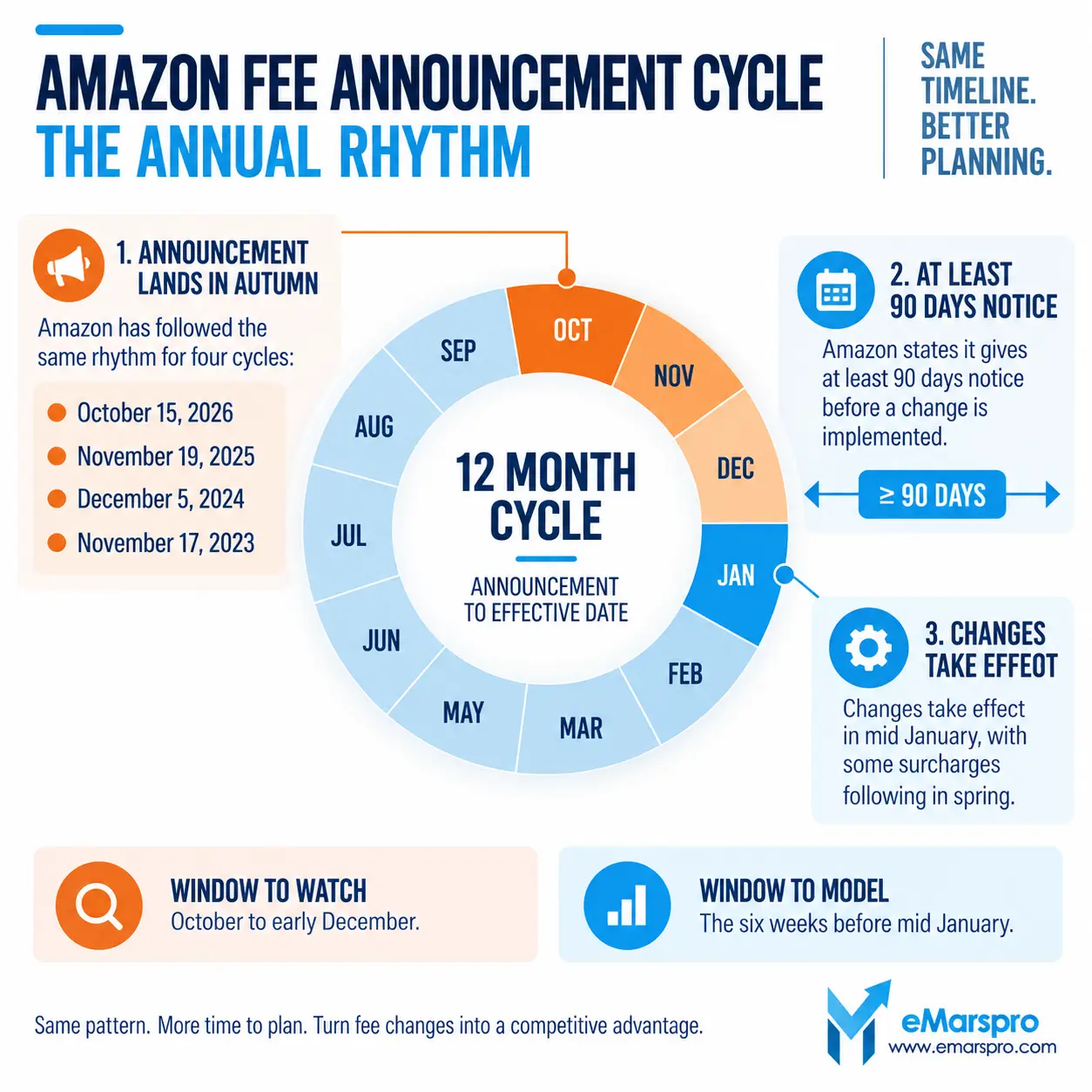
Amazon has followed the same rhythm for four cycles:
- The announcement lands in the autumn. October 15 for 2026, November 19 for 2025, December 5 for 2024, November 17 for 2023.
- Amazon states it gives at least 90 days notice before a change is implemented.
- Changes take effect in mid January, with some surcharges following in spring.
So the window to watch is October to early December, and the window to model is the six weeks before mid January.
Two things worth knowing about the direction of travel. Amazon cited annual carrier cost increases of 3.9% to 5.9% when explaining the 2026 fulfillment rise, and it has held referral fees flat while doing so. Plan for fulfillment side movement, not referral side movement.
Where to check, in order:
- Amazon’s selling partner announcements, which is where the annual fee update is published.
- sell.amazon.com/pricing for current referral fees and selling plans.
- Your own rate card and Fee Preview report in Seller Central, which is the only source that reflects your actual SKUs.
Check your own account against this page
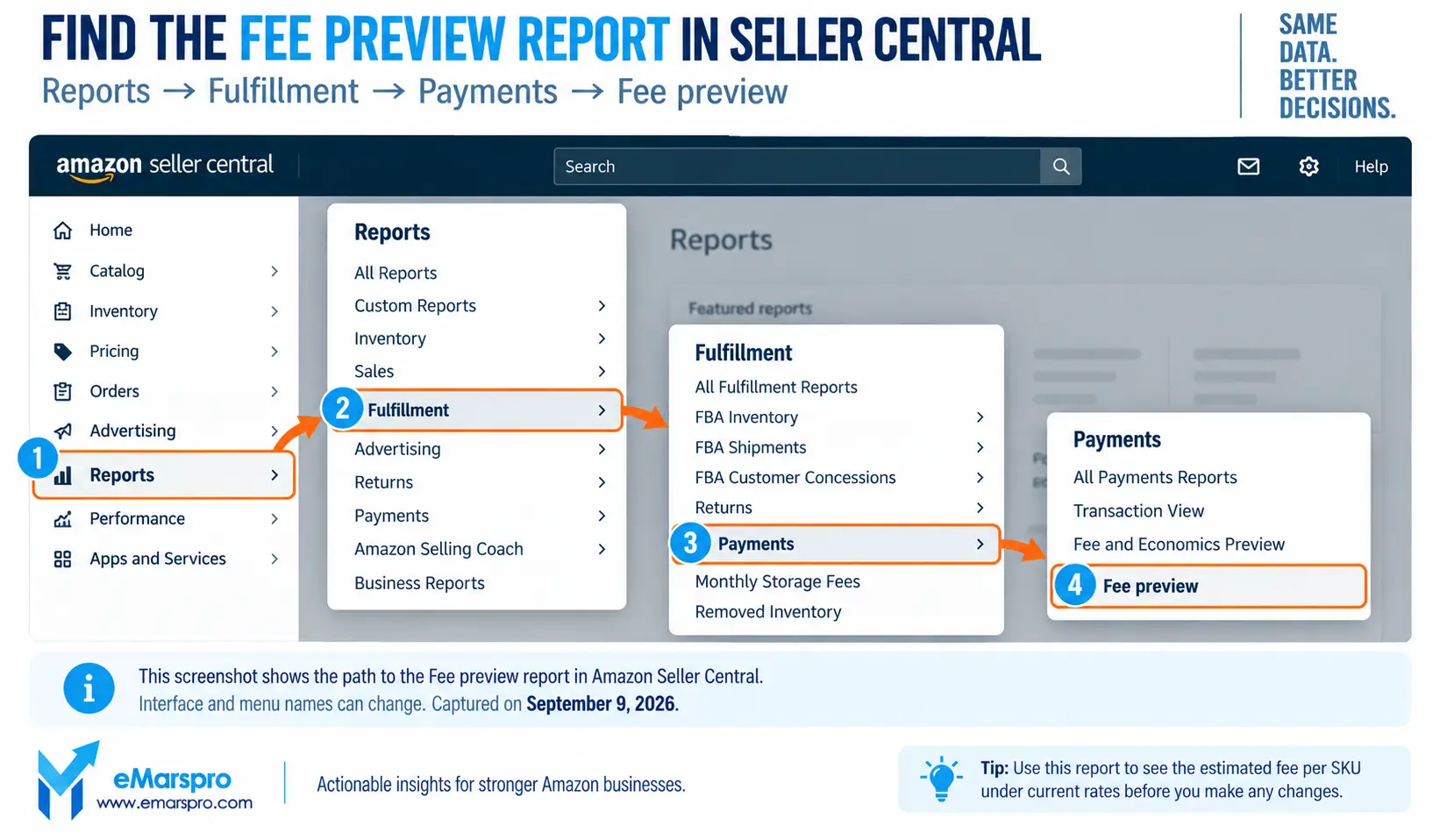
A rate change only matters once you can see it on your own units. Five steps, in order:
- Open Reports, then Fulfillment, then Payments, then Fee preview. This shows the estimated fee per SKU under current rates.
- Run your top ten SKUs through the FBA Revenue Calculator in Seller Central and compare its estimate against what you were charged last month.
- Check the Fee and Economics Preview report and the Profit Analytics dashboard, both named by Amazon in its 2026 announcement as the tools for exactly this.
- Compare the dimensions Amazon has on record against the real product on your five highest fee SKUs. A recorded size that is too large inflates every fulfillment fee on that SKU.
- Model any change before you send inventory, using our Amazon FBA calculator walkthrough.
If step four turns up a mismatch, or the numbers move the wrong way, the levers are on your side of the transaction. Our guide to how to reduce your Amazon FBA fees covers packaging, size tiers, inventory age and removals.
Frequently Asked Questions
Yes, but only on the fulfillment side. FBA fulfillment fees rose by about $0.08 per unit sold from January 15, 2026, which Amazon puts at under 0.5% of an average item’s selling price. No new fee types were introduced for 2026.
No. Amazon confirmed US referral fees do not change in 2026, and they did not increase in 2025 either. Most categories sit at 15%, the full range runs 5% to 45%, and most categories carry a $0.30 minimum per item.
In the autumn, for a mid January effective date. The 2026 update was published on October 15, 2025 and took effect on January 15, 2026. Amazon states it gives at least 90 days notice before a change is implemented, so watch October to early December.
No. That waiver covered the first 100 units per new parent ASIN in the FBA New Selection program, and it applied only to shipments created between December 1, 2024 and March 31, 2025. The window is closed.
Referral fees and selling plan costs sit on sell.amazon.com/pricing. Fulfillment, storage and related charges are described on Amazon’s FBA cost pages. Your own rate card in Seller Central is the only figure that reflects your actual SKUs.
Find Out What the Change Actually Cost You
The real impact of Amazon fee changes depends on your SKU size, weight, age, and placement. An FBA management company reviews these reports regularly to find the fee lines costing you most. Our free audit requires no Seller Central access to start and delivers findings within 48 hours.