

Direct answer: Outsourced Amazon account management in the US is quoted four ways: percentage of sales, flat retainer, hybrid, or hourly. Directory data fetched August 15, 2026 shows advertised rates from the $25 to $49 hourly band up to $150 to $199, minimum engagement sizes starting between $1,000 and $10,000, and typical engagements landing in the $10,000 to $49,000 range, per Clutch’s Amazon marketing category. Clutch’s August 2026 pricing guide puts the average monthly cost of paid-search management near $7,165, per Clutch’s PPC pricing guide. Your quote depends on catalog size, channel mix, and ad scope.
Most cost guides for this search are written by the people selling the retainers, quoting their own price lists as market truth. This one works differently: every number below carries a neutral, public source checked the week of publication, and where no verifiable range exists, we say so instead of inventing one.
What you are actually paying for
Before comparing prices, pin down the scope. Full Amazon account management typically spans five workstreams.
- Catalog and listing work: creation, optimization, A+ content, variation fixes.
- Advertising: campaign structure, bids, budgets, search term hygiene.
- Inventory and FBA operations: forecasting, shipment plans, reimbursement recovery.
- Account health: policy compliance, suppressed listings, case log management.
- Reporting and strategy: weekly numbers, quarterly plans, someone accountable for them.
Two quotes are only comparable when they cover the same list. Most pricing confusion in this market is scope confusion wearing a price tag.
The four pricing models, with what the market data shows
1. Percentage of sales
The provider takes an agreed share of your Amazon revenue, sometimes above a baseline, usually with a monthly minimum. It aligns incentives on growth, and it gets expensive precisely when you succeed.
There is no neutral public dataset that pins the typical percentage, so treat any confident number here with suspicion. The honest structural truth: the percentage falls as revenue rises, minimums protect the provider on small accounts, and anyone quoting a rate before seeing your catalog is guessing.
2. Flat monthly retainer
One fixed fee for a defined scope. This is the most common model in the US market and the easiest to budget.
For scale, the closest neutral benchmark: Clutch’s PPC pricing guide, updated August 15, 2026, reports an average monthly cost near $7,165 for paid-search engagements, with typical projects in the $10,000 to $49,999 band (source linked above).
Full-account retainers covering catalog, operations, and ads price against a wider scope than ads alone, which is why the same directory shows minimum engagement sizes from $1,000 up past $10,000.
3. Hybrid: base fee plus percentage
A lower fixed retainer plus a smaller share of sales or ad spend. Providers use it to derisk small accounts; sellers use it to keep the fixed line lean.
No neutral source publishes reliable hybrid splits, so evaluate a hybrid quote by modeling it at three revenue levels: current, plus 50 percent, and double. The model that looks cheapest today often looks worst at double.
4. Hourly and project work
Hourly fits diagnostics, cleanups, reinstatements, and second opinions rather than ongoing operations. Advertised hourly rates on Clutch’s Amazon marketing category run from the $25 to $49 band up to $150 to $199 (source linked above), with US-based teams concentrated at the upper bands.
If the problem is a specific fire rather than ongoing growth, targeted Amazon Seller Central consulting hours usually beat a full retainer on cost.
What moves the price
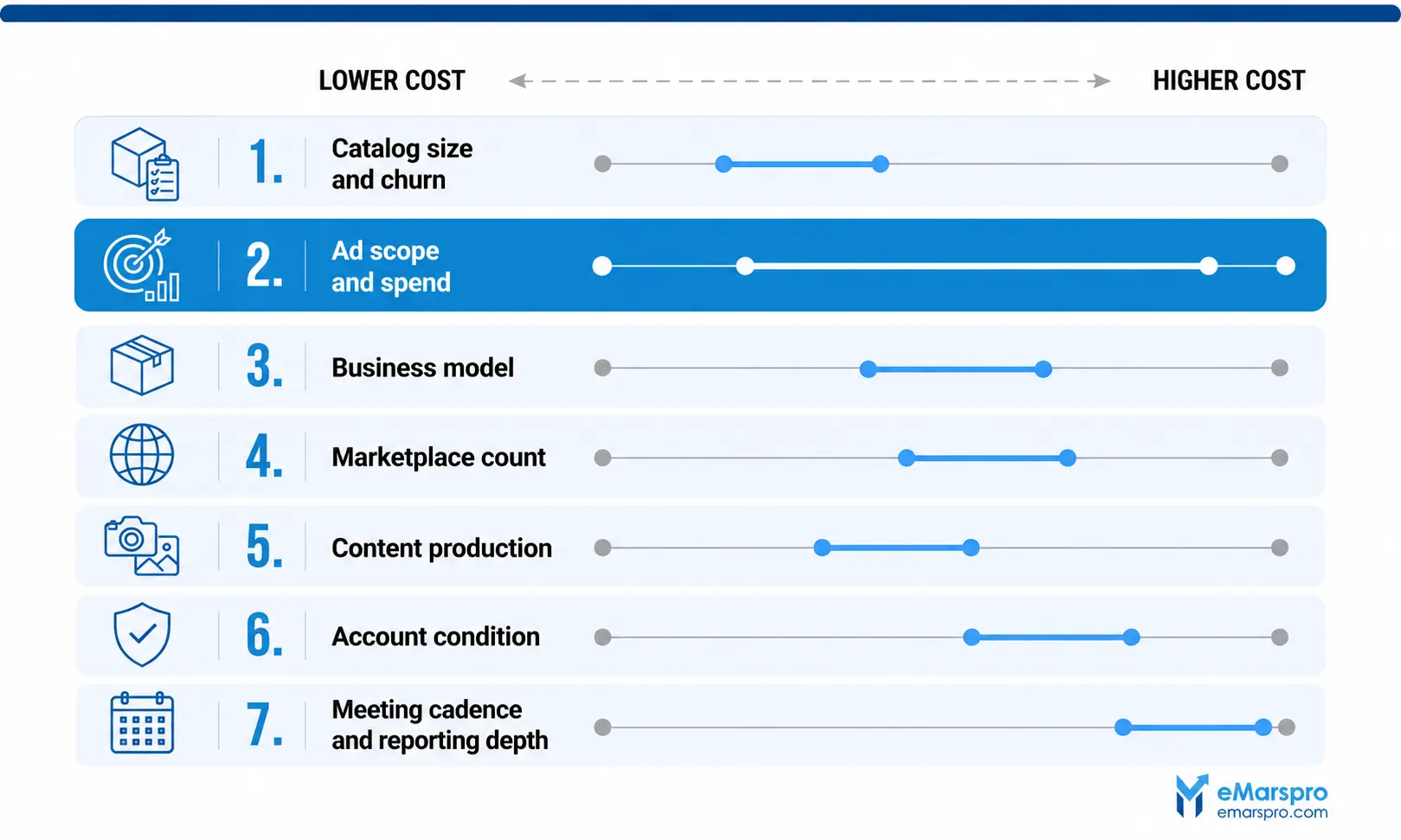
Seven drivers explain most of the spread between a four-figure and five-figure monthly quote.
- Catalog size and churn: 40 SKUs with variations is a different job than 6 stable ones.
- Ad scope and spend: managing Amazon PPC at $5,000 per month of spend is not the job it is at $80,000.
- Business model: private label, or wholesale FBA with its buy-sheet and Buy Box mechanics, or both.
- Marketplace count: US only versus US, Canada, and Europe.
- Content production: whether photography, A+ modules, and video sit inside the fee.
- Account condition: clean accounts cost less to run than accounts mid-crisis.
- Meeting cadence and reporting depth: weekly live calls price above monthly dashboards.
When you ask a provider for a quote, ask which of these seven they priced. The answer tells you more than the number does.
Red flags in cheap offers
A suspiciously low retainer usually has a mechanism behind it. These are the five we see most.
- No named account manager, just a shared inbox and a queue.
- “Unlimited” everything in the pitch, then a change-order fee for anything specific.
- No deliverables in writing: scope, hours, and SLAs should be set in your SOW.
- Guaranteed rankings or guaranteed revenue. Nobody controls Amazon’s algorithm.
- Demands for your login credentials instead of proper Seller Central user permissions.
Cheap is not the red flag by itself. Cheap with vague scope is.
How to compare quotes without getting played
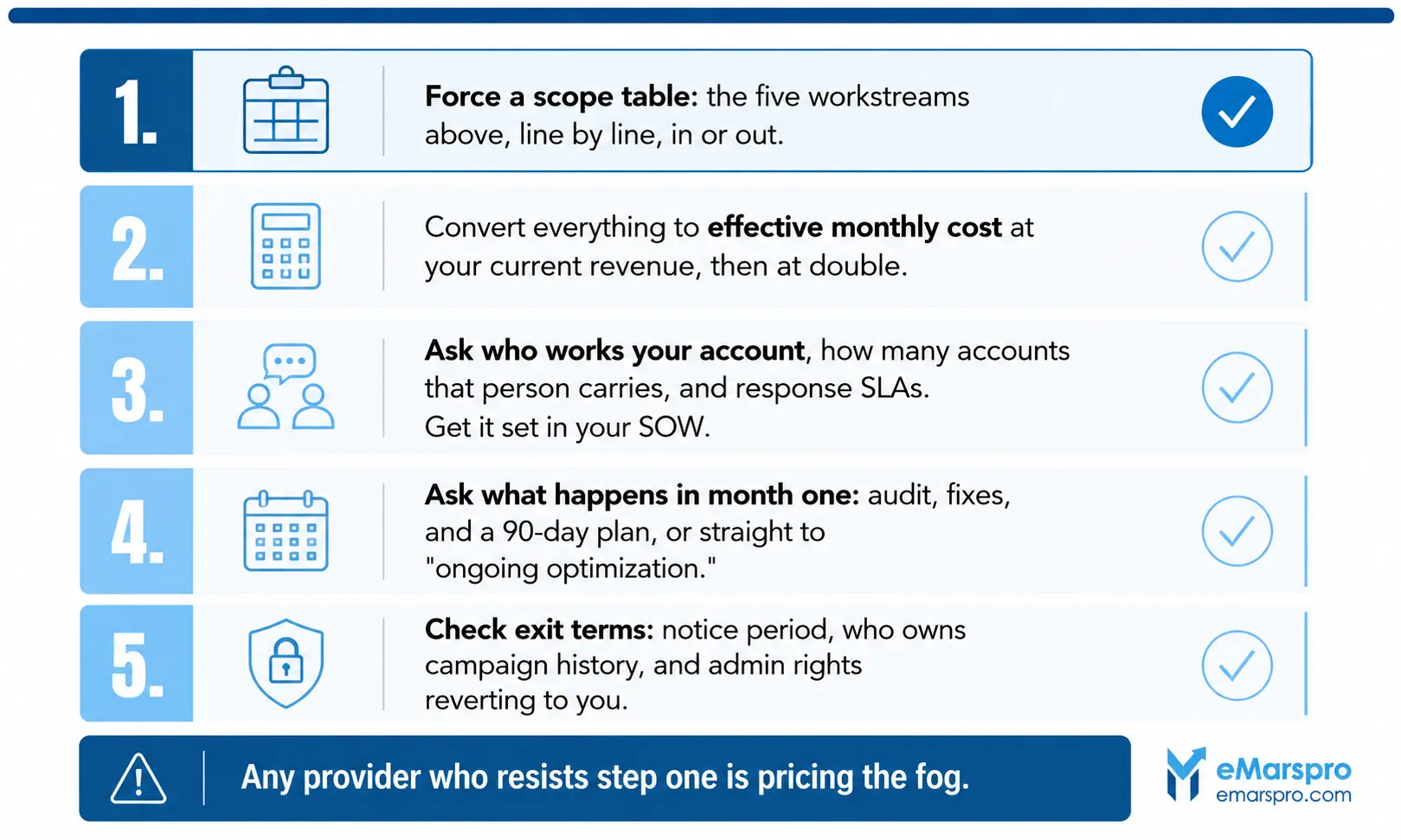
Run every quote through the same five steps.
- Force a scope table: the five workstreams above, line by line, in or out.
- Convert everything to effective monthly cost at your current revenue, then at double.
- Ask who works your account, how many accounts that person carries, and response SLAs. Get it set in your SOW.
- Ask what happens in month one: audit, fixes, and a 90-day plan, or straight to “ongoing optimization.”
- Check exit terms: notice period, who owns campaign history, and admin rights reverting to you.
Any provider who resists step one is telling you the price only survives while the scope stays foggy.
When in-house beats an agency
Outsourcing is not always the answer, and a cost guide that never says so is a sales page. In-house tends to win when Amazon is your only channel, volume justifies a dedicated hire, and you can afford the salary, tools, and the months of ramp time.
An external team tends to win when you need senior coverage across catalog, ads, and operations at less than the cost of one specialist salary, or when nobody inside owns the channel today. Many brands land on a split: an internal owner for the P&L, an external team for execution.
Frequently Asked Questions
US market data fetched August 15, 2026 shows minimum engagement sizes from $1,000 to $10,000 and up, hourly rates from the $25 to $49 band up to $150 to $199, and typical engagements between $10,000 and $49,000, per Clutch’s Amazon marketing category. The exact figure depends on catalog size, ad spend, and scope.
No. Amazon’s referral, FBA, and subscription fees are what Amazon charges you to sell. Account management cost is what you pay a person or team to run the account, and it comes on top of Amazon’s fees.
Some do, usually with a monthly minimum, and the percentage typically falls as revenue grows. No neutral public dataset verifies a standard rate, so model any percentage offer at your current revenue and at double before signing.
It is worth it when the fee is smaller than the profit recovered from fixed listings, cleaner ad spend, fewer stockouts, and reclaimed reimbursements. It is not worth it when scope is vague or your margins cannot absorb the fee. Run the quote-comparison steps above before deciding.
Common terms in the market run month to month or quarterly after an initial period, with 30-day notice. Whatever you agree, get the term, notice period, and ownership of campaign history set in your SOW.
Buy Scope, Not The Label
Full service Amazon account management quotes swing from four to five figures a month for the same six words. We’ve managed marketplace accounts since 2011 across 600+ clients and 300+ brands. Request a free account audit and get grounded findings in 48 hours.