
Quick answer: you can sell on Amazon without storing or shipping anything yourself. Five models make it work: FBA with supplier direct inbound, compliant dropshipping, Multi-Channel Fulfillment, Amazon Merch on Demand, and Kindle Direct Publishing. Each one moves storage and delivery to Amazon or a supplier while you keep the listing, the brand, and control of every sale.
This guide compares all five, with every Amazon policy fact checked against Amazon’s own pages on August 16, 2026. No recycled stats, no dead tools, no guesswork.
The five models at a glance
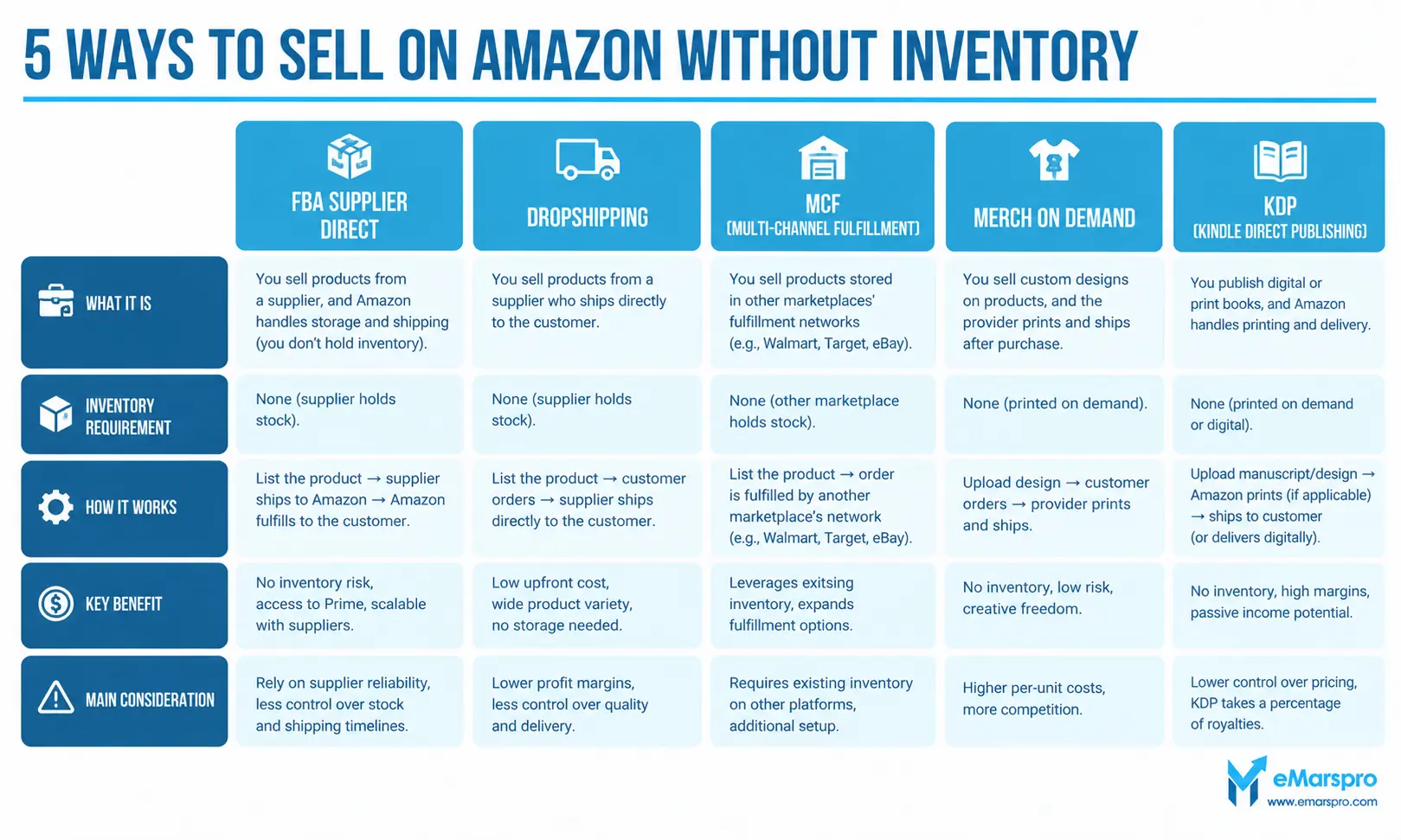
| Model | Who buys the stock | Who stores and ships | Upfront cost profile | Brand control | Best for |
|---|---|---|---|---|---|
| FBA with supplier direct inbound | You, in bulk from your supplier | Amazon fulfillment centers | Moderate, you own stock | High | Established brands that want Prime |
| Dropshipping | You, per order, as seller of record | Your supplier | Low | Medium, packaging must identify you | Testing demand with little capital |
| Multi-Channel Fulfillment (MCF) | You, stock already in FBA | Amazon, for non Amazon orders | Uses existing FBA stock | High | Brands also selling on Shopify or TikTok Shop |
| Amazon Merch on Demand | No one, printed per order | Amazon | Design costs only | Medium, royalty model | Design led merch lines |
| Kindle Direct Publishing (KDP) | No physical stock | Amazon, printed per order | Content creation only | High | Authors and expertise driven brands |
What selling without inventory actually means
“Without inventory” really means without warehousing. In two of these models you never own physical stock at all. In the other three you may own it on paper, but you never rent a unit, pack a box, or drive to a carrier.
| Aspect | Traditional selling | Selling without holding inventory |
|---|---|---|
| Storage | You rent and manage space | Amazon or a supplier stores goods |
| Fulfillment | You pick, pack, ship | Amazon or the supplier ships |
| Unsold stock risk | Sits in your warehouse | Reduced, or zero in print on demand models |
| Scaling | Limited by your space and labor | Limited mainly by demand and capital |
One honest clarification most guides skip: with FBA you still buy and own the stock. What disappears is the physical handling, not the ownership. That distinction decides which model fits you, so keep it in mind through the whole list.
1. FBA with supplier direct inbound
Fulfillment by Amazon means you send products into Amazon’s fulfillment network, and Amazon picks, packs, and ships orders, plus handles customer service and returns for those orders. FBA products are also eligible for Prime shipping, per Amazon’s FBA page.
The inventory free version: your supplier ships directly from the factory or wholesale warehouse to Amazon’s fulfillment centers. You never touch a carton. A third party inspection at origin replaces your own receiving check.
How to run it
- Source through wholesale or manufacturer relationships. Our guide to Amazon FBA product sourcing covers vetting suppliers.
- Have the supplier prep and label to Amazon’s requirements, stated in Seller Central’s FBA shipment workflow.
- Book inspection at origin, then ship straight into FBA.
- Watch stock health weekly with Amazon inventory management software so restocks stay ahead of demand.
Trade-offs. You carry stock risk and Amazon storage fees, which Amazon publishes in Seller Central. Listings can also break and leave sellable units sitting as stranded inventory, so someone has to watch the account. That operational layer is exactly what Amazon FBA management exists to handle.
Best fit: brands already doing steady revenue that want Prime placement without touching boxes.
2. Dropshipping, done inside Amazon’s rules
Dropshipping means a supplier ships each order directly to your customer after the sale. Amazon allows it, with strict conditions. Per Amazon’s published dropshipping requirements, fetched August 16, 2026, you must:
- Be the seller of record, with an agreement identifying you as owner of the products before customers buy. You set the price, record the revenue, and handle sales tax.
- Keep products, packaging, packing slips, and invoices free of any references that identify a third party.
- Accept and process returns yourself, and provide customer service that meets or exceeds Amazon’s policies.
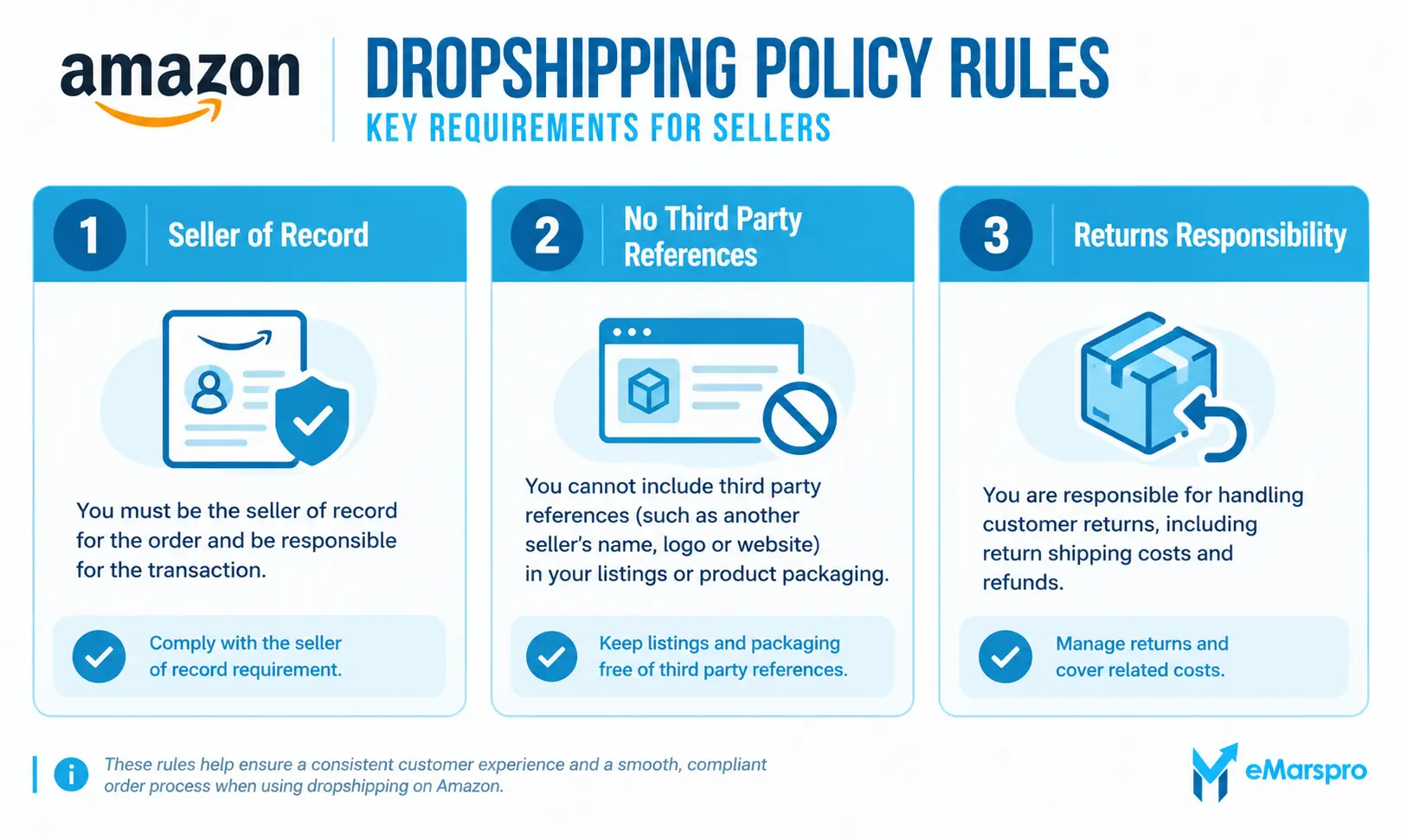
Buying from a big box retailer and letting them ship their own branded package to your buyer fails the third party reference rule on its face. Before you list anything, read the full Drop Shipping Policy in Seller Central, which is the controlling document.
Trade-offs. Margins are thin, shipping speed depends entirely on your supplier, and every policy miss lands on your account health, not theirs. Vet suppliers for blank packaging, US warehouses, and fast defect resolution before the first order.
Best fit: testing new products or categories with minimal capital, then graduating winners into FBA.
3. Multi-Channel Fulfillment (MCF)
MCF uses the stock you already hold in Amazon’s fulfillment network to ship orders from everywhere else. Per Amazon’s Multi-Channel Fulfillment page, fetched August 16, 2026, MCF picks, packs, and ships for non Amazon channels, integrates with platforms like Shopify and TikTok Shop, and ships in unbranded packaging by default.
Why it belongs on this list: one inbound shipment from your supplier covers Amazon, your own site, and social commerce. One stock pool, zero warehouses of your own, no separate 3PL contract to manage.
Process transparency: on accounts we manage, MCF is standing practice for filling Shopify and other off Amazon orders from the same FBA pool. It is the shortest path from “Amazon only” to “everywhere” without adding logistics staff.
Trade-offs. MCF fees differ from standard FBA fees, and Amazon publishes current rates and delivery speeds on the MCF page. Check them against your off Amazon margins before routing a channel through it.
Best fit: brands adding Shopify, TikTok Shop, or wholesale portals on top of Amazon.
4. Print on demand with Amazon Merch on Demand
Amazon Merch on Demand is Amazon’s print on demand program, and yes, that is the current name; the old “Merch by Amazon” label is retired. You upload original artwork, choose products like shirts and mugs, and set your price. Amazon prints each item after the sale, ships it, and pays you monthly royalties, per Amazon’s own guide fetched today.
There is no stock, no printer, and no fulfillment vendor to manage. The trade is control: Amazon runs production, and your earnings work on a royalty model rather than a normal retail margin.
Trade-offs. Design quality and trademark compliance decide survival. Uploading art that infringes someone’s IP is the fastest way to lose the account, so clear every phrase and graphic first.
Best fit: brands and creators with real design ability who want a merch line with zero logistics.
5. Digital products with Kindle Direct Publishing
Kindle Direct Publishing lets you publish eBooks, paperbacks, and hardcovers that Amazon sells and delivers with no upfront printing costs. Print copies are produced per order. Per KDP’s current published rates, fetched August 16, 2026, authors earn up to 70% royalties on eBooks and up to 60% on paperbacks and hardcovers.
For a brand, KDP is a credibility engine as much as a revenue line. A buying guide or recipe book that ranks in your niche introduces shoppers to your products with zero inventory risk.
Best fit: experts, niche authorities, and brands with teachable subject matter.
Two options we left off the main list
Amazon Associates pays commissions for referring shoppers to Amazon products, up to 10% depending on category per Amazon’s guide. It is real income, but you are not the seller, so it is affiliate marketing rather than selling.
Online arbitrage, reselling discounted retail finds through FBA, still means buying and owning stock. It removes the warehouse, not the inventory, so it lives closer to model one than to true inventory free selling.
How to choose
If you already run a brand doing steady revenue, start with FBA supplier direct, then add MCF the day you open a second channel. That pairing keeps Prime on Amazon and one stock pool everywhere else.
If you are validating an idea, dropship compliantly or launch a Merch on Demand line first. Move proven winners into FBA once demand is real, since that path upgrades both margin and delivery speed.
If your edge is knowledge or design rather than products, KDP and Merch on Demand let you sell with no physical stock at all.
Launch steps that apply to every model
- Open a Seller Central account and pick the plan that matches your volume, or a KDP account for books.
- Confirm the policy that governs your model, starting with the Drop Shipping Policy if a supplier ships for you.
- Validate demand and margin before you commit capital or design time.
- Write listings around real search terms, with images that meet Amazon’s style rules.
- Set a weekly rhythm for stock, ads, and account health checks.
- Reinvest in the model that proves out, and prune the ones that do not.
Frequently Asked Questions
Yes. Five models make it possible: FBA with supplier direct inbound, compliant dropshipping, Multi-Channel Fulfillment, Amazon Merch on Demand, and Kindle Direct Publishing. In each case, Amazon or a supplier stores and ships the product. You still own the listing, the pricing, and the customer experience.
Yes, with strict conditions. Amazon’s Drop Shipping Policy requires you to be the seller of record, keep packaging, packing slips, and invoices free of any third party references, and accept and process customer returns yourself. Review the full Drop Shipping Policy in Seller Central before you list.
It depends on the model. With FBA, Amazon handles customer service and returns for those orders. In dropshipping, Amazon’s policy makes you responsible for accepting and processing returns even though a supplier shipped the item. For Merch on Demand and KDP, Amazon produces each order and manages delivery.
For brands already doing steady revenue, FBA with supplier direct inbound usually wins because you get Prime eligibility without touching boxes. Multi-Channel Fulfillment then extends the same stock to Shopify or TikTok Shop orders. Dropshipping, Merch on Demand, and KDP work better as tests or added revenue streams.
Where eMarspro Fits
eMarspro has managed marketplace accounts since 2011 and was founded as an agency in 2019. Today the team runs Amazon and 60+ marketplaces for US brand owners, most doing between $250K and $5M a year. As an
FBA management company,
we run supplier direct inbound, MCF routing, and account health as one system.
Want to know which of these five models your numbers actually support? Request a free account audit and get findings within 48 hours. Scope and pricing for ongoing work are set in your SOW, never from a rate card.